
Import & Export
Air freight transport — Top 30 of 40 selected economies (2023)
23 Nov 2026 · 06:03 CET
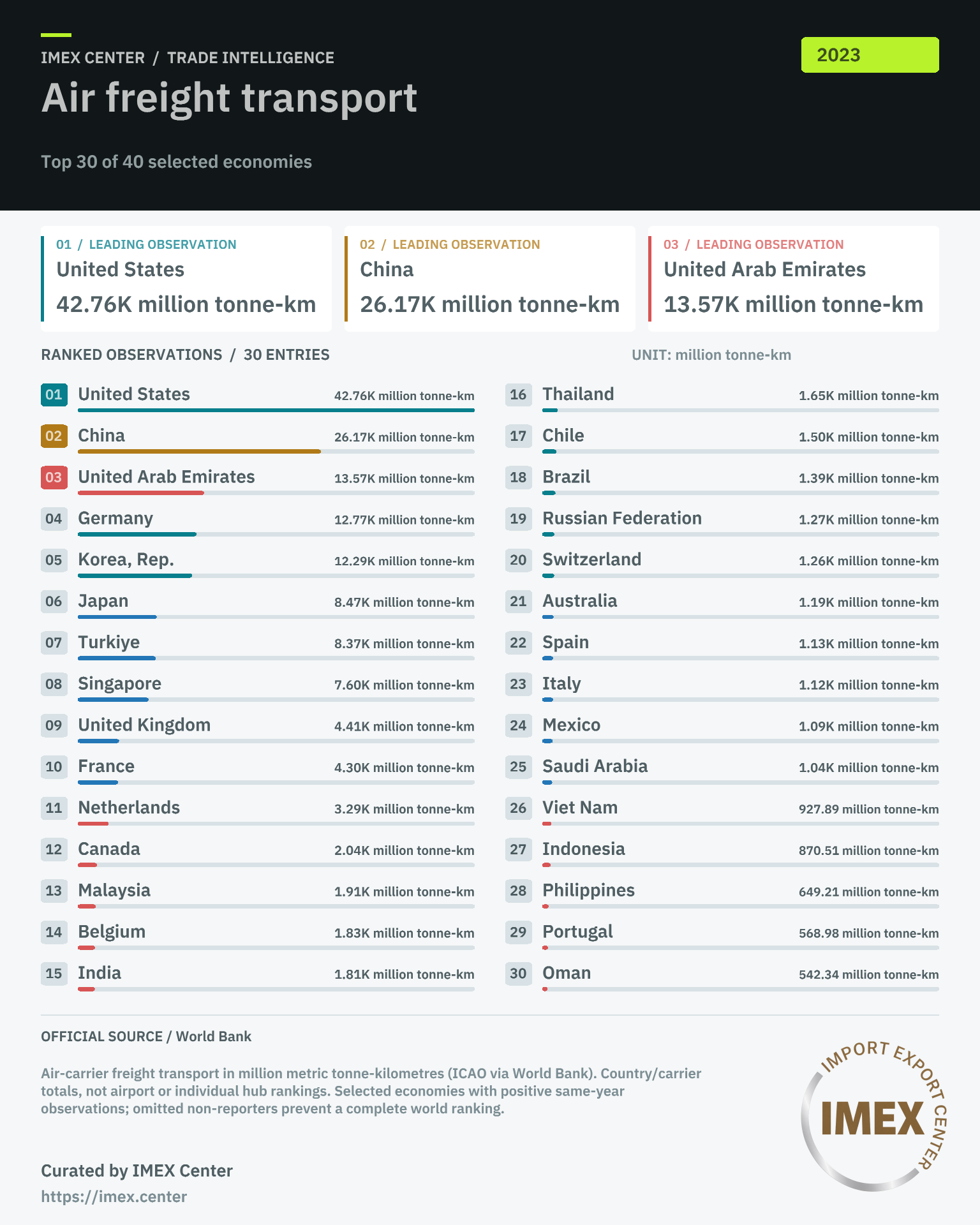
Air freight transport — Top 30 of 40 selected economies (2023)
2023 · Top 30 of 40 selected economies · Air freight transport: United States 42.76K million tonne-km; China 26.17K million tonne-km; United Arab Emirates 13.57K million tonne-km.
| Rank | Top 30 of 40 selected economies | million tonne-km |
|---|---|---|
| 1 | United States | 42,762.858703 |
| 2 | China | 26,170.3716 |
| 3 | United Arab Emirates | 13,566.15894 |
| 4 | Germany | 12,766.528681 |
| 5 | Korea, Rep. | 12,293.784212 |
| 6 | Japan | 8,474.02 |
| 7 | Turkiye | 8,367.297795 |
| 8 | Singapore | 7,604.20872 |
| 9 | United Kingdom | 4,413.895 |
| 10 | France | 4,301.69 |
| 11 | Netherlands | 3,285.748163 |
| 12 | Canada | 2,036.406681 |
| 13 | Malaysia | 1,910.139712 |
| 14 | Belgium | 1,831.476606 |
| 15 | India | 1,806.986382 |
| 16 | Thailand | 1,649.928515 |
| 17 | Chile | 1,499.03535 |
| 18 | Brazil | 1,387.08273 |
| 19 | Russian Federation | 1,268.80857 |
| 20 | Switzerland | 1,257.503636 |
| 21 | Australia | 1,188.146859 |
| 22 | Spain | 1,130.882599 |
| 23 | Italy | 1,120.987029 |
| 24 | Mexico | 1,091.480464 |
| 25 | Saudi Arabia | 1,036.791068 |
| 26 | Viet Nam | 927.8888 |
| 27 | Indonesia | 870.51342 |
| 28 | Philippines | 649.206834 |
| 29 | Portugal | 568.97882 |
| 30 | Oman | 542.341 |
Air-carrier freight transport in million metric tonne-kilometres (ICAO via World Bank). Country/carrier totals, not airport or individual hub rankings. Selected economies with positive same-year observations; omitted non-reporters prevent a complete world ranking.
Curated by IMEX Center. Original sources:
A country can record substantial air-freight activity and still offer no suitable departure for your urgent shipment. For an importer facing a production deadline, the decisive questions are more specific: can the carrier accept the cargo, is space confirmed, and what does the quoted delivery service actually include?
This historical guide to air freight transport by country uses 2023 observations from ICAO via the World Bank. Among the supplied observations, the United States records 42762.858703, China 26170.3716 and the United Arab Emirates 13566.15894 million tonne-km. These are the largest values in the displayed selection—not a complete global top three and not evidence of current bookable capacity.
The table provides context for carrier activity. The procurement guidance explains how to move from that context to a shipment decision supported by written acceptance, comparable charges and clear responsibilities.
What air freight transport by country measures
The World Bank indicator IS.AIR.GOOD.MT.K1, titled “Air transport, freight (million ton-km),” presents air-carrier freight transport using data credited to the International Civil Aviation Organization, or ICAO.
Tonne-kilometres combine cargo mass and distance travelled. Transporting the same cargo mass over a longer distance produces more tonne-kilometres. The indicator therefore measures transport activity, not simply the physical weight of goods handled.
A larger observation does not, by itself, establish stronger import demand, more available aircraft space, lower prices or better service. It also does not show the value of the goods transported.
Keep these measures separate:
- Carrier freight transport: cargo mass combined with distance travelled, as used in this article.
- Airport throughput: freight handled at an airport, requiring separate airport-level evidence.
- Shipment availability: whether a provider can accept your cargo on a particular routing and departure.
The country labels identify country/carrier observations. They do not identify the origin and destination of each shipment. These figures must not be read as bilateral trade flows, destination-market demand or a ranking of international-only services.
Air-carrier freight transport: 30 selected economies in 2023
Reference period: 2023. Coverage: 30 supplied economy observations, displayed in descending order. Unit: million tonne-km.
Air-carrier freight transport in million metric tonne-kilometres, from ICAO via the World Bank. These are country/carrier totals, not airport or individual hub rankings. The selection contains positive same-year observations and is not a complete world ranking. Missing observations must not be treated as zero activity.
| Position among displayed observations | Economy | million tonne-km |
|---|---|---|
| 1 | United States | 42762.858703 |
| 2 | China | 26170.3716 |
| 3 | United Arab Emirates | 13566.15894 |
| 4 | Germany | 12766.528681 |
| 5 | Korea, Rep. | 12293.78421188 |
| 6 | Japan | 8474.02 |
| 7 | Turkiye | 8367.297795 |
| 8 | Singapore | 7604.20871972 |
| 9 | United Kingdom | 4413.895 |
| 10 | France | 4301.69 |
| 11 | Netherlands | 3285.74816264 |
| 12 | Canada | 2036.406681 |
| 13 | Malaysia | 1910.139712 |
| 14 | Belgium | 1831.4766060564 |
| 15 | India | 1806.986382 |
| 16 | Thailand | 1649.928515 |
| 17 | Chile | 1499.03535 |
| 18 | Brazil | 1387.08273 |
| 19 | Russian Federation | 1268.80857 |
| 20 | Switzerland | 1257.503636363 |
| 21 | Australia | 1188.14685942814 |
| 22 | Spain | 1130.88259932 |
| 23 | Italy | 1120.9870294 |
| 24 | Mexico | 1091.480464 |
| 25 | Saudi Arabia | 1036.791068 |
| 26 | Viet Nam | 927.8888 |
| 27 | Indonesia | 870.513420389 |
| 28 | Philippines | 649.206834 |
| 29 | Portugal | 568.97882 |
| 30 | Oman | 542.341 |
Source: ICAO via World Bank, indicator IS.AIR.GOOD.MT.K1. Official source query for the selected economies and 2023 observations.
Curated by IMEX Center. This means editorial curation, not independent certification.
Methodology and coverage limitations
The table reproduces the country labels and numerical values in the supplied source extracts. All displayed observations use the same year and unit, and their order follows their values from highest to lowest.
The linked query covers a broader selection than the rows reproduced here. Because the remaining observations are not included in the supplied extracts, this article limits its ranking claim to the displayed economies. It does not independently establish their positions within the broader query or among all reporting economies worldwide.
No growth rates, global market shares or combined totals are inferred. The decimal precision follows the supplied records; it is not a claim about measurement accuracy. The supplied observation fields do not establish a separate reported-versus-estimated classification, so none is added.
This is a historical comparison, not a latest-data release. The supplied evidence does not establish whether newer comparable official observations are available. A recent retrieval of a historical observation does not change its reference year.
What the comparison can—and cannot—tell a buyer
The figures can help a sourcing team distinguish the scale of recorded carrier activity across the displayed economies. They cannot identify which airline serves a particular factory, which airport can handle a sensitive product or which forwarding company will deliver reliably.
For example, a buyer moving production equipment needs to know whether the packed dimensions fit the proposed aircraft and handling arrangements. A buyer moving temperature-sensitive goods needs acceptance conditions and a credible handling plan. Neither question is answered by a national tonne-kilometre total.
Treat the table as background for research, not a supplier scorecard. A provider should earn a place on your shortlist through relevant service evidence, a clear quotation and an executable routing—not through association with a high-ranking economy.
Why this is not a logistics-hub ranking
Choosing an air-cargo gateway requires airport-specific information. The suitable destination airport is the one that supports your delivery requirement, customs arrangements and onward transport—not necessarily an airport in the country with the largest carrier observation.
For a transfer airport, ask who controls the connection, which handling agent receives the cargo and what storage arrangements apply. Restricted or temperature-sensitive cargo requires written confirmation that the facilities and carriers can accept it.
The table also does not establish whether a route is currently available or legally permissible. Current counterparty screening, routing checks and applicable trade restrictions remain separate responsibilities.
Build a quotation brief providers can actually price
Comparable air-freight quotations start with identical cargo information. If forwarders receive different assumptions, their offers may look competitive while covering different shipments or service boundaries.
Define the packed cargo
Send every provider the same brief:
- Commodity description, intended use and relevant product documentation.
- Package count, packaging type and dimensions of each packed unit.
- Gross weight, including packaging, and stackability.
- Cargo-ready date and required delivery deadline.
- Battery, dangerous-goods, temperature-control or other acceptance considerations.
- Pickup and delivery addresses, including access or unloading restrictions.
Use dimensions for the cargo as it will be tendered, not an unpacked product specification. An export crate, protective frame or pallet can change both acceptance and pricing.
If cargo characteristics are uncertain, identify the uncertainty rather than allowing the provider to assume ordinary general cargo. The exporter should resolve product classification and handling questions with appropriately qualified specialists before booking.
Require a transparent chargeable-weight calculation
Ask each provider to show gross weight, calculated volumetric weight and the chargeable weight used for pricing. Require the dimensional conversion method, measurement units, rounding rules and minimum charges.
Do not assume every quotation uses the same calculation. A lower rate per chargeable unit can still produce a higher invoice if the charging basis or additional fees differ.
Agree who measures the shipment and how discrepancies will be documented. The logistics owner should obtain the provider's procedure for approving any revised charge before cargo handover, rather than trying to resolve a surprise invoice after departure.
Identify the route and service boundary
Require written answers to the questions that affect execution:
- What are the actual origin and destination airports?
- Which carrier and routing are proposed?
- Is the service nonstop, connecting or partly operated by road?
- Who handles transfers, and what happens if a connection is missed?
- Which departure is offered, and is space confirmed or subject to booking?
- What are the cargo acceptance and documentation cutoffs?
- Does the price cover airport-to-airport, door-to-airport or door-to-door delivery?
A published schedule is not a reservation. The forwarder should distinguish indicative availability from booking confirmation and identify outstanding cargo-acceptance conditions.
Ask whether the quoted transit time is an estimate or a contractual service commitment. Any commitment should identify its starting point, endpoint, exclusions and remedies; otherwise, providers may be measuring different parts of the journey.
Compare total scope—not just the headline rate
An effective air freight forwarder comparison puts every offer against the same checklist. Record an excluded item as an exclusion, not as a free service.
Review these cost categories:
- Pickup and origin handling.
- Screening, documentation and export-clearance services.
- Air carriage and applicable surcharges.
- Transfer handling and possible storage charges.
- Destination terminal charges and customs-brokerage services.
- Final delivery, special handling and insurance where requested.
Require the currency, quotation validity, payment terms and circumstances that permit repricing. Ask separately how duties and taxes are treated; do not silently include them in a freight-only comparison.
A common comparison problem is straightforward: one offer ends at the destination airport, while another includes delivery to the buyer's warehouse. Neither is automatically better. Procurement must first align the delivery boundary, price the remaining tasks and identify who is responsible for completing them.
Match trade terms to air transport
For an air shipment, use an appropriate Incoterms 2020 rule with a precise named place. FOB, CFR and CIF are sea/inland-waterway rules, not air-freight terms.
Incoterms allocate delivery responsibilities, risks and costs. They do not determine payment or ownership, and they do not replace the forwarding agreement. The sales contract and logistics booking should be checked together so that operational instructions support the agreed commercial responsibilities.
Separate insurance from carrier responsibility
Do not assume a forwarding quotation includes cargo insurance. If cover is required, ask an authorized provider to confirm the insured interests, journey, exclusions, deductible, limits and claims procedure before shipment.
Carrier liability and cargo insurance are not interchangeable. A service enquiry, indicative premium or statement that insurance is available is not evidence that cover has been bound.
Assign owners before releasing the cargo
A clear handover prevents a well-priced quotation from becoming a poorly controlled shipment.
Before quote approval, the procurement owner should align cargo details, delivery scope and commercial assumptions across offers. Missing charges and unanswered routing questions should return to the provider before selection.
Before booking, the logistics owner should obtain written cargo acceptance, departure details and confirmation of space. Any proposed substitution should be assessed against the delivery requirement and approved through the agreed exception process.
Before cargo handover, the exporter or warehouse owner should confirm that packed dimensions, weight, labels and documents match the booking information. Material changes should be reported before dispatch to the terminal.
Before financial commitment, the authorized commercial owner should verify counterparties, approve payment arrangements and confirm contractual authority. A country ranking, platform profile or quotation cannot replace these controls.
Before dispatch, the destination owner or appointed broker should confirm document readiness, import requirements and final-delivery arrangements. If an arrival cannot be cleared or received, a fast flight may simply move the delay to a more expensive location.
Frequently asked questions
Does this show the world's busiest cargo airports?
No. It shows country/carrier freight transport measured in million tonne-km. Airport throughput requires separate airport-level evidence, and these observations cannot establish individual hub performance.
Does a higher country value mean cheaper air freight?
No. The table contains no shipment prices or bookable capacity. A useful quotation must specify your cargo, route, departure, charging basis and delivery scope.
Is 2023 the latest available data year?
That has not been established by the supplied evidence. This is a historical comparison using 2023 observations, not a claim that newer comparable official releases are unavailable.
What should I send when requesting an air-freight quote?
Provide the commodity, packed dimensions, gross weight, package count, cargo-ready date, pickup and delivery locations, deadline and special handling needs. Request routing, chargeable weight, acceptance conditions, itemized charges and quotation validity.
Turn market context into a structured trade enquiry
The ranking provides context; the shipment brief makes that context actionable. Before approaching counterparties through IMEX Center, prepare a requirement that makes the cargo, delivery boundary and approval responsibilities clear.
Importers and sourcing managers: register a business account and prepare a trade enquiry that connects the product specification to the delivery requirement. Where formal RFQ functionality is available to your eligible business account, request comparable technical and commercial responses rather than a headline freight rate alone.
Exporters and trading companies: identify the cargo-ready date, final packaging and proposed delivery responsibilities before seeking service quotations. Have an authorized commercial owner review proposed terms; a draft or pre-contract is not evidence of an executed supply agreement.
Freight forwarders and other service providers: present your actual service scope, cargo restrictions, routing assumptions and pricing exclusions. Claim licenses, insurance or certifications only where you hold supporting evidence.
Business-account eligibility and platform availability should be confirmed before relying on a particular workflow. Individual accounts are service-only and, after required verification and eligibility checks, may manage service offerings; they cannot list goods, create formal RFQs or execute business pre-contracts.
Counterparty verification is not proof of product quality or delivery performance. A quotation is not confirmed airline space, bound insurance or payment approval. Obtain each relevant provider's written confirmation before commitment.
Register at IMEX Center to prepare your next business trade or service enquiry with clear cargo details, comparable quotation requirements and named decision owners.
Source or sell globally with IMEX Center
Browse verified suppliers →