Import & Export
Aluminium Ingot Suppliers in UAE: Bulk Sourcing for Indian Foundries
26 Oct 2026 · 06:02 CET
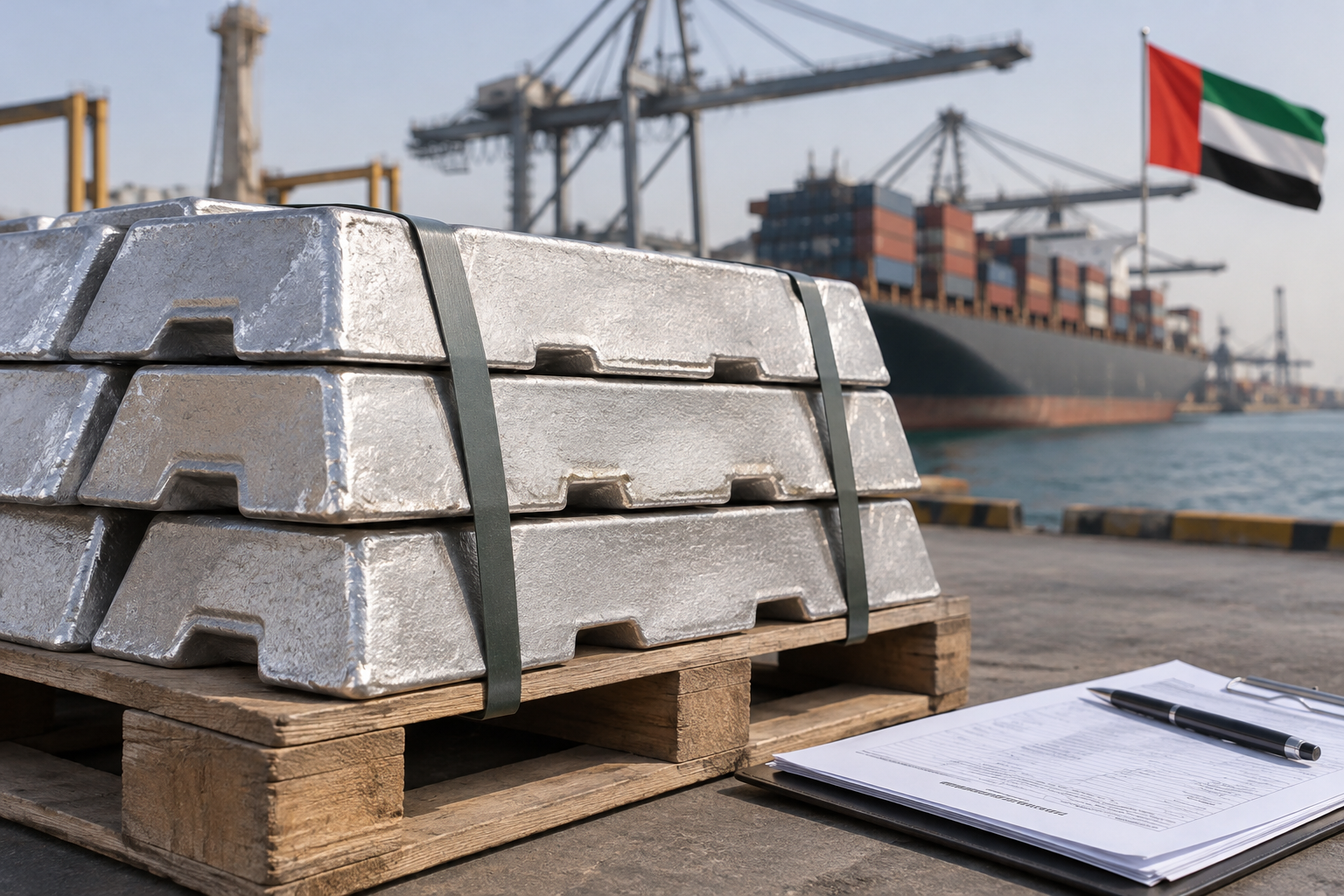
For Indian foundries evaluating aluminium ingot suppliers in the UAE, the first buying decision is not the lowest price—it is whether the offered metal suits the casting process and finished-part specification. Primary non-alloyed aluminium, casting alloy ingots and secondary remelt material are not interchangeable descriptions.
A useful sourcing process connects the foundry’s technical requirement with supplier verification, transparent pricing and shipment economics. It also distinguishes the country of dispatch from the product’s verified origin: metal shipped from a UAE warehouse does not automatically qualify as UAE-origin material.
Define the Grade Before Requesting Prices
Start with the component and casting process. Pressure die casting, gravity casting and other foundry applications can require different chemistry, melt treatment and performance controls. A generic request for “aluminium ingots” leaves too much room for incomparable offers.
Separate material categories correctly
Primary non-alloyed aluminium is typically purchased to a specified purity and impurity profile. A purity description alone is insufficient where individual impurities affect the intended alloy or finished component.
Aluminium alloy ingots contain controlled alloying additions. Specify the designation, governing standard and edition, alongside any tighter buyer limits. Similar commercial grade names should not be treated as equivalent without checking their chemistry requirements.
Secondary remelt material describes a production route or feedstock history, not one universal grade. Secondary aluminium can be supplied as a controlled alloy ingot. Buyers should assess demonstrated compliance rather than assume that “secondary” always means unsuitable or that “primary” guarantees casting performance.
Purchase-definition checklist
Before procurement approaches suppliers, the foundry quality owner should approve:
- Intended component, casting process and end-customer requirements.
- Alloy designation, governing standard and edition, or non-alloyed purity specification.
- Minimum and maximum chemistry limits, units and measurement basis for relevant elements.
- Whether primary, secondary or blended-source material is permitted.
- Required controls for inclusions, hydrogen or other melt-quality characteristics, where applicable.
- Ingot weight, acceptable dimensions and handling constraints.
- Trial quantity, bulk order quantity, quantity tolerance and delivery window.
Where a supplier proposes an alternative grade, require a written deviation table and quality approval before commercial acceptance.
How to Evaluate Aluminium Ingot Suppliers in UAE
Supplier searches often return producers, traders, stockists and intermediaries together. Each can serve a legitimate procurement need, but their control over production, documentation and delivery differs.
Verify the business and its role
The sourcing team should verify the seller’s legal identity, registration, signatory authority and payment beneficiary before shortlisting. Record whether the company manufactures the offered material, owns warehouse stock or arranges supply from another producer. Independently confirm any mismatch between the contracting seller and payment beneficiary before transferring funds.
For UAE aluminium alloy ingot manufacturers, request evidence of the production location, available grades, relevant process controls and achievable delivery capacity. For stockists, request stock identification, warehouse location, producer details and evidence supporting ownership or authority to sell.
Do not treat website claims, catalogue photographs or an undated certificate as proof that the quoted lot exists. Ask for lot-specific documents for existing stock. For future production, agree how lots will be allocated and documented before shipment. Where the order risk warrants it, arrange an independent warehouse or plant inspection.
Shortlist against evidence
Use a simple comparison sheet covering:
- Verified legal entity and contracting role.
- Producer, production location and declared product origin.
- Available quantity and production or stock status.
- Traceable example certificates of analysis, followed by certificates for the supplied lots.
- Export capability, packing arrangements and shipment readiness.
- Written acceptance of the buyer’s specification and inspection requirements.
Mark unresolved points as pending verification. Procurement should close material gaps before issuing a purchase commitment, not after paying a deposit. Historical test certificates support an assessment of capability but do not establish conformity of a new shipment.
Approve Technical Evidence Before Bulk Commitment
A certificate of analysis is useful only when it connects to the supplied material. Require heat or batch identifiers that match the agreed ingot or bundle markings and packing records.
The foundry quality team should agree sampling procedures, analytical methods, measurement basis, acceptance limits and the process for resolving disputed results. A supplier’s routine test report may not address every characteristic relevant to the buyer’s casting operation.
Use a controlled trial
For a new source or material route, define trial acceptance before ordering the sample shipment. Depending on the application, this may cover incoming chemistry, melting behaviour, metal recovery and casting performance under controlled conditions.
Compare suppliers using the same evaluation protocol. Differences in furnace practice, melt treatment or casting settings can otherwise obscure the material comparison.
Before bulk release, quality should document approval, conditional approval or rejection, with any corrective action assigned to an owner and a completion deadline. Independent inspection can verify agreed checks, but it does not replace a clear specification or supplier responsibility for conformity. Trial approval also does not remove the need for shipment-level acceptance checks.
Check the Aluminium Ingot HS Code
The aluminium ingot HS code depends on the product’s characteristics, not simply its commercial name or production route. At the six-digit Harmonized System level, the relevant subheadings generally include:
- HS 760110: unwrought aluminium, not alloyed.
- HS 760120: unwrought aluminium alloys.
These subheadings distinguish non-alloyed metal from alloys; they do not independently establish whether material is primary or secondary. The applicable tariff definitions and composition must support classification. Scrap, residues and other product forms require separate consideration.
Before ordering, the Indian importer, supported by its customs broker, should confirm the applicable Indian tariff line using the chemistry, product form and technical documents. The broker should also check current import-policy conditions, applicable standards or quality-control requirements, duties, taxes and documentation obligations.
Do not copy a supplier’s export classification into the Indian import declaration without review. National tariff subdivisions and regulatory requirements can differ.
Compare the Bulk Aluminium Ingot Price Structure
A bulk aluminium ingot price is meaningful only when grade, quantity, pricing basis and delivery scope are comparable. An attractive headline figure may exclude alloying charges, packing or inland movement.
Ask each supplier to identify:
- Whether the quotation is fixed-price or benchmark-linked.
- Any metal-price reference, such as a specified London Metal Exchange (LME) quotation, if used.
- The benchmark quotation type, averaging period and fixing mechanism.
- Alloy premium, conversion charge and other additions or deductions.
- Currency, unit of measure, unit price, total quoted value and quantity tolerance.
- Packing, inspection and handling charges included or excluded.
- Quote validity, available capacity, production lead time and shipment schedule.
Do not impose one benchmark structure on every category. Some suppliers offer all-in fixed prices, while others use formulas. The objective is a transparent comparison, not a mandatory pricing model.
For primary aluminium ingot suppliers, check whether purity and impurity limits support the quoted premium. For alloy or secondary material, compare the agreed chemistry and demonstrated usable yield alongside purchase price.
Procurement and finance should normalise shortlisted offers to the same pricing date or scenario before award. Where prices float, record who fixes the price, when fixation occurs and how the final invoice is calculated.
Calculate UAE-to-India Landed Cost Without Origin Assumptions
To import aluminium ingots from the UAE to India, build a route-specific cost model rather than adding a generic freight allowance to the supplier’s price.
Use the right Incoterms 2020 location
Every offer should name the Incoterm and precise port or place. FOB, CFR and CIF apply to sea or inland-waterway transport; under these terms, risk transfers when goods are on board at the loading port.
Under CFR, the seller pays freight to the named destination port. CIF also requires seller-arranged cargo insurance, but its default minimum cover may not match the buyer’s needs. Agree any additional coverage before contracting. Neither term means that risk transfers only on arrival.
For containerised shipments handed to a carrier before vessel loading, consider whether FCA, CPT or CIP better reflects the actual handover. Incoterms allocate delivery obligations, risk and costs—not payment terms or ownership.
Build a comparable landed-cost sheet
Finance and logistics should include, without double-counting items already covered by the quotation:
- Metal value, premiums and conversion charges.
- Origin inland transport, export handling and packing.
- International freight and cargo insurance.
- Destination terminal, clearance and broker charges.
- Applicable duties, taxes and other assessed levies.
- Inland delivery to the foundry.
- Financing, currency exposure and realistic delay contingencies.
Separate cash required at import from any tax amounts that may be recoverable, subject to eligibility. Finance should confirm the treatment before approving the purchase economics.
Verify origin before assuming preference
UAE dispatch, UAE seller registration and UAE product origin are different facts. Re-exported metal may retain another country’s origin, while locally produced material still requires supporting evidence for any preference claimed.
If considering preferential treatment under the India-UAE Comprehensive Economic Partnership Agreement (CEPA), the importer and customs broker should verify current product coverage, applicable origin rules, required origin documentation and other eligibility conditions before award. Do not price in preferential duty solely because the shipment leaves a UAE port.
Prepare a Purchase RFQ That Produces Comparable Offers
Procurement should issue one controlled request for quotation (RFQ) after quality approves the specification and logistics confirms the intended route. Include:
- RFQ reference, issue date, validity, response deadline and authorised issuer.
- Buyer’s legal identity and registration details, plus a request for the seller’s legal identity, registration and authorised representative; mark unverified information as pending verification.
- Grade, governing standard and edition, application, chemistry limits, units, measurement basis and permitted material route.
- Producer, production location and declared country of origin.
- Quantity, unit, tolerance, packing, ingot weight and marking requirements.
- Heat or batch identification and traceability requirements.
- Delivery schedule, loading point or port, destination and partial-shipment conditions.
- Named Incoterms 2020 term and location.
- Unit and total price or calculation formula, pricing breakdown, currency and quotation validity.
- Available capacity, production lead time and shipment readiness.
- Proposed payment terms, bank acceptance and documentary conditions.
- Proposed inspection arrangements, a mutually agreed independent inspector where required, sampling and testing methods, and acceptance criteria.
- Required invoice, packing list, transport document, heat- or batch-level COA and certificate of origin or other applicable origin evidence; insurance documents where applicable.
- A mandatory compliance-and-deviations schedule with supporting technical and documentary evidence.
If proposing an irrevocable letter of credit at sight, align documentary requirements with documents the seller can actually provide. Payment depends on complying documents, not automatically on vessel arrival or satisfactory casting performance.
Before award, procurement should close commercial deviations and complete counterparty verification, quality should release technical approval, and the importer and broker should confirm classification and import requirements. An RFQ requests an offer; it is not a concluded supply contract.
Frequently Asked Questions
Are primary aluminium ingots always better for foundries?
No. Suitability depends on the required chemistry, casting process and component performance. A controlled secondary alloy can be appropriate where permitted; primary material still requires specification checks and traceability.
Which HS code applies to aluminium ingots imported into India?
Non-alloyed unwrought aluminium generally falls under HS 760110, while unwrought aluminium alloys generally fall under HS 760120. The importer, supported by its customs broker, should confirm India’s applicable tariff line using composition, product form and current requirements.
Does shipping from the UAE guarantee preferential import duty?
No. Dispatch location does not establish origin. Preferential treatment depends on applicable agreement provisions, product coverage, origin qualification and valid supporting documentation.
How should buyers compare two different ingot quotations?
Align grade, chemistry, quantity, pricing period, Incoterm and delivery schedule first. Then compare landed cost, payment exposure, traceability and trial results—not only the quoted price per tonne.
Explore Sourcing on IMEX Center
Ready to approach suppliers with a clearer requirement? Visit IMEX Center to explore sourcing and listing options. Prepare a grade-specific RFQ before seeking offers, and complete supplier and lot verification before commitment.
UAE producers and stockists preparing aluminium ingot listings should state clear grades, material routes, quantities and delivery terms. Precise information helps Indian foundry buyers assess technical fit and request comparable quotations; a listing alone does not establish supplier verification or lot conformity.
Source or sell globally with IMEX Center
Browse verified suppliers →