Import & Export
Black Pepper Suppliers in Vietnam: Bulk Buying for Germany
20 Oct 2026 · 06:02 CET
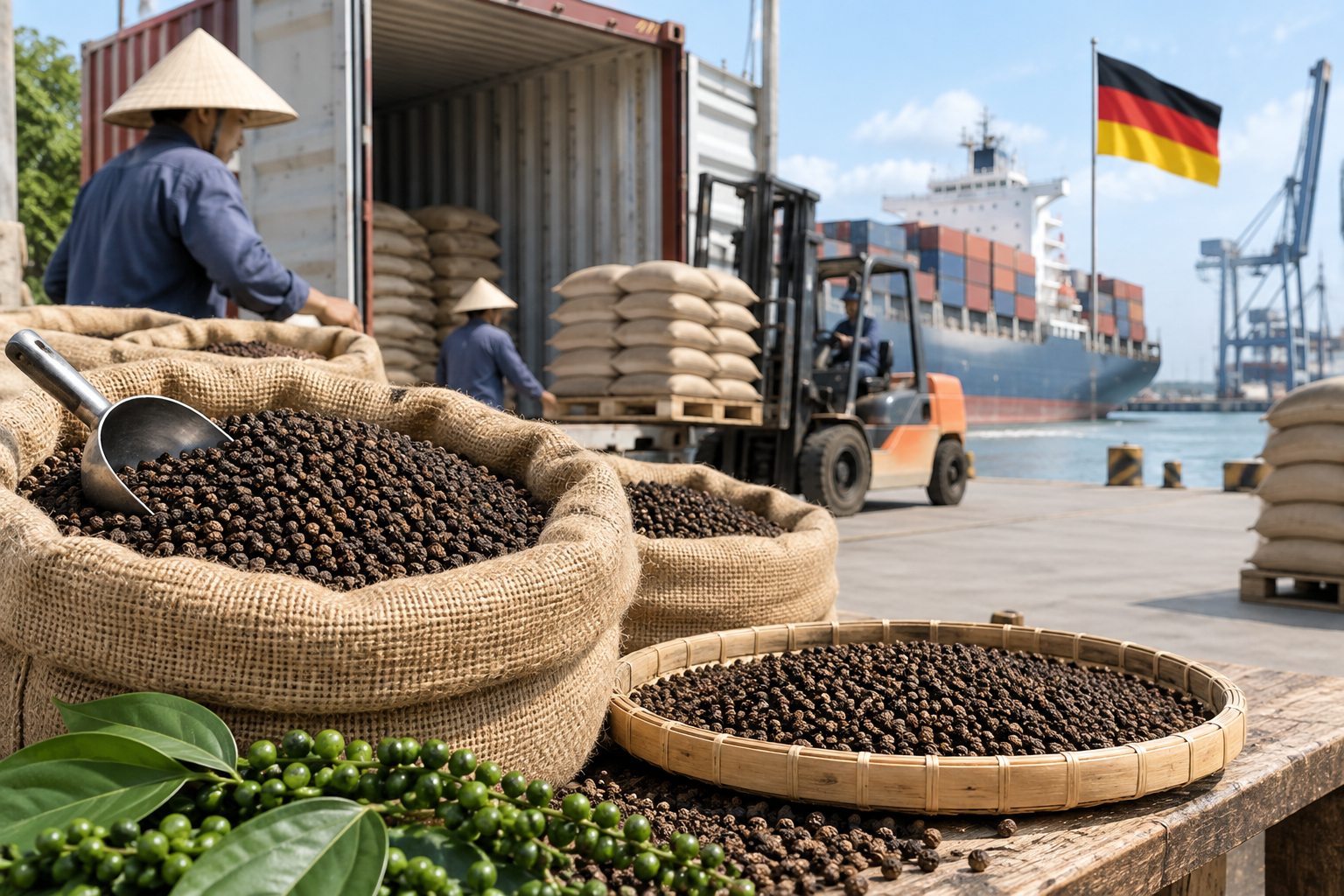
Choosing black pepper suppliers in Vietnam requires more than comparing export prices. German spice importers need pepper that fits their processing line, customer specifications and food-safety obligations. An inexpensive shipment can become costly if it needs additional cleaning, microbial treatment or reworking before release.
A sound buying process starts with a written specification and ends with an agreed lot-release procedure. Between those points, compare density, processing capability, traceability and the cost per usable kilogram—not just the quoted price per tonne.
Define the purchase before approaching exporters
A supplier cannot quote meaningfully against “black pepper, good quality.” Start by describing the product, intended use and delivery requirement.
Whole pepper intended for grinding in Germany may need a different purchasing specification from pepper packed directly into retail grinders. Ground pepper requires additional controls around particle size, authenticity and consistency because visual inspection provides less information about the original material.
Initial purchasing checklist
Your sourcing manager should confirm these points before sending enquiries:
- Product: whole, crushed or ground black pepper.
- Application: retail packing, industrial seasoning, grinding or another defined use.
- Processing state: cleaning status and whether untreated or microbially treated, with the treatment method and scope documented.
- Quantity: trial shipment, initial commercial order and expected repeat demand.
- Packaging: bag size, food-contact suitability, liner requirements, pallet configuration and identification marks.
- Destination: named German port or warehouse, with a requested delivery window.
- Commercial basis: currency, payment terms and Incoterms rule with a named place or port and version.
State whether another processor will handle the pepper after arrival. This determines which operations belong in the supplier’s quotation and which costs remain with the importer.
How to compare black pepper suppliers in Vietnam
Evaluate Vietnamese black pepper exporters against the same specification and evidence requirements. A trader can be a suitable partner, but the actual processing site and responsibilities must be clear.
Ask who buys the raw pepper, who cleans it, who performs treatment and who releases the finished lot. If several businesses are involved, establish how lot identification remains intact through each transfer.
Supplier shortlist checklist
Before requesting commercial samples, obtain:
- The exporter’s legal identity and the relevant processing-site details.
- A process flow covering cleaning, grading, metal control, treatment and packing.
- Minimum order quantities for the exact grade and treatment requested.
- Production lead times and any constraints affecting repeat orders.
- Traceability procedures and an example of lot-level documentation.
- Relevant food-safety certificates, including site, scope, validity and issuing body.
- Confirmation of whether microbial treatment is in-house or subcontracted.
- Procedures for deviations, complaints, withdrawals and recalls.
For subcontracted treatment, request the treatment site’s identity and controls for segregation, transport and post-treatment handling. A certificate held by the exporter does not automatically cover every subcontractor or operation, nor does certification alone establish shipment compliance.
The sourcing manager should resolve commercial gaps during shortlisting; the quality manager should review processing and traceability evidence before approving the supplier.
Understand 500 GL and 550 GL specifications
The trade expressions 500 GL and 550 GL generally refer to bulk densities of 500 and 550 grams per litre, respectively. Use the explicit unit g/L in the specification. When comparing these offers, ask whether the quoted figure is a minimum acceptance limit or a typical result, and specify the measurement method.
Bulk density describes the mass occupying a defined volume under stated test conditions. It does not, by itself, establish flavour strength, microbiological condition, pesticide compliance or overall suitability.
A 550 GL offer may still be unsuitable if its moisture, foreign matter or processing status falls outside your specification. A 500 GL offer may suit a particular grinding application if it meets the buyer’s complete requirements.
Compare the full physical and sensory specification
Agree limits or assessment methods for:
- Moisture content and, where relevant, water activity.
- Foreign matter and extraneous plant material.
- Light berries, damaged material and other defined defects.
- Infestation and visible mould.
- Aroma, appearance and absence of unacceptable taints.
- Volatile oil or piperine where commercially relevant.
- Particle-size distribution for crushed or ground pepper.
Use consistent methods when comparing samples and certificates of analysis. Otherwise, apparent differences may reflect testing procedures rather than meaningful product differences.
Set food-safety acceptance criteria before the RFQ
Importing black pepper from Vietnam into Germany requires a compliance plan appropriate to the product and supply chain. Do not leave this at “EU compliant” in an email or contract.
Before issuing the request for quotation, the importer’s quality manager should define applicable legal requirements, customer specifications and the evidence needed for release. Legal limits and private purchasing limits are not always identical; label each clearly. Supplier assurances do not replace the importer’s own food-safety responsibilities.
Residues, contaminants and microbiology
For pesticide residues, identify the applicable commodity classification and current EU maximum residue limits. Specify a risk-based analytical scope and suitable reporting limits. A generic multi-residue screening statement is not enough without knowing which substances and methods it covers.
For contaminants, identify applicable requirements, including relevant mycotoxin limits, and agree any additional risk-based testing. Check current legal texts rather than copying an old specification.
Define microbiological criteria by applicable law, intended use and customer requirements. These may include Salmonella and agreed indicator or spoilage-organism limits. Record the sampling plan, analytical method and acceptance rule rather than listing organisms alone. Testing supports verification but does not replace preventive controls or guarantee that an entire lot is free of hazards.
Useful official starting points include the European Commission’s EU Pesticides Database and EUR-Lex for applicable food legislation. The quality manager and customs specialist should also check whether current product-and-origin import controls affect the shipment before booking, including any required advance notification, entry-point restrictions or official documentation.
Use a laboratory with suitable accreditation and a scope covering the required tests. Agree how samples and results link to the shipment lot, who pays for testing and what happens after a failure.
Compare untreated and steam-sterilized offers fairly
Untreated pepper and steam-treated pepper are not interchangeable commercial offers. The first may require a validated downstream microbial-reduction step; the second should include evidence of the treatment and protection against subsequent contamination.
When assessing suppliers of steam-treated black pepper, ask for process-validation evidence relevant to pepper, routine monitoring records, lot linkage and post-treatment hygiene controls. The commercial term “steam sterilized” should not be interpreted as a guarantee of sterility or used as a substitute for a defined microbiological outcome.
Steam treatment should not be assumed to correct pesticide-residue failures or eliminate chemical contaminants. It can also affect product characteristics, so assess aroma, moisture and physical condition after treatment—not only before it.
If treatment will take place in Germany, confirm the processor’s acceptance criteria, capacity, fees and expected yield before choosing an untreated offer. The sourcing manager should secure that processing quotation before comparing final supplier bids. Planned downstream treatment does not waive applicable import or food-safety requirements.
Verify the black pepper HS code and import costs
At the six-digit HS level, pepper of the genus Piper is distinguished as follows:
- 090411: neither crushed nor ground.
- 090412: crushed or ground.
These subheadings are starting points, not complete codes for a German import declaration. The customs broker or importer’s customs specialist should verify the current EU tariff subdivisions and relevant TARIC measures for the actual product.
Use the European Commission’s Access2Markets and TARIC consultation to investigate applicable duties and import requirements. Do not assume a duty rate from an old quotation or from the six-digit code alone.
If claiming preferential treatment, verify the applicable origin rule, supporting evidence and documentary requirements. Shipment from Vietnam does not, by itself, prove preferential Vietnamese origin.
Complete these checks before accepting the final offer, then reconfirm relevant measures before shipment. Keep import VAT cash-flow effects separate from permanent sourcing costs where recovery is available under the importer’s circumstances.
Calculate usable landed cost, not just purchase price
Compare bulk black pepper suppliers on an equivalent delivery and processing basis. An FOB quotation and a delivered-warehouse quotation cannot be ranked directly without accounting for their different cost coverage.
A practical calculation is:
Usable landed cost per kilogram = total attributable procurement and processing cost ÷ kilograms released for the intended use.
Include the following where applicable, without double-counting items already covered by the quoted price and delivery terms:
- Pepper purchase price and origin-side charges.
- Freight, insurance, terminal handling and customs clearance.
- Applicable duties, non-recoverable taxes and inland transport.
- Sampling, laboratory testing and inspections.
- Cleaning, treatment, repacking and storage.
- Financing and other attributable handling costs.
Reflect cleaning and processing losses in the usable-weight denominator. Do not assume every purchased kilogram becomes saleable material.
Keep uncertain rejection, delay or rework exposure in a separate scenario analysis rather than presenting it as a known expense. Procurement should obtain comparable costs; quality and the processor should validate yield assumptions before the award decision.
Move from shortlist to a controlled order
A specification-led RFQ asks every shortlisted exporter to quote the same product and disclose deviations explicitly.
RFQ-to-order checklist
- Sourcing manager, before RFQ: issue the specification, volume, packaging, destination, delivery basis and required documents.
- Supplier, with the quotation: confirm each requirement, list deviations and separate optional treatment or testing charges.
- Quality manager, before contracting: assess representative samples and define how commercial lots will match the approved standard.
- Sourcing and quality, before order confirmation: agree testing responsibilities, rejection remedies and change-control requirements.
- Quality manager, before shipment: review the agreed lot-specific evidence and authorize shipment only under the contracted release conditions.
- Logistics and customs specialist, before dispatch: verify classification, shipment documents, origin evidence where claimed and destination handling arrangements.
Sample approval is not blanket approval for future shipments. Define whether samples represent a production lot, a proposed grade or a reference standard. Retain identified samples and agree any arrival checks and final release conditions. The importer’s quality manager should keep any lot subject to outstanding release checks on hold until those conditions are met.
Frequently asked questions
Is 550 GL black pepper always better than 500 GL?
No. Bulk density is one specification parameter. Suitability also depends on moisture, defects, aroma, processing status and food-safety compliance. Compare both grades against the intended use and expected usable yield.
Does steam sterilization guarantee EU compliance?
No. A validated treatment can address defined microbiological hazards, but it does not guarantee sterility or establish pesticide or contaminant compliance. Treatment evidence, risk-based chemical testing and post-treatment hygiene need separate evaluation.
What is the black pepper HS code for German imports?
At six digits, whole pepper falls under HS 090411, while crushed or ground pepper falls under HS 090412. Verify the complete declaration code, current EU measures and applicable origin requirements before declaring the shipment.
What should a German importer request before ordering?
Request an agreed specification, representative samples, processing and traceability evidence, a comparable quotation and lot-testing conditions. The quality manager should approve acceptance criteria before procurement commits to the order.
Source or list black pepper on IMEX Center
Ready to compare offers on a consistent basis? Visit IMEX Center to explore sourcing and supplier-listing options for black pepper. Buyers should prepare a specification-led enquiry; suppliers should state grade, treatment status, packing, minimum order and available documentation. Include these details in the initial enquiry or offer to make the next quotation easier to evaluate.
Source or sell globally with IMEX Center
Browse verified suppliers →