Import & Export
Cashew Nut Exporters in Vietnam: A German Buyer’s Guide
04 Oct 2026 · 06:02 CET
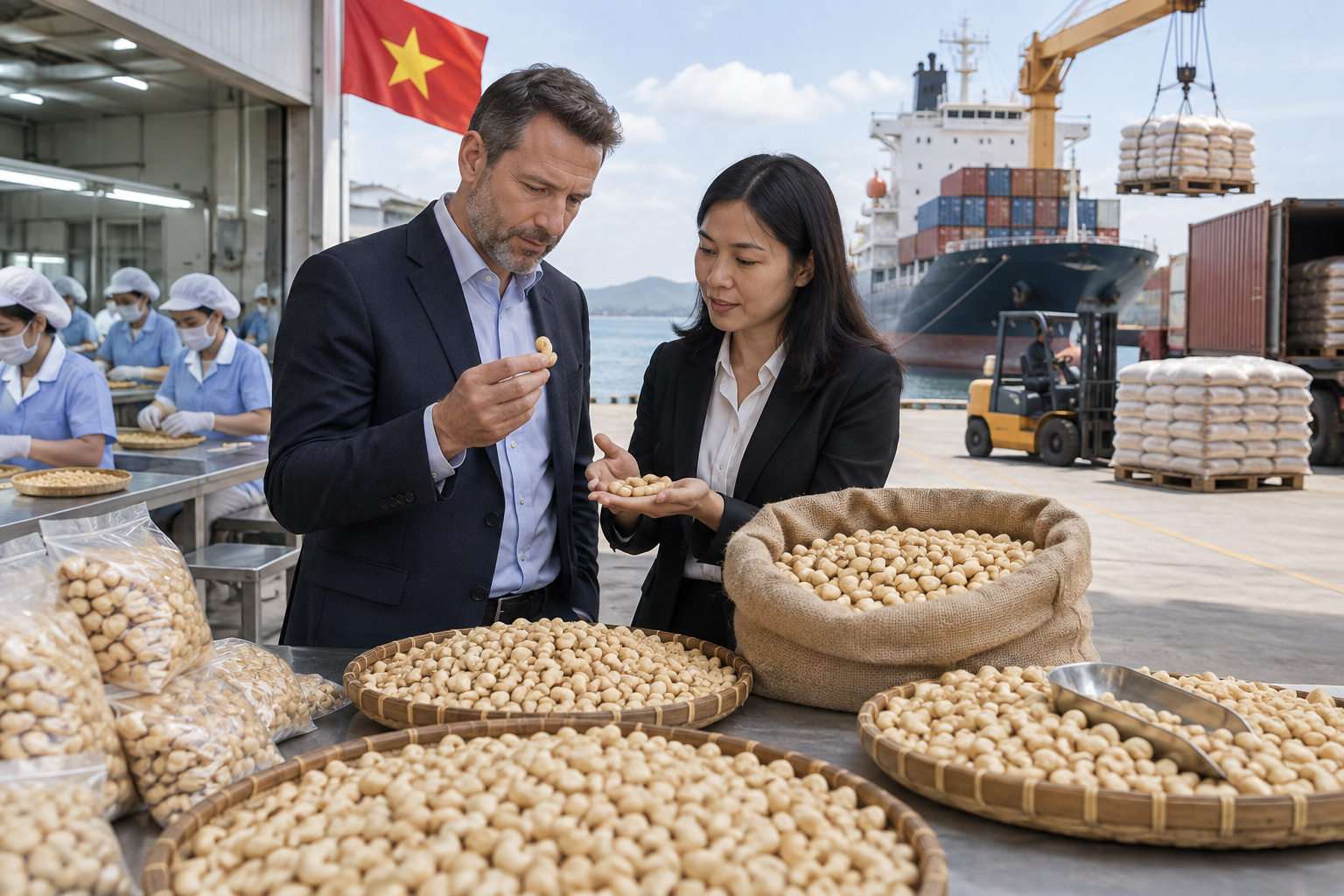
Choosing cashew nut exporters in Vietnam requires more than comparing a W320 quotation. For German importers, roasters and food wholesalers, the strongest offer is the one that delivers the right usable kernels, with reliable documentation and clear, contractually agreed quality terms.
A lower price per kilogram can disappear through excess breakage, inconsistent roasting performance or unsuitable packaging. This guide explains how to define your requirements, assess Vietnamese cashew suppliers and compare bulk offers on an equivalent basis.
Define the buying brief before requesting prices
Start with the product you intend to sell or manufacture. Kernel size matters, but its commercial value depends on the application.
Retail packs: prioritise appearance and consistency
Premium snack packs may justify larger whole kernels such as W240. Mainstream retail products may suit W320, provided colour, sizing and the delivered whole-kernel proportion remain consistent.
Specify whether kernels will be packed directly or processed further. Broken kernels that are acceptable for an ingredient buyer may undermine the presentation of a whole-kernel retail product.
Roasting: prioritise process performance
Roasters should assess size distribution, moisture consistency and flavour after a representative roast trial. Mixed sizes can complicate roasting because kernels may develop colour and texture differently.
Do not judge suitability from an attractive raw sample alone. Run the proposed grade through your intended process before approval.
Food manufacturing: buy the form you actually need
Pieces, splits or broken kernels may offer better value for bakery, confectionery, sauces and nut pastes. If the production line chops every kernel, paying a premium for intact wholes may add little value.
Your inquiry checklist should include:
- End use and required processing state: unroasted, roasted or otherwise prepared.
- Preferred grade and acceptable alternatives.
- Trial quantity, recurring volume and delivery frequency.
- Delivery location in Germany and requested Incoterms rule.
- Packaging format, shelf-life requirement and storage conditions.
- Required testing, certifications and traceability information.
How to shortlist cashew nut exporters in Vietnam
Distinguish the selling company from the processing facility. A trader can be a capable sourcing partner, but you need to know who controls production, testing and corrective action.
Ask shortlisted exporters to identify their legal entity, factory location and any subcontracted processing or packing. Establish whether the quoted goods come from their own production, a nominated partner or changing third-party sources.
Vietnamese processing does not necessarily mean the raw cashew nuts were grown in Vietnam. Request traceability covering raw-material origin, processing batches and finished-product lots. Keep agricultural origin, processing location and customs-origin declarations distinct; customs origin depends on the applicable rules, not simply the country of shipment.
A practical supplier-verification checklist includes:
- Company registration and independently verified contact details.
- Processing and packing locations relevant to your order.
- Available capacity and realistic lead time for your specification.
- Food-safety certificates checked for scope, site and validity.
- Example lot records, test reports and export documents.
- Controls for foreign material, allergens and pest prevention.
- Complaint handling, product-withdrawal and recall procedures.
When comparing bulk cashew suppliers, give more weight to verifiable operational evidence than polished sales materials. Confirm unexpected bank-detail changes through an independently established contact channel.
Choose a kernel specification that fits the application
W240 versus W320
Under commonly used trade grading conventions, W240 refers to white whole kernels with approximately 220–240 kernels per pound; W320 typically corresponds to 300–320 kernels per pound. The lower count indicates larger kernels.
W240 can suit premium visual presentation. W320 is a practical option for many snack and roasting applications. Neither designation alone establishes superior flavour, safety or suitability.
Ask prospective W320 suppliers in Vietnam to name the grading standard used and provide the complete specification. A grade label is not a substitute for agreed tolerances.
Whole kernels, pieces and defects
Define the minimum whole-kernel proportion and the permitted levels of broken kernels, splits, discolouration and other defects. State how each characteristic will be measured, including sample size and whether the result is calculated by weight or count.
For ingredient production, specify piece-size distribution and maximum fines. Excess dust or small fragments can affect dosing, texture and usable yield even when the product is commercially described as pieces.
Colour should also be explicit. Do not assume that a photograph establishes the acceptance standard for white, scorched or other kernel categories.
Approve representative samples and a testing plan
Samples should represent the goods you will receive, not merely demonstrate the supplier’s best possible output. Request a sample from an identified production lot or a documented production run made to your specification. If it is a pre-production sample, distinguish approval of that sample from acceptance of the eventual shipment.
Assess appearance, aroma, flavour, texture, moisture and breakage. Conduct sensory evaluation under appropriate food-safety procedures and, where relevant, carry out roasting, chopping or packing trials. Agree a numerical moisture limit and test method rather than accepting an undefined promise of suitable dryness.
Build food-safety testing around the product, intended use, origin history and your risk assessment. Relevant checks may include aflatoxins, pesticide residues and microbiological hazards such as Salmonella. Distinguish statutory requirements from additional customer specifications.
Use a competent laboratory, preferably accredited for the relevant methods, and agree the sampling procedure. Testing a small hand-selected sample cannot establish that an entire consignment complies, particularly when contamination may be unevenly distributed.
Before approval, document:
- Sample identity and its relationship to the shipment.
- Agreed sensory, physical and analytical criteria.
- Methods, reporting units and acceptance limits.
- Whether shipment-level testing is required.
- Retained-sample arrangements for both parties.
Roasting should not be treated as a blanket remedy for chemical contamination or poor incoming quality. Where a roasting step is intended to control microbiological hazards, its effectiveness must be validated for the process concerned.
Verify German and EU import requirements
Before you import cashew nuts from Vietnam to Germany, confirm the requirements for the exact product and shipment. Product form, customs classification, origin and current control measures can affect the import process.
Use current EU legislation and European Commission guidance, the EU pesticide database, TARIC and German customs information. Consult the responsible German food-control authority and your customs representative where necessary. This checklist is a starting point, not a shipment-specific compliance determination.
Check these areas before shipment:
- Contaminants: applicable maximum levels, including relevant aflatoxin limits and any distinctions based on intended treatment or use.
- Pesticides: applicable maximum residue levels for the commodity and substances concerned.
- Food safety: hygiene controls and microbiological criteria where applicable, alongside the general obligation to place safe food on the market.
- Traceability: lot identification and records linking supplier, consignment and customer.
- Labelling: information required on business-to-business packaging or accompanying documents and eventual consumer packs, including cashew allergen information and applicable language requirements.
- Customs: EORI, classification, valuation, duty treatment and origin evidence where relevant. Any preferential tariff claim must meet the applicable origin rules and documentary requirements.
- Official controls: whether the particular product-origin combination currently requires additional checks, advance notification or specified documentation.
Do not assume every shipment requires a health certificate, or that previous clearance guarantees the next shipment will follow identical procedures. Confirm requirements before dispatch.
If selling the kernels as organic, separately verify certification and applicable organic import procedures, including the required certificate of inspection through TRACES. A supplier’s certification does not replace the importer’s own responsibilities.
Compare offers by usable-kernel cost
Wholesale cashew quotations from Vietnam may look comparable while differing in grade, freight basis, packaging and quality allowances.
Put every offer into a common comparison sheet. Align grade, specification, net product weight, order quantity, packaging, payment terms, delivery window and the Incoterms rule with its named place or port and version.
Calculate the cost of usable output
Use this working formula:
Usable-kernel cost = (landed batch cost + relevant incremental handling costs − recoverable by-product value) ÷ usable kilograms.
Define usable kilograms against your end use. For retail whole kernels, this may exclude excessive breakage and sorting rejects. For paste production, sound broken kernels may remain fully usable.
Consider two offers for the same purchased weight. The lower-priced batch may require more sorting and deliver fewer kernels suitable for a whole-kernel retail pack. The higher-priced batch may provide more saleable output and therefore a lower cost per usable kilogram. For paste production, the comparison could change because sound pieces may be usable rather than a loss.
Use representative trial results and documented cost assumptions to estimate yield. If shipment performance is not yet established, compare a range of plausible yields rather than treating a supplier’s estimate as guaranteed output.
Include freight, insurance, clearance, inland delivery and applicable duties consistently. Treat import VAT separately from economic cost to the extent it is recoverable, while allowing for its cash-flow effect. Avoid counting the same sorting loss twice. Credit by-products only where they have a legitimate, food-safe use and a realistic recoverable value.
Packaging and claims change the economics
Ask how the supplier controls oxygen exposure, moisture ingress and transport damage. Confirm food-contact suitability, inner-pack integrity, net weight, pallet configuration and storage requirements.
Vacuum or gas-flushed packaging should be specified precisely rather than treated as a guarantee of shelf life. Agree the remaining shelf life required at arrival and request the basis for the stated shelf life under the specified storage conditions.
Incoterms allocate specified delivery obligations, costs and transport risks; they do not replace product-quality, payment or claim provisions.
Structure the first bulk order around measurable acceptance
Keep the first order manageable, but large enough to validate normal commercial production and logistics. Reference the signed specification and approved sample records in the purchase contract.
Agree before shipment:
- Inspection timing, responsible party and sampling method.
- Batch-specific test reports and release conditions.
- Breakage, moisture, defect and packaging acceptance criteria.
- Sealed retained samples and storage arrangements.
- Arrival inspection procedures and evidence requirements.
- Claim deadlines, including treatment of latent defects.
- Independent testing and dispute-resolution arrangements.
- Remedies such as replacement, credit or rejection where agreed.
Record seal condition, packaging damage and lot details on arrival. Quarantine questionable stock pending assessment rather than mixing it into production and losing traceability. Commercial claim procedures do not replace any legal obligation to withdraw, recall or report unsafe food.
Frequently asked questions
Is W240 better than W320 for German buyers?
Not automatically. W240 offers larger kernels, which may support premium presentation. W320 may suit mainstream snacks and roasting. Choose through application trials and usable-kernel economics.
Can broken cashews be the better purchase?
Yes. Sound pieces can suit chopping, bakery and paste production. Specify piece size, fines and defects; compare usable output rather than assuming whole kernels provide better value.
What should a first supplier inquiry contain?
Include end use, grade, quantity, delivery location, requested Incoterms rule, packaging, testing requirements and acceptance criteria. Ask for processing-site details, traceability evidence and a representative sample.
Does a supplier certificate prove EU compliance?
No. Certification can support supplier assessment, but it does not establish compliance for every lot. Verify its scope and combine it with current legal checks, traceability and appropriate testing.
Turn your specification into a sourcing conversation
A strong buying decision connects end use, measurable quality and landed usable-kernel cost. Build that specification before negotiating the headline price.
Ready to start? Visit IMEX Center to discuss your sourcing needs with a clear buying brief. Vietnamese exporters preparing to approach German buyers should present their kernel grades, processing capabilities, supporting documentation and commercial terms clearly.
Source or sell globally with IMEX Center
Browse verified suppliers →