Import & Export
Cashew Nut Suppliers in Vietnam: Grades for U.S. Buyers
18 Oct 2026 · 06:02 CET
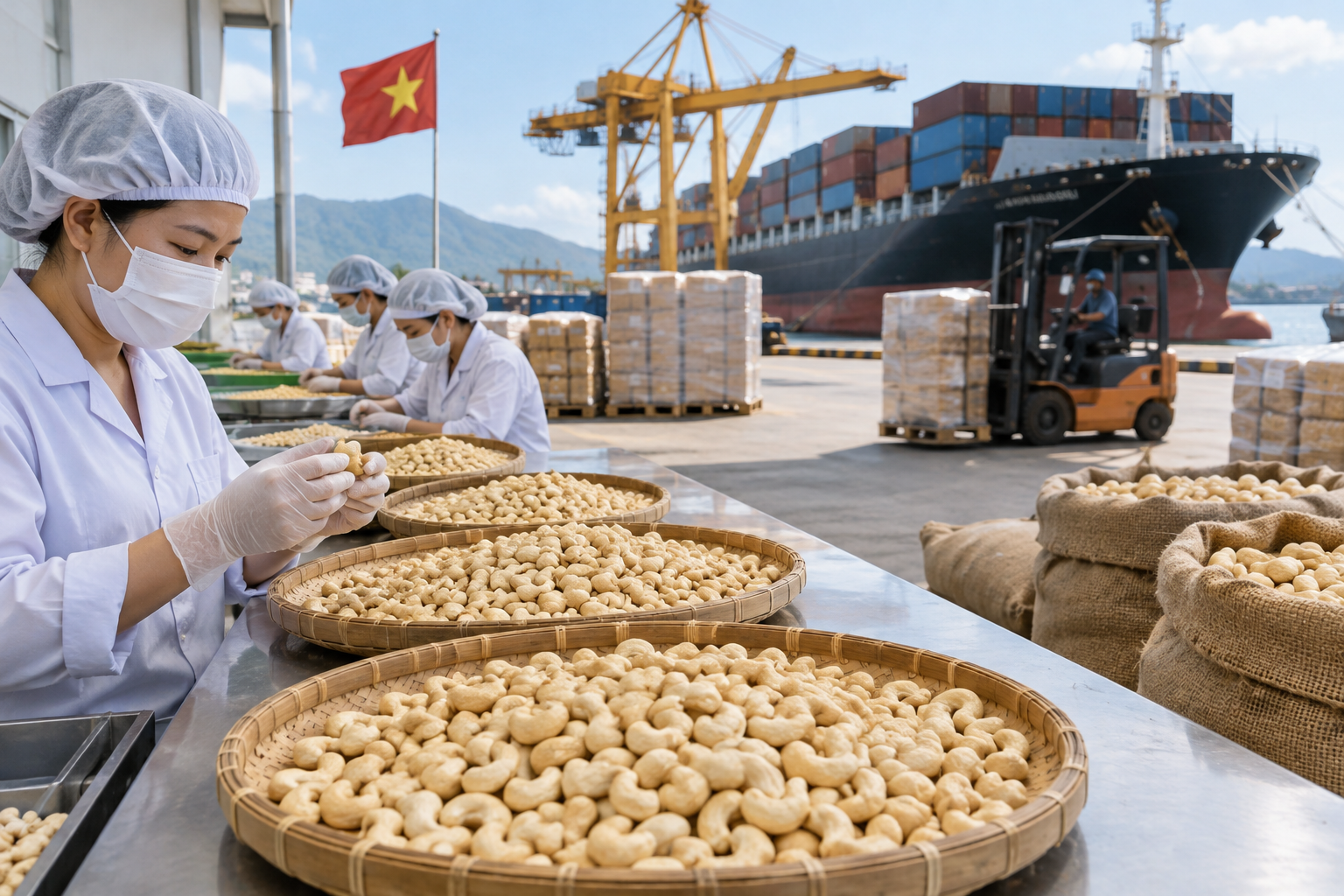
For U.S. buyers evaluating cashew nut suppliers in Vietnam, the lowest price per kilogram is not necessarily the best purchase. Kernel size, breakage, color, processing controls and packaging determine how much of a shipment fits your intended product. A competitive quote can become expensive if retail kernels require sorting or ingredient pieces need additional sizing.
The better approach is to define the usable product first, then compare suppliers against the same specification. This guide explains how to build that specification, assess Vietnamese processors and prepare a purchase order with clear quality and import responsibilities.
Define the product before requesting prices
Start with the finished application: retail snack packs, foodservice, bakery inclusions, confectionery, nut butter or another ingredient use. Each application changes which grades and processing services are worth paying for.
Unroasted kernels for further processing
Trade offers commonly describe unroasted kernels as “raw,” but that does not establish their complete heat-treatment history or microbiological status. Shell-removal processing and a validated pathogen-reduction treatment are not interchangeable claims.
Owner: product development and quality assurance. Timing: before the RFQ. Specify whether the kernels will undergo a subsequent validated treatment, who will perform it and what supplier processing evidence is required. Do not assume that an intended roasting step provides adequate pathogen reduction without validation.
Roasted and seasoned products
For roasted cashews, define roast color, flavor, texture, oil use and salt level. For seasoned products, approve the ingredient formula and identify allergens or cross-contact concerns introduced by seasoning and shared equipment.
Decide whether you are buying bulk finished snacks or consumer-ready packs. Retail-ready products require separate agreement on pack format, label review, date coding and shelf-life support.
Compare grades from cashew nut suppliers in Vietnam
Grade names help shortlist offers, but they do not replace a written specification. Ask each supplier which grading standard and version it uses, then attach the agreed requirements to the contract.
W240 versus W320
In common commercial terminology, “W” denotes white whole kernels. The number relates to kernel count per pound: W240 kernels are larger than W320 kernels. Common count bands are 220–240 kernels per pound for W240 and 300–320 for W320; confirm these against the supplier’s stated standard.
W240 can suit products where a larger kernel supports the intended presentation. W320 is often a practical option for general snacking and mixed-nut products. Neither grade is automatically better for every application.
When comparing W320 offers, request actual count results and the permitted proportion of broken kernels. Two nominally identical grades may deliver different pack appearance if their breakage and color tolerances differ.
Whole kernels versus splits and pieces
Splits and pieces may offer better value for bakery, confectionery or nut-butter production when whole-kernel appearance adds little value. However, piece size affects dosing, distribution, roasting behavior and texture.
Specify the required screen-size range, fines limit and acceptable size distribution. Avoid ordering simply “broken cashews” when your production line needs consistent inclusions.
Make tolerances measurable
Owner: sourcing manager, with QA approval. Timing: before suppliers quote. Define:
- Grade, count range or piece-size distribution.
- Permitted broken kernels within whole-kernel lots.
- Color category and acceptable variation.
- Limits for defects, foreign material and infestation.
- Moisture limit and test method.
- Sensory acceptance criteria, including rancid or abnormal odors.
Keep each tolerance tied to an agreed inspection method. Terms such as “premium quality” provide little protection when acceptance is disputed.
Compare usable yield, not invoice price alone
A useful commercial measure is effective cost per usable kilogram = total relevant cost ÷ kilograms suitable for the intended application.
Define relevant costs consistently across offers: product, freight, insurance, applicable import charges, inspection, handling and any necessary sorting or reprocessing. Account consistently for any recoverable value from downgraded material; broken kernels are not automatically worthless. Avoid counting that value twice in the comparison.
For retail whole-kernel packs, breakage may reduce usable yield. For nut butter, the same breakage may have little commercial impact, while flavor, contamination controls and processing performance remain critical.
Owner: procurement and production. Timing: after sample trials, before supplier selection. Compare quotes using your own trial results rather than assuming every supplier’s stated yield is equivalent. Treat sample results as estimates until production-lot performance is verified.
Verify Vietnamese processors and exporters
Vietnamese cashew exporters may be processors, trading companies or businesses using contracted processing facilities. These models can all be workable, but you need to know who processes, stores and dispatches your goods.
Ask for the legal seller’s identity, the actual processing site and a description of any outsourced operations. A trader should still provide a credible route to traceability and production records.
Check capability and traceability
Request evidence relevant to your purchase:
- Processing flow covering shelling, grading, treatment and packing as applicable.
- Food-safety documentation and current certification where required by your purchasing policy.
- Lot coding that connects incoming materials, processing and packed goods.
- Allergen, foreign-material and pest-control procedures.
- Recall procedures and a recent traceability exercise summary.
- Capacity and scheduling information for your intended grade and packaging.
Verify certificate scope, validity and site identity, not just the presence of a logo. Certification does not by itself establish that a particular shipment meets your specification.
Connect approved samples to production lots
Ask whether samples represent current stock, a production trial or a specially selected presentation sample. Record the sample reference, specification version and approval date.
Owner: supplier QA and buyer QA. Timing: sample approval and again before shipment. Retain reference samples and agree how production lots will be checked against the written specification and approved samples. Require written approval before changing the grade, processing site, treatment or packaging.
Build comparable bulk quotations
Use one RFQ template for bulk cashew purchases. Otherwise, apparent price differences may reflect different packaging, delivery responsibilities or product tolerances.
Require each quotation to state:
- Product form, grade and specification reference.
- Quantity, minimum order quantity and price tiers.
- Currency, quotation validity and payment terms.
- Net product weight per inner pack and carton.
- Packaging materials, sealing method and pallet arrangement.
- Production lead time, shipment window and stock status.
- Incoterms rule, named place or port, and edition.
- Included tests, inspection services and documentation.
Distinguish estimated production completion from vessel departure and destination arrival. Ask the supplier to identify which milestones it controls. Address payment, product acceptance and claims separately in the contract; an Incoterms rule does not settle all commercial obligations.
Specify packaging for the actual supply chain
Cashews need protection against moisture, oxygen, physical damage and odor contamination. Ask whether the proposal uses vacuum packing, gas flushing or another system, and request evidence supporting the proposed shelf life under stated storage conditions.
Define food-contact suitability, seal checks, carton strength, lot marking and acceptable pack integrity on arrival. Require remaining shelf life at the agreed delivery milestone, not merely total shelf life from manufacture.
Owner: logistics and QA. Timing: before order confirmation. Review packaging against transit conditions, warehousing and your unloading or production equipment.
Confirm classification and U.S. import responsibilities
Before importing cashews from Vietnam into the United States, resolve customs and food-safety responsibilities. Supplier paperwork supports this work but does not transfer the importer’s obligations.
Confirm the customs classification
The international six-digit HS code for shelled cashew nuts is 0801.32, covering shelled cashews in the fresh-or-dried category. Roasted, seasoned or otherwise prepared products may require a different classification.
The U.S. HTS classification uses additional digits. Owner: importer of record, supported by the customs broker. Timing: before the purchase order is finalized. Confirm the current classification, applicable duty treatment, origin and entry requirements using the exact product composition and processing details. Consult the current U.S. Harmonized Tariff Schedule rather than relying on an old quotation. Do not assume the country of shipment alone settles customs origin.
Assign food-safety responsibilities
Owner: the responsible U.S. importer and food-safety lead. Timing: before supplier approval. Determine applicable FDA requirements, including facility registration where required, prior notice and Foreign Supplier Verification Program responsibilities, subject to applicable exemptions or modified requirements. FDA facility registration is not FDA approval of the facility or its products.
Identify the FSVP importer explicitly; do not assume it is automatically the customs broker or the same party serving as importer of record. Confirm who will submit prior notice and provide the required entry information before shipment.
For consumer packs, arrange review of ingredient, allergen, nutrition and other required labeling. Cashews are tree nuts; required allergen declarations must identify cashew rather than relying only on the generic term “tree nuts.”
Establish a risk-based verification and testing plan addressing relevant hazards, such as Salmonella, mycotoxins and foreign material. Testing supports verification; it does not replace effective preventive controls or supplier oversight.
Approve the first shipment before it leaves
A first order should have a written release plan, not an informal promise that the goods will match the sample.
Owner: buyer QA. Timing: agreed before signing the purchase order. Define sampling, test methods, laboratory expectations, acceptance limits and who pays for inspection, retesting or rejected goods.
Before shipment, check:
- Lot-specific grade, moisture and other agreed results.
- Required microbiological or chemical test reports.
- Net weights, pack counts, seals and markings.
- Commercial invoice, packing list and available transport-document details for consistency.
- Container cleanliness, dryness and suitability.
- Recorded authorization to release the lot.
Buyer QA release does not replace U.S. customs or FDA admissibility decisions. Logistics should also reconcile final transport documents when issued.
Agree claim deadlines and remedies in the contract. Assign receiving QA to inspect the arrival lot within the agreed claim window, retaining samples and evidence of any discrepancy. Hold suspect goods pending a documented disposition decision.
Supplier inquiry checklist
Send shortlisted suppliers a concise brief containing the intended application, product form, grade, initial quantity, expected repeat demand and delivery location.
Request grade-specific pricing, sample availability, production lead time and supporting documentation. Ask suppliers to identify every deviation from your specification rather than silently quoting their standard product.
Owner: sourcing manager. Timing: with the initial inquiry. Set a quotation deadline and tell suppliers what is needed to advance: document review, sample approval, commercial agreement and pre-shipment release. Resolve exceptions before issuing the purchase order.
Frequently asked questions
Is W240 better than W320 for retail cashews?
W240 is larger and may suit a larger-kernel presentation. W320 can also suit retail packs. Choose using pack appearance, cost, breakage tolerance and consumer-product requirements rather than size alone.
Are broken cashews a lower-quality ingredient?
Not necessarily. Splits and pieces can be suitable ingredients when their size, flavor and safety specifications match the application. Physical grade does not establish microbiological safety or freshness.
Can I use HS code 0801.32 for roasted cashews?
Do not assume so. That code covers shelled cashews within the fresh-or-dried category. Have your customs broker classify roasted or seasoned products from their actual processing and composition.
What should I request before placing a first order?
Request a grade-specific quotation, representative samples, processing-site details, traceability information and relevant food-safety documents. Agree testing, acceptance criteria, packaging and import responsibilities before signing.
Source or list cashews on IMEX Center
Ready to compare offers? Use IMEX Center as a starting point for sourcing inquiries, with a grade-specific RFQ that makes supplier responses comparable. Suppliers should describe their grades, processing options, packaging and order requirements clearly so buyers can assess the fit. Apply the same document, sample and shipment checks to every prospective supplier, regardless of where you find them.
Source or sell globally with IMEX Center
Browse verified suppliers →