Import & Export
Cocoa Bean Suppliers in Ghana: Bulk Sourcing for Dutch Buyers
04 Oct 2026 · 20:02 CET
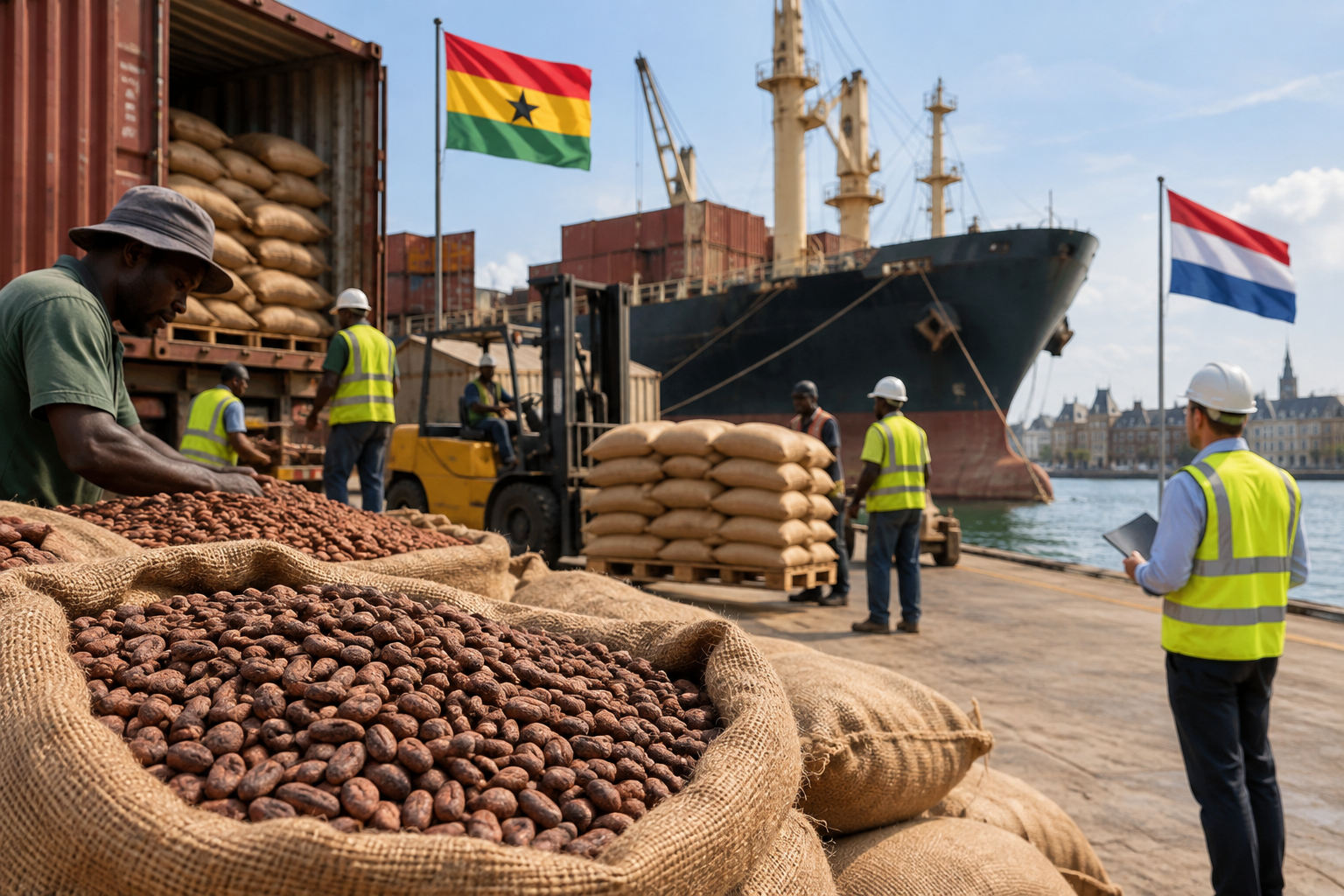
Finding reliable cocoa bean suppliers in Ghana requires more than comparing prices and photographs. Dutch importers and chocolate manufacturers need to connect the seller’s commercial role and export arrangements with a specific lot, measurable quality specifications and usable traceability records. An attractive offer is not necessarily an export-ready cargo.
This guide focuses on buying cocoa beans—not powder, butter or finished chocolate. Use it to qualify counterparties, request comparable quotations and control the journey from Ghana to your receiving warehouse in the Netherlands.
Define the cocoa beans you actually need
Start with the processing application. Beans intended for industrial chocolate production may need a different sensory profile and operating tolerance from beans intended for specialty chocolate or cocoa liquor production.
State whether you require whole, fermented and dried, unroasted cocoa beans. Do not assume that a listing labelled raw, premium or organic defines fermentation, grade or suitability for your process.
Your purchase brief should include:
- Intended use: chocolate, cocoa liquor, pressing feedstock or another bean-processing application.
- Quality target: standard commercial profile or a defined sensory specification.
- Volume: trial quantity, shipment quantity and expected repeat demand.
- Supply period: required dispatch window and production deadline.
- Delivery point: Rotterdam terminal, another named location or your Dutch warehouse.
- Commercial constraints: budget basis, payment conditions and required certifications.
For bulk cocoa beans from Ghana, ask suppliers to propose a loading plan rather than assuming a universal container payload. Packaging, equipment, permitted weights and route constraints affect the shipment configuration.
Qualify cocoa bean suppliers in Ghana by role and authority
Ghana’s cocoa sector has a regulated purchasing and export structure. The Ghana Cocoa Board, commonly known as COCOBOD, and Cocoa Marketing Company (Ghana) Limited are central to that framework. A business involved in domestic buying or aggregation should not automatically be treated as authorised to contract and ship export cargoes.
Identify who is actually selling
Ask whether the advertiser is a farmer organisation, licensed buying company, broker, exporter or international trading company. Establish which legal entity will sign the contract, receive payment, provide the beans and appear on shipment documents.
A broker can facilitate a legitimate transaction, but should clearly identify its mandate and the principal responsible for delivery. Likewise, a trading company may supply Ghana-origin beans without being the original domestic buyer.
Verify the proposed export route
When screening prospective exporters and trading counterparties, request:
- Legal business name, registered address and registration details.
- An explanation of the entity’s role in Ghana’s cocoa supply chain.
- Evidence of the authority or contractual arrangements supporting the proposed export.
- Confirmation of the contracting seller, exporter of record and payment beneficiary.
- Trade references and redacted transaction records where available.
Confirm relevant documents through independently obtained contact details and appropriate Ghanaian authorities or issuing organisations. Registration alone does not establish export authority, stock ownership or financial reliability.
Pause if the seller refuses to explain its supply route, requests payment to an unrelated beneficiary or cannot connect its offer to identifiable stock or a documented forward supply arrangement.
Write an RFQ that makes bulk offers comparable
A request for quotation should turn marketing descriptions into measurable obligations. Send the same specification to each shortlisted seller, including those offering specialty fermentation or sensory profiles.
Product and quality specification
Include these fields in your RFQ:
- Origin and lot: Ghana origin, available lot identifiers and sourcing detail.
- Crop information: crop period and whether beans are existing stock or future supply.
- Bean count: required range, measurement basis and test method.
- Moisture: contractual limit, measurement method and inspection point.
- Fermentation: assessment method and acceptable cut-test results.
- Defects: tolerances for mouldy, slaty, insect-damaged, germinated and broken beans, plus foreign matter.
- Sensory requirements: desired profile and unacceptable smoky, musty or other off-notes.
- Packaging: bag material, net weight, markings and any liners.
- Certification: named scheme, required scope and supporting transaction records where relevant.
Specify how every percentage is calculated. A defect limit is ambiguous if one party uses bean count and another uses mass. Agree how overlapping defects will be recorded and assessed.
Commercial quotation fields
Request currency, price per net unit, minimum order, quantity tolerance, shipment window, quotation validity and payment terms. Require the named Incoterms rule, its version and the exact named port or place.
For wholesale purchases, clarify whether pricing is fixed or linked to an agreed market reference. Any differential, fixation process and adjustment mechanism should be explicit before commitment.
Evaluate representative lot samples
A carefully selected sample can demonstrate potential quality without representing the cargo you will receive. Ask who collected it, from which lots, using what sampling procedure and on what date.
For existing stock, link the sample to identifiable bags or storage lots. For forward contracts, treat an early sample as indicative and require later approval or verification against the actual shipment lot.
Combine physical, sensory and laboratory checks
Use a documented cut test to assess fermentation indicators and internal defects. Check moisture, bean size consistency, foreign material and odour using agreed methods.
Run a processing trial appropriate to your intended use. Evaluate roast response, flavour development and any persistent off-notes. Attractive bean appearance does not establish chocolate performance.
Build a risk-based testing plan with a competent laboratory. Depending on the product and supply chain, this may include pesticide residues, relevant contaminants and microbiological parameters. Ask the laboratory to distinguish legal requirements from buyer specifications and downstream product requirements.
For example, cadmium limits applicable to certain finished cocoa and chocolate products should not be presented as an identical universal limit for raw cocoa beans. Your bean purchasing specification should support compliance in the intended finished product.
Agree pass/fail criteria before testing, and retain sealed reference samples with documented custody for potential disputes.
Request lot-level origin and traceability records
Buyers planning to import cocoa beans into the Netherlands should assess compliance readiness before reserving production capacity or paying a deposit.
EU food-safety, traceability and deforestation-related requirements must be evaluated for the actual product, transaction, operator and applicable implementation timetable. Confirm current obligations through official EU and Dutch guidance and qualified advisers rather than relying on a supplier’s claim that a cargo is EU compliant.
Traceability checklist
Ask the supplier to demonstrate the link between:
- Producer groups or farms and the relevant production locations.
- Purchase, aggregation and storage records.
- Lot creation, splitting and mixing events.
- Bag markings, shipping lots and commercial documents.
- Supporting legality and due-diligence information where required.
For deforestation-related due diligence, establish whether the necessary plot geolocation, production-period and supply-chain information can be provided in a usable format. Check how records remain connected to the beans after aggregation. Collecting information alone does not complete any required risk assessment, mitigation or due-diligence submission.
Certification can support a sourcing programme, but it does not automatically replace statutory due diligence or prove that every offered lot meets your requirements. Confirm certificate validity, scope, chain-of-custody arrangements and coverage of the proposed supply.
Reject generic traceability presentations as a substitute for records tied to the proposed supply.
Compare landed costs through Rotterdam
The cheapest quoted tonne may not be the cheapest usable tonne at your factory. Compare offers on the same quantity, quality, delivery and timing assumptions.
Build a landed-cost worksheet covering:
- Cocoa bean purchase price.
- Origin handling and export charges allocated to the buyer.
- Ocean freight and cargo insurance.
- Destination terminal, release and handling charges.
- Customs brokerage, any applicable duty and import VAT treatment.
- Sampling, inspection and laboratory testing.
- Inland transport, storage and financing.
- Potential demurrage, detention and quality-related losses.
Confirm customs classification, required origin documentation and tax treatment with your customs representative. Distinguish recoverable import VAT and its cash-flow impact from non-recoverable costs, and avoid double-counting charges already included in the seller’s price.
Separate cost allocation from risk transfer
Under CIF, the seller pays for carriage and the required insurance to the named destination port, but risk transfers when the goods are loaded on board at the port of shipment. CIF is not a guarantee of arrival condition or an all-inclusive delivered price, and its default insurance requirement may not cover every relevant risk.
For container shipments, discuss whether FCA better reflects the actual handover than FOB. Whatever rule you choose, document insurance coverage, exclusions, deductibles, claims responsibilities and destination charges.
Assess usable yield as well as purchase price. Excess moisture, high shell content, foreign matter or rejected beans can erode an apparently favourable quotation.
Agree shipment and arrival controls before signing
The contract should connect the approved specification to the shipped cargo and define what happens when results differ.
Include:
- Sampling rights: who may sample, where and under which procedure.
- Inspection basis: pre-shipment, arrival or both, with their contractual status.
- Lot identification: consistent references across bags, samples and documents.
- Moisture protection: dry containers, suitable packaging and an agreed condensation-control plan.
- Transport suitability: checks for odours, contamination, damage and pest evidence.
- Document requirements: invoice, packing list, transport documents and other applicable certificates.
- Claims procedure: notice deadlines, evidence, independent testing and remedies.
At receipt, inspect container condition and seals before unloading. Record damaged or wet bags, preserve photographs and isolate suspect stock.
Do not leave dispute handling to informal messages after discharge. Agree how conflicting laboratory results will be resolved and whether rejection, replacement or a price adjustment is available. Distinguish claims for contractual non-conformity from transport damage and insurance claims.
Frequently asked questions
Can Dutch buyers purchase directly from Ghanaian cocoa farmers?
Direct sourcing relationships may be possible, but they do not bypass Ghana’s regulated cocoa purchasing and export arrangements. Confirm which authorised parties will contract, assemble and export the cargo before paying.
What should a bulk cocoa bean quotation include?
Require origin, crop information, quantity, quality specification, packaging, shipment window, price basis, payment terms and a named Incoterms rule with its version and port or place. Request supporting export-route and traceability information alongside the quotation.
Is a supplier sample enough to approve an order?
No. Establish whether it represents the contracted lot, then agree sampling, testing and acceptance criteria. Forward supply usually needs later verification against the beans prepared for shipment.
Does certification guarantee EU compliance?
No. Certification may support verification, but buyers must assess applicable legal obligations separately. Check lot-level traceability, required due-diligence information and food-safety suitability for the intended use.
Source or list cocoa beans on IMEX Center
Start with a precise buying brief, not a generic request for the lowest price. Use IMEX Center to explore sourcing opportunities and discuss cocoa bean specifications, commercial terms and supporting records with potential counterparties.
Supplying Ghana-origin beans? List your offer with a clear seller role, quality specification, shipment basis and traceability scope so Dutch buyers can assess its fit. Complete independent counterparty and cargo checks before committing funds.
Source or sell globally with IMEX Center
Browse verified suppliers →