
Import & Export
Container port traffic — Top 30 of 40 major trading economies (2024)
09 Nov 2026 · 06:03 CET
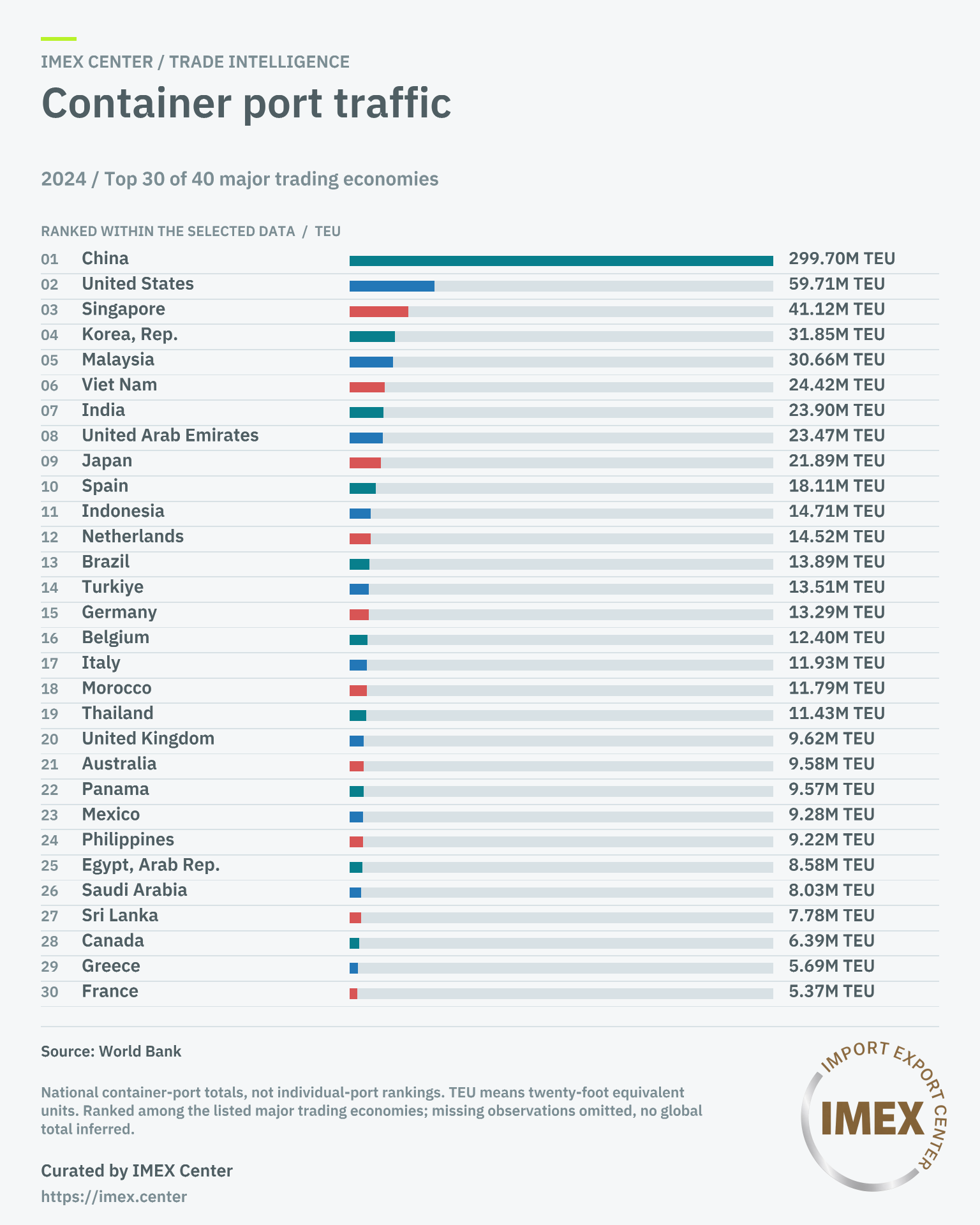
Container port traffic — Top 30 of 40 major trading economies (2024)
2024 · Top 30 of 40 major trading economies · Container port traffic: China 299.70M TEU; United States 59.71M TEU; Singapore 41.12M TEU.
| Rank | Top 30 of 40 major trading economies | TEU |
|---|---|---|
| 1 | China | 299,703,800 |
| 2 | United States | 59,707,490 |
| 3 | Singapore | 41,124,100 |
| 4 | Korea, Rep. | 31,850,924 |
| 5 | Malaysia | 30,659,850 |
| 6 | Viet Nam | 24,423,183 |
| 7 | India | 23,898,000 |
| 8 | United Arab Emirates | 23,466,906 |
| 9 | Japan | 21,886,683 |
| 10 | Spain | 18,114,517 |
| 11 | Indonesia | 14,709,550 |
| 12 | Netherlands | 14,517,179 |
| 13 | Brazil | 13,893,906 |
| 14 | Turkiye | 13,507,070 |
| 15 | Germany | 13,294,081 |
| 16 | Belgium | 12,395,047 |
| 17 | Italy | 11,927,016 |
| 18 | Morocco | 11,789,130 |
| 19 | Thailand | 11,432,626 |
| 20 | United Kingdom | 9,621,469 |
| 21 | Australia | 9,579,396 |
| 22 | Panama | 9,570,767 |
| 23 | Mexico | 9,284,170 |
| 24 | Philippines | 9,216,842 |
| 25 | Egypt, Arab Rep. | 8,581,339 |
| 26 | Saudi Arabia | 8,029,571 |
| 27 | Sri Lanka | 7,782,776 |
| 28 | Canada | 6,394,038 |
| 29 | Greece | 5,691,448 |
| 30 | France | 5,371,045 |
National container-port totals, not individual-port rankings. TEU means twenty-foot equivalent units. Ranked among the listed major trading economies; missing observations omitted, no global total inferred.
Curated by IMEX Center. Original sources:
The cheapest freight quote is not necessarily the cheapest shipment. An attractive ocean rate can leave destination handling, customs work and final delivery outside the price—and leave your team responsible for closing the gaps after the container arrives.
Container freight forwarder selection should therefore begin with a delivery requirement, not a headline rate. For importers and sourcing managers, the challenge is to make competing offers describe the same service. A terminal-only quote and a door-delivery quote are different proposals, even when they cover the same container and sailing.
This guide explains how to build a shipment brief, test destination arrangements and compare providers using a practical bid matrix. Historical World Bank container-port observations provide context, but the award decision belongs to shipment-specific evidence: who will move the cargo, under what conditions, at what cost and with what responsibility when something changes.
What container-port statistics can—and cannot—tell you
Historical national container-port traffic: 2024 examples
The World Bank indicator IS.SHP.GOOD.TU measures container port traffic, expressed in TEU, or twenty-foot equivalent units. TEU is a capacity-equivalent unit, not a count of identical physical containers. National container-port traffic describes handling scale; it does not measure the performance of a particular forwarder.
The supplied official-source observations record the following national totals for 2024:
- China: 299,703,800 TEU.
- Singapore: 41,124,100 TEU.
- Germany: 13,294,081 TEU.
These are selected examples, not a ranking. Their cargo scope is containers; no commodity HS-code breakdown is supplied. They are national figures, not individual-port totals or measurements of traffic between these economies.
Source: World Bank, container port traffic, indicator IS.SHP.GOOD.TU. Figures above reproduce the supplied country observations. Missing observations are not treated as zero, and no global total is inferred. Curated by IMEX Center denotes editorial curation, not independent certification.
The evidence provided supports these individual observations, but it does not include the complete response needed to independently reconcile the broader selection’s ranking completeness. No claim about that ranking is made here.
For procurement, the important boundary is simple: a large national total cannot establish available vessel space, equipment availability, customs speed, current congestion or the quality of a proposed local agent. These observations also do not establish growth, market share, freight prices or transit commitments. Use them to understand national handling scale—not to score a bidder.
Start container freight forwarder selection with a shipment mandate
Before asking providers to quote, define successful delivery. Your purchasing team should own the enquiry, the supplier should confirm cargo details, and the receiving team should confirm delivery constraints before it goes out.
A useful shipment mandate includes:
- Locations: exact collection address, proposed loading port, destination port and final delivery address.
- Cargo: plain-language description, intended use where relevant, packaging, dimensions and gross weight. Identify dangerous goods, temperature control or other special handling requirements explicitly.
- Equipment: container type, quantity, loading arrangement and any special equipment needs. State whether the enquiry is for full-container or less-than-container service.
- Timing: cargo-ready date, acceptable shipment window, required delivery window and flexibility.
- Commercial scope: the sales delivery term, its named place or port, and the separate services requested from the forwarder.
- Customs: who provides cargo information, who arranges declarations, who acts as importer of record and who appoints the customs representative.
- Delivery conditions: access restrictions, appointments, unloading responsibility and empty-container return arrangements.
- Quotation rules: document reference, issue date, response deadline, currency, quote validity, payment terms and required breakdown of charges.
- Contacts: the authorised procurement contact and the people responsible for cargo, documents and destination receipt.
Do not substitute a general product description for information a carrier needs to accept the cargo. If acceptance depends on technical documentation, the supplier should provide it before the bidder confirms suitability. Keep unresolved requirements visible rather than assuming they will be settled after booking.
Separate the sales contract from the forwarding scope
Specify the applicable Incoterms 2020 rule and named place or port in the sales arrangements. Incoterms allocate delivery responsibilities, risk and costs; they do not determine payment terms or ownership. The forwarder’s service agreement must separately explain which activities it will perform and for whom.
For example, a seller-paid freight arrangement does not automatically mean the seller bears transit risk until arrival. Under CFR and CIF, risk passes when the goods are on board at loading, although the seller pays freight to the named destination port. CIF also requires insurance. Neither term alone establishes a door-delivery service.
Ask every bidder to complete the same scope schedule. Alternatives are welcome, but bidders should price and explain them separately rather than silently changing the requirement.
Make the freight enquiry destination-specific
Container shipping from China to Germany
An enquiry for container shipping from China to Germany needs more than country names. State the supplier’s collection address and the German delivery location, then require each bidder to identify its proposed origin and destination terminals.
Ask whether the service is direct or involves transshipment, which parties handle each leg and how inland transport connects with the receiving appointment. Require an explanation of customs representation and the documents the importer must supply. Do not assume the destination terminal and the customs-clearance location are necessarily the same.
The receiving team should confirm access, unloading capability and appointment procedures before final pricing. If the delivery site cannot accept the proposed equipment or arrival window, the apparently competitive route may not meet the actual requirement.
A port-to-port proposal is not comparable with a door-delivery proposal until the missing services and charges are identified. The buyer’s logistics lead should resolve those differences before commercial scoring.
Container shipping from India to the UAE
For container shipping from India to the UAE, specify the collection point, proposed discharge terminal and exact receiving location. Explain whether delivery is to a warehouse, project site or free-zone facility, so the bidder can identify the relevant procedures and service boundaries.
Require the destination agent’s legal identity and contact details. Ask who coordinates cargo release, clearance, delivery access and empty return. A statement that local charges apply is not an adequate destination-cost schedule.
The importer or its appointed customs representative should confirm the relevant clearance requirements before booking. The forwarder should explain how its proposal fits those requirements, including any movement between the discharge terminal and the receiving facility.
These are illustrative tender scenarios, not measured trade corridors. The national observations above do not establish bilateral volumes, service frequency, current prices or routing quality for either country pair.
Use a freight-provider bid evaluation matrix
Strong freight forwarder tender requirements separate essential eligibility from commercial preference. A low price should not compensate for unconfirmed cargo acceptance, an unidentified contracting entity or an unexplained destination handover.
Use the following matrix for each bidder. Alongside the evidence, record any unresolved question, the responsible reviewer and the clarification deadline.
| Evaluation area | Evidence to require | Decision rule |
|---|---|---|
| Legal identity and role | Contracting entity, registration, signatory authority, applicable licences and whether acting as agent or principal | Mark unknown parties pending verification; resolve identity and responsibility before commitment |
| Terminal coverage | Named origin and destination terminals, operating parties and local agents | Do not accept generic country coverage as proof of shipment capability |
| Cargo capability | Written acceptance of cargo, equipment and handling requirements, including exclusions | Do not award while essential acceptance conditions remain unresolved |
| Booking and routing | Proposed carrier, route, schedule assumptions, validity and booking status | Distinguish an indicative offer from confirmed arrangements |
| Destination charges | Itemised charges, currencies, charging basis and third-party costs | Resolve material omissions or agree a transparent treatment of contingent costs |
| Free time and equipment return | Allowances, start events, calendar basis, applicable tariffs and return location | Compare exposure under the same delivery assumptions |
| Inland delivery | Transport scope, appointments, unloading boundaries and subcontractor responsibilities | Confirm the service reaches the required delivery point |
| Customs and documents | Responsible parties, document checklist and submission deadlines | Close responsibility gaps before cargo handover |
| Insurance and liability | Applicable liability terms and any separately quoted cargo cover | Do not equate forwarding liability with cargo insurance |
| Exception management | Named operational and escalation contacts, notification process and cost-approval procedure | Require an executable response process, not only a sales contact |
Agree the evaluation method internally before opening commercial offers. Mandatory conditions should be clear; preferences such as reporting format or optional routing flexibility can be assessed separately. National traffic totals do not belong in the provider-performance score.
Evidence requirements should also match the procurement stage. At quotation, ask for transparent availability assumptions and acceptance conditions. Before cargo handover, require the agreed booking evidence and reconfirm equipment, routing and cut-offs. A booking confirmation is important operational evidence, but it does not eliminate the possibility of subsequent schedule changes.
Compare container freight forwarding quotes on equal terms
Normalise scope before comparing totals. Ask each bidder to label firm charges, estimates, pass-through costs and exclusions. For variable items, require the charging basis, applicable tariff or calculation method, and the approval process where appropriate.
The comparison should cover collection, export handling, ocean transport, destination handling, customs services where requested and inland delivery. Include separately requested inspection or insurance without implying that these services are automatically part of a freight quote. Identify duties and taxes separately.
Finance should review payment timing and currency exposure before award. If offers use different currencies, use an internally agreed comparison basis and date; do not disguise exchange-rate assumptions as provider pricing. Also ask what happens if the sailing moves beyond the quotation’s validity.
Test the destination bill
Ask every bidder: What could be invoiced after arrival that is not included in this quote?
Require a written response covering applicable terminal, documentation, storage, equipment-use, examination and delivery-related charges. Not every item applies to every shipment. The bidder should distinguish known costs from charges triggered by an event, such as an inspection or a failed delivery appointment.
Free time needs particular attention. Ask how demurrage, detention and storage are defined in the proposed arrangement, when charging begins, whether allowances are separate or combined, and which tariff applies. Terminology and arrangements can differ; compare the actual conditions rather than the labels alone.
Some external charges cannot be fixed in advance. The answer is not to demand an unrealistic all-inclusive promise, but to identify the trigger, calculation basis, responsible payer and supporting evidence required for invoicing.
Test the exception plan
Ask how the bidder would handle a missed sailing, unavailable equipment, a customs query or a rejected delivery appointment. Require the notification channel, escalation owner, proposed response commitments and cost-authorisation procedure.
For international container shipping services, accountability matters as much as geographic reach. Identify who coordinates recovery when a carrier, terminal or subcontractor causes disruption. Keep that coordination duty distinct from legal liability: the party managing the response is not automatically liable for every resulting loss.
The procurement owner should issue a consolidated clarification round before award. The selected provider should then return a final scope incorporating its answers, so operational staff do not have to reconstruct commitments from scattered messages.
Carry the tender decision into shipment execution
A well-run tender still needs an operational handover. Before cargo release, the logistics lead should confirm that the selected quotation, agreed service scope, booking details and document responsibilities are consistent.
Assign responsibility for shipping instructions, verified gross mass where applicable, transport-document review and submission deadlines. Confirm who checks consignee details and who authorises changes. A correct freight rate cannot compensate for release instructions that prevent the receiving party from obtaining the cargo.
The importer should confirm customs readiness before arrival. The receiving team should reconfirm the delivery appointment, unloading arrangements and empty-return responsibilities before the inland leg is dispatched.
After delivery, procurement and finance should reconcile the invoice against the accepted scope and supporting records. Separate legitimate event-driven costs from unexplained additions. Record the reason for each material variance and ask the forwarder to address recurring problems before the next booking. This turns a completed shipment into useful evidence for future selection.
Frequently asked questions
Does high national container traffic identify the best forwarder?
No. National traffic measures handling scale, not a particular company’s capability. Select against shipment-specific evidence: terminal coverage, cargo acceptance, destination arrangements, charges and accountable contacts.
What should a comparable freight quote include?
It should identify shipment scope, equipment, routing assumptions, included and excluded charges, currency, payment terms, validity, free-time conditions and delivery responsibilities. Estimates and conditional charges should be labelled, with their calculation basis explained.
Can these statistics show current capacity on China–Germany or India–UAE shipments?
No. The cited observations cover national container-port traffic in 2024. They do not measure those bilateral corridors or establish current vessel space, equipment availability, freight prices or transit commitments.
Should the lowest-priced forwarder win?
Only if the offer meets essential requirements and remains competitive after scope differences and conditional costs are addressed. An incomplete quote is not a cheaper version of a complete service; it is an unresolved proposal.
Prepare your next logistics enquiry with IMEX Center
For importers and sourcing managers, the next step is a shipment mandate your team can approve and providers can price consistently. Prepare the cargo details, destination requirements, charge schedule and evaluation matrix before inviting offers. Register at IMEX Center with the appropriate account type for your intended activity.
For exporters, confirm which transport responsibilities belong to your business before promising a delivered price or arrival window. Give the logistics provider the same cargo and timing information used in your customer proposal, and make conditional arrangements explicit.
For freight forwarders and other service providers, prepare a response that names the contracting entity, defines service boundaries and identifies destination partners. Explain exclusions plainly and provide shipment-specific evidence instead of relying on broad claims of worldwide coverage.
Formal RFQs and business pre-contracts require an eligible business account. Individual accounts are limited to publishing and managing service offerings after the required verification and an IMEX Score of at least 20; they cannot list goods, bid on tenders, create formal RFQs or execute business pre-contracts. Registration or a profile does not by itself establish shipment capability, insurance cover or regulatory authorisation.
Bring a defined delivery requirement rather than a request for the cheapest rate. Your providers will have a clearer basis to respond, and your team will have a stronger basis to award.
Register at IMEX Center to start preparing your trade or logistics enquiry.
Source or sell globally with IMEX Center
Browse verified suppliers →