International Trade
Direct Shipping vs Transshipment: Choose the Route Before You Sign the Purchase Order
03 Oct 2026 · 08:02 CET
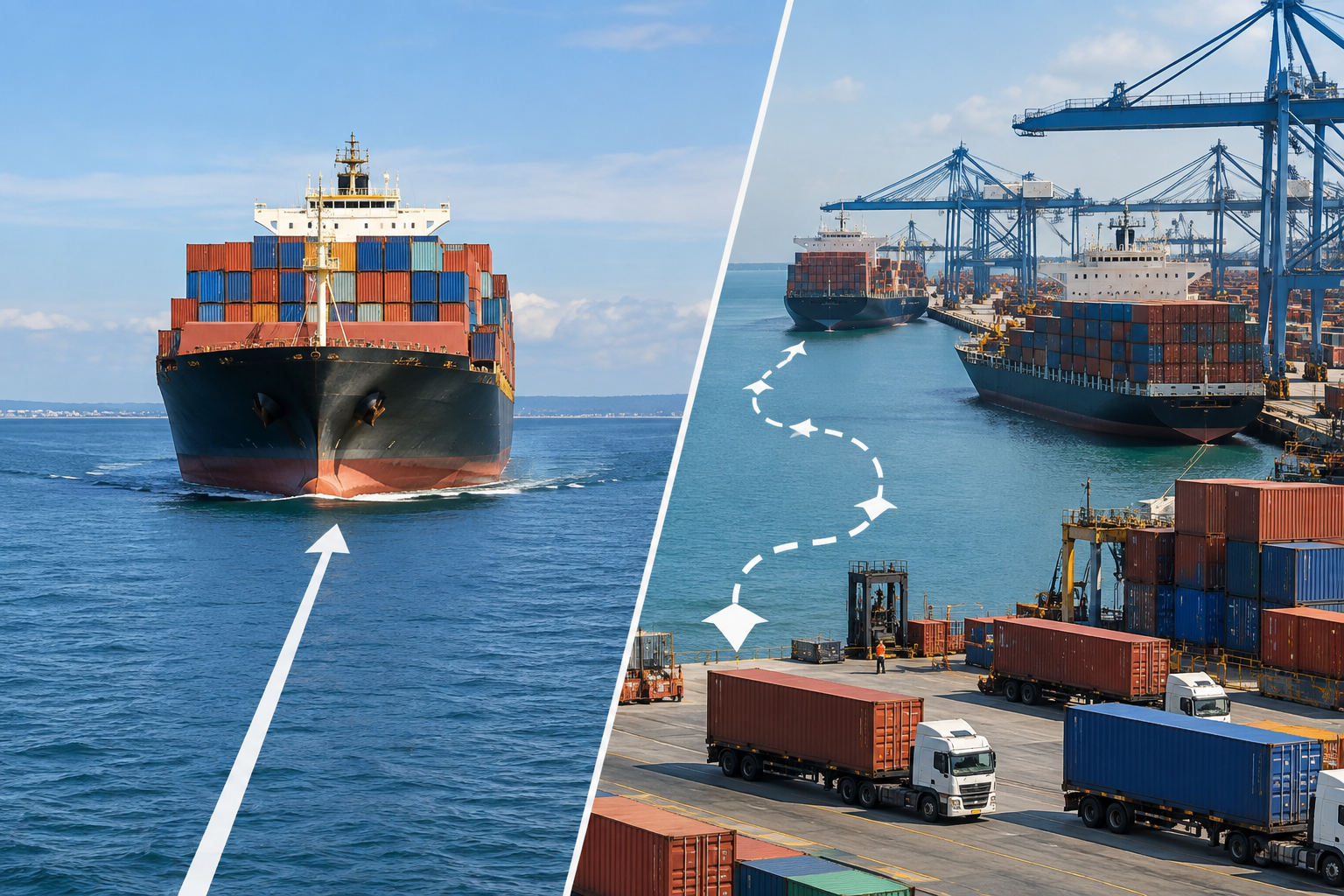
Choosing between direct shipping and transshipment is a commercial decision, not simply a freight-forwarding preference. The route can affect your supplier commitment, inventory exposure and ability to meet a customer’s required delivery window. Agree the routing requirements before signing the purchase order, then confirm a suitable service when booking.
A direct service is not automatically faster or cheaper. A hub-based route may offer an earlier departure, a better destination gateway or more practical inland connections. A useful shipping route comparison follows the cargo from its actual origin to the buyer’s receiving location.
Direct shipping vs transshipment: what actually changes?
In container shipping, a direct service generally carries your container from the loading port to the discharge port on the same vessel. It may call at intermediate ports. Direct does not necessarily mean nonstop. Here, direct shipping refers to the vessel routing, not to a supplier shipping directly to a customer.
Transshipment involves transferring the container between vessels at an intermediate port. A shipment might move on a mainline vessel to a regional hub, then connect to a feeder vessel serving the destination.
An intermediate port call is therefore not, by itself, transshipment. Ask whether the container changes vessels and where. Also distinguish vessel transfers from cargo consolidation: a less-than-container-load (LCL) shipment can involve additional warehouse handling that a vessel itinerary alone does not reveal.
When comparing direct and transshipment services, obtain the proposed itinerary. A through bill of lading or a single freight quote does not prove that the cargo remains on one vessel.
Start with the buyer’s delivery window
Work backwards from when the goods must be available at the final receiving point. A vessel’s estimated arrival is not the same as customs release, terminal availability or warehouse delivery.
The distinction between port-to-port and door-to-door transit time matters because a shorter sea passage can still produce a later delivery if the discharge port has less suitable inland connections.
Before requesting quotes, define:
- Receiving location: full address, unloading capability and appointment requirements.
- Delivery window: earliest acceptable delivery and latest usable arrival.
- Cargo-ready date: when packed goods and required export documents will be available.
- Cargo constraints: dimensions, weight, dangerous-goods status, temperature needs and handling limits.
- Commercial consequence: what a late delivery means for production, resale or stock availability.
Separate a firm business deadline from a preferred target. That distinction helps determine whether a lower-cost route with more connection exposure is acceptable.
Request comparable route quotes
Ask each supplier or forwarder to quote against the same cargo details, readiness date and delivery scope. Comparing port-to-port freight with a door-delivery offer creates a misleading price difference.
Route and schedule checklist
Request the following in writing:
- Proposed loading and discharge ports, plus terminals where known.
- Carrier, service name and proposed vessel itinerary.
- Every planned transfer hub and connecting service.
- Applicable cargo and documentation cut-offs, departure date, connection window and estimated arrival.
- Sailing frequency for each leg.
- Origin collection, destination handling and inland delivery arrangements.
- Included charges, exclusions, quote validity and booking conditions.
- Assumptions about equipment, space and cargo acceptance.
Ask whether the itinerary is indicative or confirmed, and what changes remain possible. A schedule shown during quotation should not be treated as an unconditional delivery guarantee.
Use one defined start and finish point for both offers. For example, compare cargo-ready-to-warehouse timelines rather than pairing one carrier’s sea transit estimate with another forwarder’s complete delivery estimate.
Assess connection risk, not just advertised transit
Key transshipment risks arise from dependencies between services. The first vessel must arrive, the container must become available for transfer, and the onward service must have space and accept the cargo.
Questions that expose connection weakness
Ask how much time is planned between arrival and onward departure. Is that allowance operationally realistic for the terminal and cargo, or does the quote assume a tight connection?
Then ask what happens if the connection is missed. A route with frequent onward departures may be more recoverable than one dependent on an infrequent feeder. Check alternatives rather than assuming the next sailing has space.
For sensitive cargo, confirm arrangements for temperature control, dangerous-goods acceptance, oversized equipment or other handling needs at the hub. Each transfer adds an operational interface, although this does not mean damage or delay is inevitable.
Direct services still carry risks: late departures, omitted calls, congestion and service changes can affect them too. Evaluate the proposed service, not just its label.
A useful decision question is: If the first plan fails, what recovery options could still meet the buyer’s latest acceptable delivery date?
Compare total delivery cost and delay exposure
Ocean freight is only one line in the total delivery-cost calculation. Request itemised costs through the agreed delivery point and identify who pays each item under the sale and transport arrangements.
Include:
- Origin collection, export handling and documentation.
- Ocean freight and applicable surcharges.
- Transfer-related charges not included in the freight rate.
- Destination terminal, release and brokerage charges.
- Inland transport, appointments and unloading costs where applicable.
- Cargo insurance costs, where applicable.
- Potential storage, demurrage, detention and equipment-related exposure.
- Inventory carrying cost and the business impact of delayed availability.
If comparing full landed cost, also account for applicable duties and taxes, including any routing-related effect on preferential tariff eligibility.
Clarify free-time allowances and when the relevant clocks start. Charge definitions and responsibility can vary by contract and location; do not treat storage, demurrage and detention as interchangeable.
For internal evaluation, compare a base case with a disruption case, such as a missed connection or delayed terminal release. Use quoted tariffs and your own inventory assumptions. If reliable probabilities are unavailable, show a scenario range rather than inventing an expected delay cost.
A higher ocean rate can still produce a lower overall cost if it improves inland access or reduces costly delivery uncertainty. The reverse can also be true.
Check cargo restrictions, customs and origin evidence
Routing can affect more than transit time. Before booking, ask the carrier and relevant customs adviser whether the proposed transit locations introduce cargo restrictions, permits, documentation requirements or special handling conditions.
For preferential tariff treatment, confirm the requirements of the specific trade agreement and importing jurisdiction. Transit through another country does not automatically remove eligibility, but applicable rules may require evidence about customs control, non-alteration or permitted operations during transit.
Ask which transport records, customs records or other evidence should be retained. Do not assume that a certificate of origin alone resolves every transit-related question.
Where relevant, also check sanctions and other restrictions affecting the goods, parties, vessels and routing. Resolve uncertainty before approving a hub rather than expecting destination clearance to fix a documentation gap.
Translate the route into purchase-order and booking instructions
Route selection should connect the sales agreement with the freight booking. Incoterms rules allocate specified obligations, costs and risks, but they do not replace a detailed delivery schedule or routing agreement. Delivery and risk transfer under the chosen rule may occur before the goods reach the buyer’s receiving location.
State the chosen rule, the precise named place or port, and the applicable version—for example, “Incoterms® 2020” when that is the version agreed. Make sure the transport scope and routing authority are consistent with the chosen rule.
Purchase-order checklist
Record:
- Required delivery window and the milestone used to measure it.
- Agreed ports and whether vessel transfers are permitted.
- Approved hubs or any route restrictions.
- Who books freight and who approves material substitutions.
- Cargo-specific handling and documentation requirements.
- Who must report delays, to whom, and within what agreed timeframe.
- How additional costs and recovery options will be reviewed.
Mirror these requirements in booking instructions. A purchase-order clause does not automatically bind a carrier that has not accepted it, and carrier terms may permit routing changes.
Where commercially important, make shipment release conditional on an acceptable booking confirmation. Agree escalation procedures for changes without assuming the seller can control every carrier decision.
Use a route-comparison worksheet before booking
To choose an international shipping route, use a shared worksheet rather than separate email summaries.
| Decision field | Direct-service offer | Hub-based offer | |---|---|---| | Full itinerary | Ports and intermediate calls | Ports, hubs and vessel transfers | | Delivery timeline | Ready date through final delivery | Same start and finish points | | Recovery options | Alternative sailings and gateways | Next connections and alternate hubs | | Cargo suitability | Equipment and handling acceptance | Acceptance across every leg | | Total quoted cost | Included and excluded charges | Same scope and assumptions | | Disruption exposure | Delay costs and operational impact | Missed-connection costs and impact | | Documentation | Required transport and customs records | Additional transit evidence, if needed | | Approval status | Preferred, fallback or rejected | Preferred, fallback or rejected |
First eliminate options that cannot reasonably meet non-negotiable cargo, compliance or delivery requirements. Then compare viable routes on total cost and recovery capability. Treat estimated schedules as planning inputs, not guarantees.
Choose a preferred service and, where available, an acceptable fallback before booking. Record when the fallback may be used, whose approval is needed and which changes require a fresh commercial decision. If no workable fallback exists, make that exposure explicit.
FAQ
Is direct shipping always faster than transshipment?
No. Departure timing, intermediate calls, destination handling and inland transport all matter. A hub-based service can deliver earlier if its complete schedule better matches cargo readiness and the final destination.
Does a direct service avoid intermediate ports?
Not necessarily. Direct generally means the container stays on the same vessel between loading and discharge. That vessel may call at other ports along the way.
What is the biggest transshipment risk to check?
Missed-connection exposure is a key risk to assess: check the transfer buffer, onward sailing frequency, cargo acceptance and recovery capacity. Its commercial importance depends on the buyer’s delivery window and the cost of delay; sensitive cargo may also have critical handling risks.
Should routing requirements appear in the purchase order?
Yes, where they matter to the deal. Specify permitted routing, delivery milestones, substitution approval and notification responsibilities, then align those terms with the booking party’s transport instructions.
Make routing part of your next B2B deal
A sound route decision connects supplier readiness, transport execution and the buyer’s receiving needs. Agree the delivery assumptions and routing requirements before committing, then validate them against available services when booking.
Ready to build clearer trade discussions? Explore IMEX Center, and bring your route-comparison checklist into the next supplier or buyer negotiation.
Source or sell globally with IMEX Center
Browse verified suppliers →