Import & Export
Green Coffee Bean Suppliers in Brazil: Bulk Sourcing for German Roasters
27 Oct 2026 · 06:02 CET
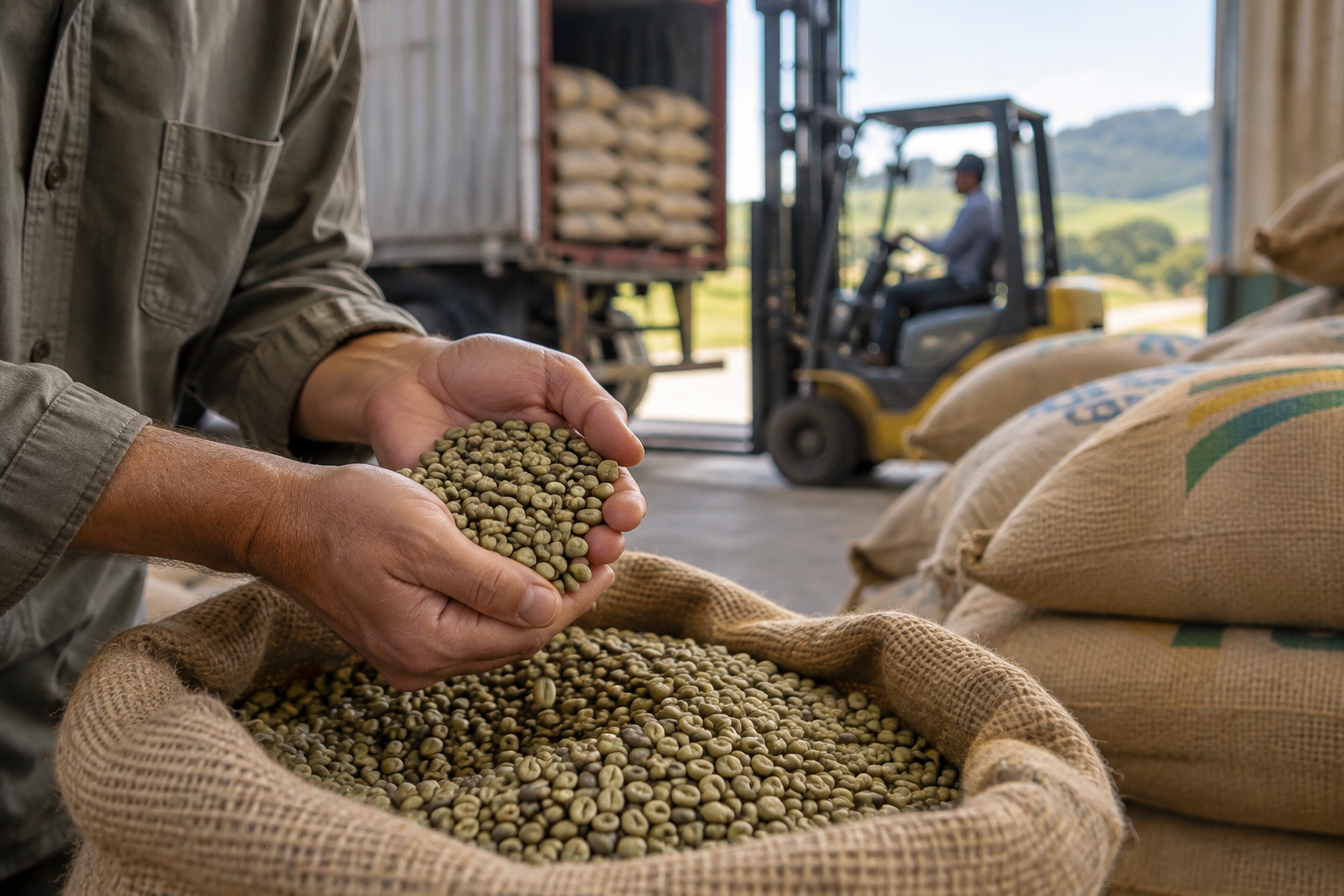
For German roasters sourcing green coffee beans from Brazil, the strongest offer is not necessarily the lowest price per green kilogram. It is the offer that matches the intended cup profile, carries verifiable lot evidence and arrives under workable commercial terms. This guide explains how to turn a roasting requirement into a sourcing specification and purchase decision.
Define the coffee before choosing the supplier
Start with the product the roasting team needs to make. A single-origin filter coffee, an espresso blend base and a cost-sensitive commercial blend require different purchasing decisions.
Arabica or Conilon?
Arabica and Conilon are not interchangeable descriptions. Conilon belongs to Coffea canephora, the species commonly traded under the broader Robusta designation. Request the declared species and commercial type rather than accepting “Brazilian coffee” as a sufficient specification.
For bulk Brazilian Arabica offers, assess sweetness, acidity, body and suitability for the intended roast. For Conilon offers, assess the same sensory dimensions against its proposed blend role. Neither species alone establishes quality or suitability.
Write a purchase brief
The head roaster and procurement lead should agree these points before requesting prices:
- Species, commercial type and intended blend role.
- Target sensory profile and unacceptable taints or defects.
- Origin, regional traceability and crop year or harvest period.
- Processing method, such as natural or pulped natural.
- Trial quantity, repeat-order expectations and delivery window.
- Packaging, bag weight, liner requirements and storage constraints.
Keep essential requirements separate from preferences. This lets suppliers propose alternatives without obscuring deviations.
How to compare green coffee bean suppliers in Brazil
A useful shortlist distinguishes who controls the coffee, who sells it and who handles export execution. This guide does not present any business as a verified supplier.
Producer cooperatives may consolidate member production and offer different levels of lot traceability. Confirm whether the cooperative exports directly and whether the offered lot comes from a defined producer group or a broader aggregation.
Exporters may source, prepare, grade and ship coffee from multiple producing regions within Brazil. Ask which operations they control and which are subcontracted.
Trading companies may provide aggregation, financing or flexible order sizes. Establish whether they hold the offered stock, act as an intermediary or intend to procure it after receiving an order.
For all Brazilian coffee exporters under consideration, procurement should verify the legal entity, registration, signing authority and payment beneficiary before commercial commitment. Mark unverified counterparties as pending verification, and independently confirm bank-detail changes through a trusted contact channel. Both parties should verify the other's legal identity and authority before committing.
Ask for evidence of relevant export capability, warehouse arrangements and previous shipments where disclosure is permitted. Experience serving Germany is useful, but it does not replace verification of the current transaction.
Build a specification that makes offers comparable
A label such as “premium Brazilian green coffee” is not an acceptance standard. Attach a technical specification to the RFQ and ask sellers to mark every line as compliant, noncompliant or subject to confirmation.
Physical and analytical requirements
Specify the following without assuming that different suppliers use identical grading systems:
- Screen size: required distribution and permitted proportion outside the range.
- Defects: named grading system, sample mass, counting method and maximum limits.
- Moisture: agreed range, measurement method and reporting basis.
- Water activity, if required: method, conditions and acceptance range.
- Foreign material and infestation: inspection criteria and rejection conditions.
- Condition: appearance, odour and evidence of mould or water damage.
Do not infer moisture or dry-matter bases. Where measurements affect acceptance, agree the instruments, methods and procedure for resolving conflicting results. Identify any required food-safety testing separately; appearance and cupping do not establish regulatory compliance.
Sensory acceptance
Translate the desired cup into observable criteria: sweetness, acidity character, body, finish and absence of specified taints. If a numerical score is required, identify the scoring protocol and evaluator arrangements.
A supplier score is supporting information, not a substitute for your quality team's approval. Agree whether acceptance depends on physical results, sensory results or both, and record any tolerance explicitly. Contractual quality tolerances cannot override applicable food-safety requirements.
Approve samples and connect them to shipment lots
Samples are useful only when their relationship to the purchased coffee is clear. An attractive introductory sample may represent a supplier's capabilities rather than available shipment stock.
Before commitment, the quality lead should establish a consistent sample-roasting and cupping protocol. Record roast settings, resting interval, water parameters, preparation method and evaluation conditions so offers are compared on a common basis.
Require each sample to identify:
- Supplier and unique sample reference.
- Lot or proposed shipment-lot identifier.
- Crop, processing method and available quantity.
- Sampling date, sampling method and storage location.
- Whether it is an offer sample, pre-shipment sample or another sample type.
Retain an approved reference sample under suitable storage conditions. The contract should connect that approval to the shipment lot and define what happens if substitution is proposed. If the shipment lot is not yet available, make final lot approval an explicit condition rather than treating an introductory sample as shipment acceptance.
Where independent inspection is required, name an inspector agreed by both parties and define the scope. Physical inspection does not automatically establish sensory conformity. Set arrival-testing deadlines, claim procedures and remedies before signing.
Request complete wholesale quotations
Send every shortlisted seller the same RFQ, identifying the buyer, document reference, issue date, response deadline and authorised contact. Comparable quotations should include:
- Seller identity, quotation reference, issue date and validity.
- Commodity, origin, crop or harvest period, lot reference, quantity, unit and quantity tolerance.
- Unit price, total price, currency and any price-adjustment mechanism.
- Available capacity, minimum order quantity and trial-order availability.
- Packaging, net bag weight, markings and liner costs.
- Shipment window, loading and destination ports or places, and partial-shipment conditions.
- Named Incoterm, port or place, and “Incoterms 2020.”
- Payment terms, documentary conditions and proposed bank arrangements.
- Technical compliance, deviations and available lot-linked evidence.
- Required shipment documents and any applicable certification evidence.
- Proposed quality-claim and dispute procedures.
Read delivery and payment terms separately
FOB, CFR and CIF apply to sea or inland-waterway transport. Under these terms, risk transfers when goods are on board at the loading port. CFR and CIF include seller-paid freight to the named destination port; CIF also requires insurance, whose coverage and exclusions should be checked.
For containerised shipments handed over before vessel loading, discuss whether FCA at a precisely named place better reflects the operation. Incoterms allocate delivery responsibilities, risks and costs—not ownership or payment terms.
An irrevocable letter of credit at sight provides for payment against complying documents. It does not guarantee coffee quality or mean payment occurs automatically upon arrival. Finance should approve the proposed bank arrangements and documentary requirements before the order is committed.
Verify the green coffee HS code and German import requirements
To import coffee from Brazil to Germany, start with the correct product description:
- HS 090111: coffee, not roasted, not decaffeinated.
- HS 090112: coffee, not roasted, decaffeinated.
These six-digit HS subheadings are starting points, not complete EU customs declaration codes. Before ordering, the buyer's customs broker should confirm the current EU tariff subdivisions, applicable measures and tax treatment for the actual goods using official customs information.
The importer and compliance adviser should also confirm before commercial commitment:
- Importer-of-record responsibilities and EORI requirements.
- Applicable food-safety, traceability, pesticide-residue and contaminant requirements.
- Whether any plant-health documents or controls apply to the specific shipment.
- Applicable EU deforestation-related due-diligence, traceability and filing obligations, including operator status, scope and application dates.
- Additional requirements if organic or other certified claims are used.
- Required commercial, transport, origin and inspection records.
Recheck time-sensitive requirements before shipment. Ask suppliers early whether they can provide the production-site information, including plot geolocation where required, needed for applicable due diligence. Do not assume a certificate of origin alone supplies the necessary production traceability.
A certificate request is not evidence that a supplier holds that certificate, and certification alone does not discharge the importer's obligations. Requirements depend on the goods, claims, transaction and rules applicable at the relevant time.
Compare landed cost and usable roasted yield
Put quotations onto the same cost boundary: coffee delivered to the same German warehouse, under equivalent quality assumptions. Do not compare FOB and delivered prices without adjusting their included services.
Build the landed-cost calculation from:
- Coffee purchase price and origin charges not already included.
- Freight and insurance not already included.
- Customs clearance and applicable duties or nonrecoverable taxes.
- Port handling, inland transport and storage.
- Inspection, sampling, financing and currency-conversion costs.
Show recoverable import VAT separately as a cash-flow consideration where appropriate. Avoid counting freight, insurance or handling twice when already included in the seller's price.
Then calculate:
Landed green-coffee cost per usable roasted kilogram = total landed green-coffee lot cost ÷ expected usable roasted kilograms.
Estimate usable output from representative roasting trials, accounting for green sorting losses, roasting mass loss and roasted-product rejection. Do not apply a universal yield assumption across different coffees and roast profiles. This calculation expresses the green-coffee input cost on a roasted-output basis; it is not the full cost of producing roasted coffee.
For a full production comparison, add roasting, labour, energy, packaging and applicable downstream taxes consistently. Finance should confirm German coffee-tax obligations associated with roasting and placing the finished product on the market rather than assuming green-coffee import treatment covers the finished product.
A cheaper green lot can become more expensive if its usable output is lower or it requires additional sorting. Yield still does not replace sensory acceptance.
Move from shortlist to purchase
Use three approval gates with clear owners and timing:
- Before final quotation comparison — procurement: verify counterparties, obtain complete offers and resolve missing lot references or unclear stock availability.
- Before contract signing — quality, compliance and finance: approve the specification, sample or conditional lot-approval process, sampling methods, acceptance criteria, claim procedures, import feasibility and payment arrangements. Reject undefined substitution rights and identify all conditions that must be met before shipment.
- Before shipment release — logistics, quality, finance and compliance: confirm final lot approval, booking readiness, required pre-shipment evidence, payment conditions and applicable import obligations. Check draft documents where possible and agree when final transport and other shipment records must be issued.
If evidence is missing, assign a specific request, responsible owner and deadline rather than treating the offer as approved. Where commercially feasible, use a trial order to validate consistency and execution before increasing volume.
FAQ
Is Arabica always preferable to Conilon for German roasters?
No. The right choice depends on the product, blend role and target cup. Evaluate each offered lot using agreed sensory and physical criteria rather than species alone.
Which green coffee HS code should buyers use?
Unroasted, non-decaffeinated coffee falls under HS 090111; unroasted, decaffeinated coffee falls under HS 090112. A customs broker should verify the current EU subdivision and applicable measures before ordering.
Does an approved sample guarantee shipment quality?
No. Approval is stronger when the sample represents an identified shipment lot. The contract must also define sampling, conformity criteria, substitution controls, arrival checks and remedies.
What is the fairest way to compare wholesale prices?
Compare equivalent specifications and delivery boundaries, then calculate landed green-coffee cost per usable roasted kilogram using representative trial yields. Assess sensory suitability and supply reliability alongside cost, and add production costs separately for a full finished-product comparison.
Source or list with a clearer specification
Ready to move from searching to a structured sourcing enquiry? Contact IMEX Center to discuss sourcing or supplier-listing options. Buyers should prepare a purchase brief, target cup profile and delivery requirements; suppliers should prepare clear specifications, commercial terms and available lot evidence. Verify counterparties and approve quality before committing.
Source or sell globally with IMEX Center
Browse verified suppliers →