Customs News
HS Code Lookup for Conveyor Belts: Rubber, Plastic or Complete Systems?
05 Oct 2026 · 18:02 CET
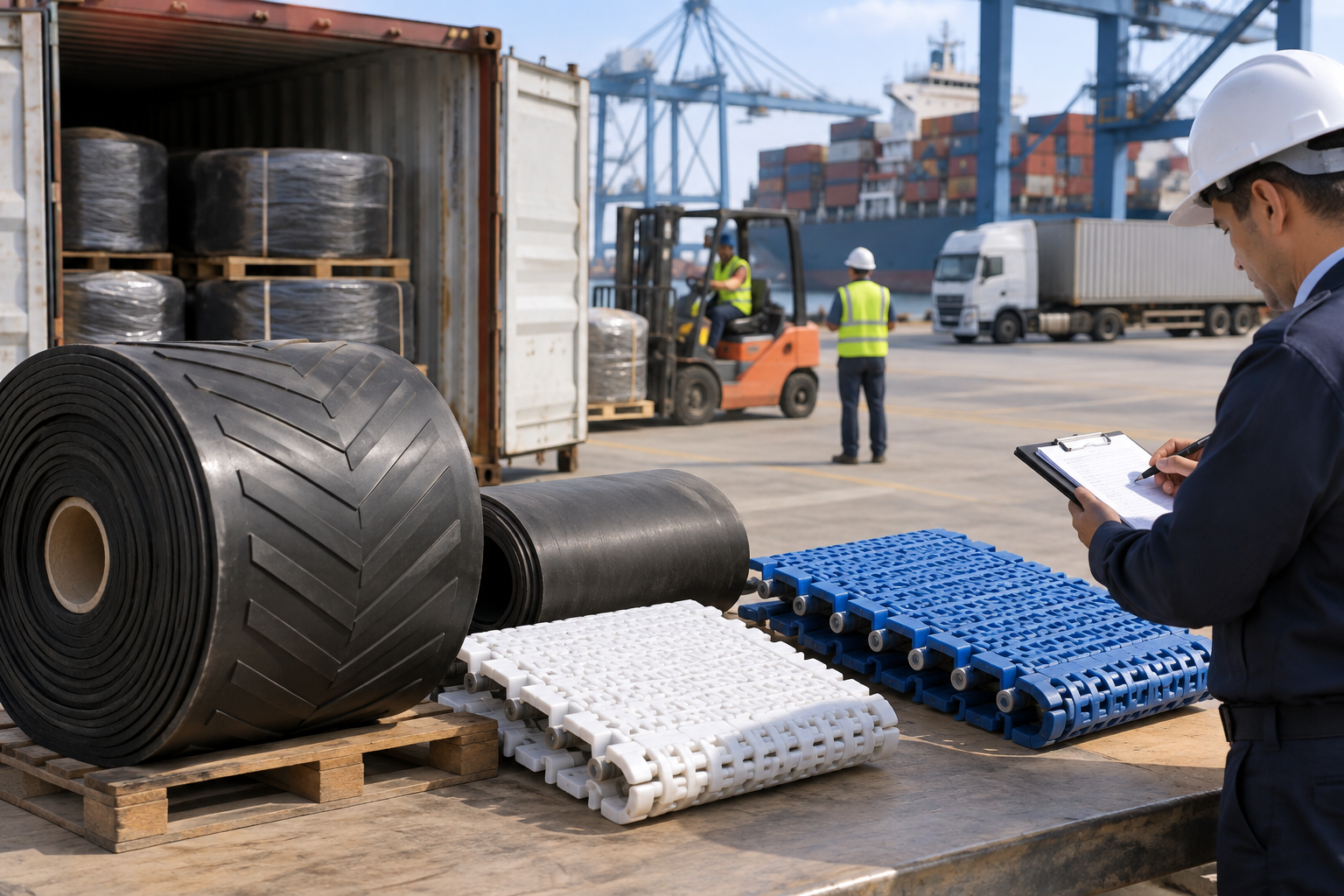
HS code lookup for conveyor belts starts with a deceptively simple question: what exactly are you importing? A replacement rubber belt, a plastic modular belt and a complete powered conveyor may perform related jobs, but they do not necessarily belong under the same tariff heading.
For importers, the objective is a defensible classification supported by technical evidence and checked against the destination tariff. That classification supports duty estimates, purchasing decisions and customs declarations. Copying a supplier’s code without checking its scope can create avoidable clearance problems.
HS Code Lookup for Conveyor Belts: Start With the Imported Product
Classify the goods as presented to customs, not simply by the production line they will eventually serve. Begin by separating these product types:
- Conveying belts: belts that carry goods or materials.
- Power-transmission belts: belts that transmit motion or power between mechanical components.
- Separate components: belt modules, connecting rods, sprockets, rollers, frames or other individually supplied items.
- Conveyor machinery: equipment incorporating a conveying mechanism, potentially supplied with a frame, drive, controls and other components.
A replacement belt does not automatically become a machinery part merely because it fits a particular conveyor. Conversely, a conveyor presented unassembled or disassembled may still be classified as machinery under the applicable interpretation rules.
Owner and timing: Before requesting a final quotation, the importer’s purchasing or engineering lead should identify each product type and tell the broker exactly what the shipment will contain.
Distinguish function from marketing language
Terms such as “industrial belt,” “food-grade conveyor” or “heavy-duty belting” are commercially useful but legally incomplete. They do not establish composition, reinforcement or whether the shipment contains a belt or a machine.
Ask whether the product carries materials, transmits power or does both. If the function is unclear, obtain an operating diagram and engineering explanation before selecting a code.
Before Ordering: Build the Supplier Specification Pack
The most effective classification tool is often a complete technical file. A catalogue page alone may omit the characteristic that determines the tariff branch.
Ask the supplier for:
- Material composition: rubber type, whether it is vulcanized, plastic resin, textile layers and other materials.
- Reinforcement: steel cords, textile plies, embedded fabric or other reinforcing structures.
- Construction: solid, layered, coated, reinforced, modular, linked or assembled from separate elements.
- Cross-section: a drawing showing covers, carcass, reinforcement and thickness.
- Dimensions and condition: width, length, thickness, roll form, cut lengths, open-ended or endless configuration.
- Photographs: the complete item, underside, edges, joints and identification labels.
- Function: what it carries or drives and how it operates.
- Shipment scope: belting alone, loose modules, accessories, a conveyor assembly or a complete system.
For machinery, add the bill of materials, assembly drawings, drive arrangement and an explanation of any missing components.
Owner and timing: The supplier’s technical team should provide this pack before the purchase order is finalized. The importer should link it to the exact SKU and revision, rather than accepting a generic family brochure.
Trace the Classification Path Through Candidate Headings
HS classification follows legal wording, interpretation rules and relevant section and chapter notes. Official explanatory materials and destination-country rulings can help interpret that framework, but a superficially similar ruling is not proof that your product receives the same treatment. A ruling’s applicability depends on its scope and the destination’s rules.
The following headings are starting points for investigation, not product-specific classification determinations.
Rubber conveyor belt classification
Heading 4010 covers conveyor or transmission belts or belting of vulcanized rubber, subject to the relevant legal notes and exclusions. Within that heading, conveyor belting and transmission belting follow different branches, and reinforcement can affect the applicable subheading.
For a rubber belt review, establish whether the goods meet the legal scope of vulcanized rubber belting and identify how they are reinforced. A black surface or the supplier’s use of “rubber belt” is insufficient evidence.
Composite construction deserves particular attention. Heading 4010 also includes certain textile belting impregnated, coated, covered or laminated with rubber, or made from textile yarn or cord impregnated, coated, covered or sheathed with rubber, under Chapter 40’s notes. Document textile backing, embedded fabric and plastic coatings so the broker can apply those provisions rather than infer classification from appearance.
Plastic modular conveyor belt classification
Determining the HS code for a plastic modular conveyor belt requires scrutiny of the imported article’s construction and the relevant legal exclusions. Heading 3926, covering other articles of plastics, may be a candidate for certain plastic belting.
Do not assume that a purpose-built plastic belt belongs under machinery parts. Equally, do not treat every module, sprocket or assembled plastic component as the same article. Chapter 39 and Section XVI rules, together with applicable official rulings, must be checked against the actual goods.
Provide the resin specification, module design, connecting-pin material and assembly condition. These details help distinguish an assembled belt from separate components.
Complete conveyor systems and separate parts
Heading 8428 includes various lifting, handling, loading and unloading machinery, including conveyors. The machinery type and operating principle matter when selecting a subheading. A broader production system containing a conveyor may require additional analysis under the relevant section notes.
Heading 8431 may be relevant to qualifying parts of machinery covered by headings 8425 to 8430, but only where the legal parts rules apply and no exclusion or more specific provision directs classification elsewhere.
For unassembled equipment, the broker should assess the applicable interpretation rules. Incomplete equipment may qualify as the complete machine if, as presented, it has that machine’s essential character. Do not assume equipment arriving in separate shipments receives the same treatment; check destination procedures before dispatch. A belt supplied with extra accessories does not automatically become a complete conveyor.
Textile belting, metal belts and unusual composites can require a different pathway. Expand the review when the evidence does not fit the initial candidates.
Before Shipment: Verify the Destination Tariff
The HS provides an internationally harmonized six-digit framework, while importing jurisdictions add their own tariff subdivisions. A supplier’s export code may therefore be incomplete or unsuitable for the destination declaration.
Importer and broker checklist, before dispatch:
- Confirm the importing country and expected entry period.
- Check the current official tariff and applicable legal notes.
- Select the destination-specific tariff extension.
- Review relevant official classification decisions for factual differences.
- Record why competing headings were accepted or rejected.
- Resolve discrepancies between the supplier’s code and the broker’s analysis.
Where uncertainty materially affects cost or clearance risk, consider an advance classification ruling from the destination customs authority. Confirm its application requirements, scope and expected processing time before relying on it for shipment planning.
The importer should own the decision to seek a ruling; the broker or classification specialist should prepare the technical submission. If resolution will not fit the purchasing schedule, agree on a lawful, documented response—such as delaying dispatch or using an available customs procedure—before the goods leave. A risk assessment does not replace a supportable declaration.
Calculate Conveyor Belt Import Duty From Verified Inputs
Conveyor belt import duty cannot be established from a product name alone. The calculation depends on the verified classification, customs value, origin, relevant entry date and applicable measures.
For an ad valorem duty, the basic calculation is the applicable percentage multiplied by customs value. However, valuation adjustments, specific duties or other measures can change the result.
The importer’s finance team and broker should verify:
- Customs value: the valuation basis and required additions or exclusions under destination rules.
- Origin: the applicable non-preferential origin, which is not necessarily the shipment’s dispatch country.
- Preference eligibility: whether an agreement applies and whether its origin and documentary requirements are met.
- Additional measures: any applicable trade remedies, safeguards, quotas or other tariff measures.
- Other border costs: import taxes, processing charges and relevant clearance expenses.
Use current official sources for rates and measure coverage. An agreement between two countries does not automatically make every shipment duty-free.
Owner and timing: Finance should approve the landed-cost estimate before ordering, with the broker rechecking tariff assumptions before filing.
Prepare Evidence for Conveyor Belt Customs Clearance
The customs clearance process for conveyor belts runs more smoothly when the invoice describes the article precisely and agrees with the technical file.
An illustrative description is: “Endless conveyor belt of vulcanized rubber, reinforced with textile plies, for conveying bulk material; dimensions and SKU as specified.” Use this wording only if every characteristic is accurate, and insert the actual dimensions and identifier.
Avoid descriptions such as “machine accessories” or “industrial spare parts” when more specific information is available.
Pre-entry document checklist
- Match invoice descriptions and SKUs to the specification pack.
- Reconcile quantities, units, package counts and weights across the invoice and packing list.
- Check transport-document details against the shipment records.
- Explain mixed shipments and separately supplied components.
- Obtain origin documentation where required.
- Retain drawings, photographs, relevant rulings and the classification rationale.
Owner and timing: The importer’s logistics lead should reconcile the documents before dispatch. The broker should confirm the entry classification against the final shipment before filing. The importer should also confirm its legal responsibilities under destination rules; using a broker does not necessarily transfer them.
For repeat orders, preserve the reviewed technical file and reassess classification when composition, reinforcement, construction, shipment scope or tariff provisions change. Apply the destination’s record-retention requirements rather than assuming a universal retention period.
Frequently Asked Questions
Is there one conveyor belt HS code for every belt?
No. Material, construction, reinforcement, function and shipment condition can change the classification. Rubber belting, plastic modular belting and complete conveyor machinery require separate analysis.
Can I use the HS code supplied by the manufacturer?
Use it as a starting point, not as final authority. Verify the technical facts, destination tariff extension and relevant legal provisions before declaring the goods.
Are replacement conveyor belts always machinery parts?
No. A belt designed for a particular machine may still fall under a provision for belting or articles of its material. Machinery-parts treatment depends on the applicable legal rules and exclusions.
How can I confirm the import duty before ordering?
Have the broker verify the destination classification, then check customs value, origin, preference eligibility and additional measures in current official sources. Recheck the assumptions before entry because applicable provisions can change.
Source or List Conveyor Products on IMEX Center
Start your next sourcing project with specifications that support both procurement and customs review. Visit IMEX Center to explore sourcing and product-listing options for conveyor belts and equipment. Buyers should request the technical pack before committing; suppliers should prepare clear material, reinforcement and shipment-scope details so buyers and brokers can evaluate the goods accurately.
Source or sell globally with IMEX Center
Browse verified suppliers →