Customs News
HS Code Lookup for Stainless Steel Water Bottles: Vacuum Flask or Non-Vacuum Container?
02 Oct 2026 · 20:03 CET
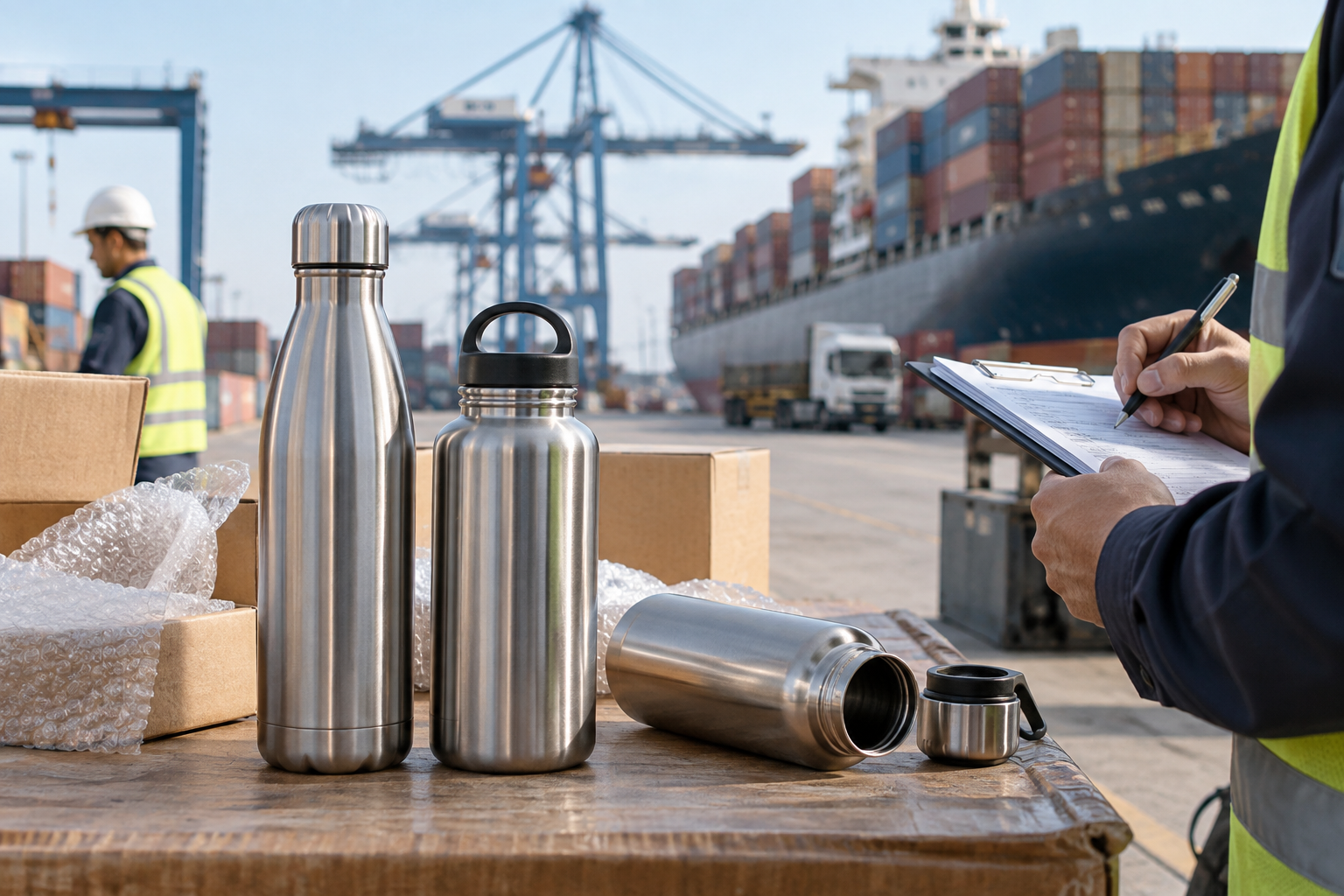
An HS code lookup for stainless steel water bottles should start with one technical question: does the product actually have a vacuum between its walls? Names such as “thermal bottle,” “sports flask,” and “double-wall tumbler” do not establish that fact. A mistaken assumption can lead to an unsuitable tariff code, an inaccurate landed-cost estimate, and clearance questions.
For importers and private-label buyers, the objective is not to find a code that another seller uses. It is to build a defensible classification from the exact product, the importing jurisdiction’s tariff schedule, and evidence available before the customs entry is filed. This guide outlines that review process; it does not establish a classification for an unexamined product.
HS code lookup for stainless steel water bottles: establish the construction
Separate the range into three construction types before comparing tariff provisions.
Vacuum-insulated bottles
These have an evacuated space between walls. Their construction makes the vacuum-flask provisions an important starting point, even when the product is marketed as a water bottle rather than a flask.
A steel inner vessel and outer shell do not, by themselves, prove that the intervening space is evacuated. Request confirmation tied to the exact SKU.
Non-vacuum double-wall bottles
A double-wall bottle may contain air or another insulating material between its walls without a vacuum. It should not automatically receive the same classification as a vacuum-insulated product.
Before classifying a double-wall water bottle, establish what occupies the gap and how the bottle is manufactured.
Single-wall containers
A single-wall stainless steel drinking bottle has no inter-wall vacuum. Its material, household or other function, and design become central to the classification review.
Do not extend one classification across a collection simply because every item shares a brand, capacity, or external shape. Similar-looking products can have materially different construction.
Request a supplier classification pack before confirming the order
Ask the supplier for evidence while specifications can still be checked and corrected. A catalogue description and a supplier-suggested HS code are useful leads, but neither replaces technical documentation.
Use this supplier checklist:
- Product identity: model number, SKU, capacity, dimensions, and intended use.
- Materials: steel grades for the inner and outer walls, as applicable, plus plastics, silicone, coatings, and other components.
- Construction: single-wall or double-wall design, supported by a cross-section drawing.
- Insulation method: explicit confirmation of vacuum, air gap, foam, or another arrangement.
- Manufacturing evidence: an explanation of evacuation and sealing where vacuum insulation is claimed.
- Images: the complete bottle, opening, base, lid, and packaging.
- Accessories: details of every lid, straw, sleeve, carrying case, brush, and spare part supplied.
- Supporting records: relevant test reports and any prior classification decisions for the same product.
Temperature-retention testing can support the technical description, but performance alone does not establish vacuum construction. Likewise, a drawing that merely says “double wall” leaves the key question unanswered.
Match every document to the purchased version. A report for a factory’s premium vacuum model does not establish the construction of its lower-priced non-vacuum model.
Compare potential headings using official tariff sources
For a vacuum-insulated bottle, heading 9617 is a key candidate. It covers vacuum flasks and other vacuum vessels, complete with cases, and parts other than glass inners. Whether a particular bottle falls there must be assessed against the actual heading text, relevant notes, and applicable interpretation rules.
For non-vacuum stainless steel household bottles, heading 7323, covering table, kitchen, and other household articles of iron or steel and their parts, may warrant investigation. It is not a universal fallback for every steel container. Industrial, transport, packaging, or other specialised functions may require consideration of different provisions.
Follow the classification rules in sequence
Begin with the heading wording and relevant section and chapter notes under the General Rules for the Interpretation of the Harmonized System. Apply the remaining rules where required, then determine the appropriate subheading under Rule 6 and the relevant subheading provisions.
Do not jump straight to material composition or “essential character” because the product contains steel and plastic. A provision describing the complete article may resolve the issue before that analysis becomes relevant.
Check:
- The importing jurisdiction’s official tariff schedule.
- Relevant legal notes and interpretation rules.
- Official classification rulings involving comparable construction.
- Explanatory guidance, while recognising its legal status in that jurisdiction.
For example, the US International Trade Commission’s tariff schedule and the UK Trade Tariff are official starting points for their respective markets. US ruling research can also begin with CBP’s CROSS database.
Marketplace listings and supplier export declarations are secondary clues. They may concern a different model, a different jurisdiction, or an incorrect historical declaration. When reviewing rulings, check whether they remain current and whether their product facts match yours.
Review lids, straws, carrying cases, and retail sets
Classify the goods as they will be presented at importation. A complete bottle with its ordinary closure is not necessarily analysed in the same way as separately imported replacement lids.
Create a packing-level description showing:
- Which components are fitted to the bottle.
- Which additional items share its retail packaging.
- Whether accessories are separately packed or separately sold.
- The materials and functions of each component.
- Whether a case is specially shaped or fitted for the bottle.
A bottle, spare lid, straw, and carrying pouch do not automatically become one tariff item merely because the supplier calls them a “gift set.” Whether the combination qualifies as a set for classification purposes requires analysis under the applicable rules, including Rule 3(b) where relevant.
Cases and packing can also raise questions under Rule 5. Separately imported parts or accessories may need their own classification review; they do not automatically take the bottle’s code.
Send the broker photographs of the actual retail and shipping configurations. A component list without packaging context may be insufficient.
Move from the HS subheading to the destination tariff code
Terminology matters: an HS heading has four digits, while an HS subheading has six digits. Importing jurisdictions extend the system into more detailed tariff and statistical codes, often using eight, ten, or additional digits.
Finding a six-digit subheading is therefore not always enough to complete an import declaration. Confirm the full code required by the destination customs authority, using the schedule version applicable to the entry.
Verify stainless steel bottle import duty separately
Classification is only one input into a duty calculation. Before estimating landed cost, confirm:
- Destination: the jurisdiction where the goods enter customs territory.
- Origin: determined under the applicable origin rules, not simply the shipping country.
- Relevant date: the date used to determine tariff treatment under the destination’s rules.
- Full tariff code: including required national subdivisions.
- Customs value: established under the destination’s valuation rules.
- Preference eligibility: supported by the necessary origin evidence.
- Additional measures: any applicable additional tariffs, trade remedies, or other charges.
A preferential rate is not available merely because a supplier provides a generic origin statement. Verify that the goods meet the relevant origin rule and documentation conditions. For trade remedies, review the measure’s product scope and origin requirements rather than relying on a tariff-code match alone.
Keep import VAT or similar taxes, processing charges, and broker fees distinct from customs duty. No single duty rate can safely be applied to stainless steel bottles worldwide.
Prepare the invoice and retain the decision trail
Customs clearance is easier to support when the invoice, purchase order, packing list, and technical pack describe the same product consistently.
Avoid vague descriptions such as “metal goods,” “drinkware,” or “thermal items.” For a verified vacuum model, a description could begin with “Reusable stainless steel drinking bottle, double-wall vacuum-insulated construction.” Add the actual capacity, model identifier, closure details, and supplied accessories where relevant.
Use vacuum-insulation wording only when the construction is verified. For a non-vacuum product, state its actual construction rather than borrowing the vacuum model’s description. Ensure the invoice also meets the destination’s documentation requirements.
Alongside the entry documentation, retain:
- The final technical pack and product photographs.
- The tariff provisions and notes reviewed.
- Relevant ruling references and important factual differences.
- A short explanation of the selected classification and rejected alternatives.
- Broker correspondence, origin evidence, and duty-check records.
- The applicable dates and versions of source materials.
Follow the importing jurisdiction’s record-retention requirements. Revisit the classification when the factory changes insulation, materials, accessories, or presentation—not only when the model name changes. Also review relevant tariff amendments and changes to classification guidance.
Resolve uncertainty before shipment
Consult a destination-country customs broker when construction is unclear, competing headings remain plausible, or the shipment includes unusual accessories or retail combinations. Provide the technical evidence rather than asking the broker to classify from a product name alone.
Consider applying for a binding classification ruling where uncertainty persists, particularly for repeat programmes or commercially significant volumes. Application procedures, timing, scope, and legal effect vary by jurisdiction. A broker’s recommendation is not itself a binding customs ruling.
A ruling issued elsewhere can inform research but should not be treated as binding in the destination market. Even a domestic ruling must be checked against the exact facts, its current validity, and any conditions governing who may rely on it.
Make unresolved classification questions a pre-shipment approval item, alongside final specifications and packaging approval.
Frequently asked questions
Are all stainless steel water bottles classified under the same HS code?
No. Vacuum-insulated vessels and non-vacuum household containers can require different classification analysis. Construction, function, presentation at importation, and the destination’s tariff provisions matter more than the general product name.
Does double-wall construction prove that a bottle is vacuum-insulated?
No. Two walls can enclose air or another insulating material. Request model-specific drawings and an explicit insulation statement. Temperature-retention claims alone are not sufficient evidence of a vacuum.
Can I use the HS code provided by the supplier?
Use it as a starting point, not as automatic approval. Check the product facts and destination tariff schedule. The supplier’s code may reflect an export-country subdivision or a different product configuration.
How do I find the applicable import duty?
Confirm the full destination tariff code, origin, customs value, and relevant date under the destination’s rules. Then check official tariff and trade-measure sources for ordinary duty, preference conditions, and additional measures, keeping taxes and service fees separate.
Source or list with clearer product evidence
Accurate specifications help buyers compare offers and prepare classification reviews before shipment. When sourcing, request insulation evidence and accessory details alongside pricing. When listing, distinguish verified vacuum construction from non-vacuum double-wall designs.
Ready to build better-informed trade enquiries? Source stainless steel water bottles or list your products on IMEX Center, and make technical clarity part of the conversation from the start.
Source or sell globally with IMEX Center
Browse verified suppliers →