Import & Export
Palm Oil Suppliers in Indonesia: Sourcing Crude vs Refined Oil for India
09 Oct 2026 · 06:02 CET
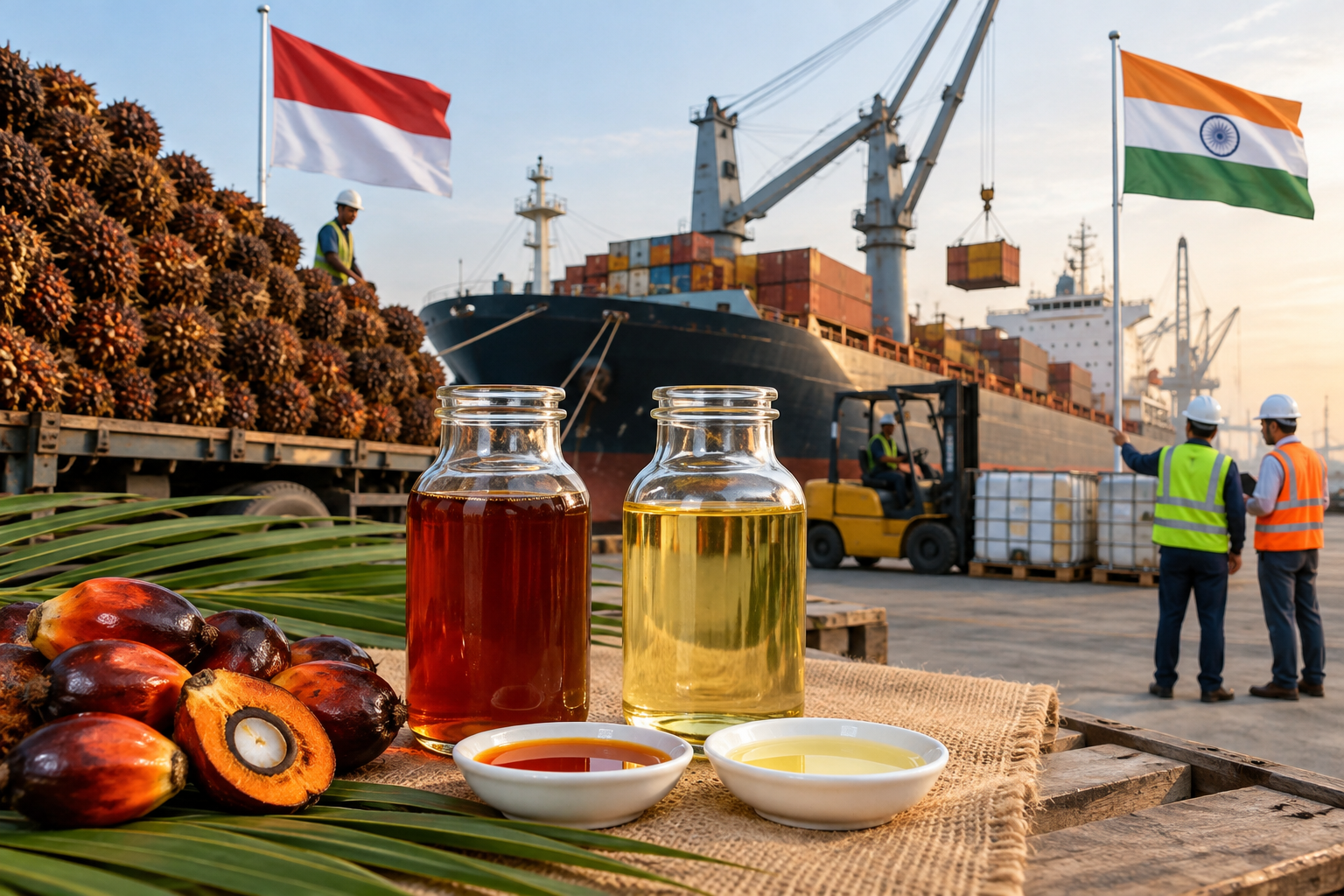
Finding palm oil suppliers in Indonesia starts with choosing the right product—not collecting the lowest quotations. Indian refiners, food manufacturers and distributors have different processing capabilities, so crude palm oil, refined palm oil and RBD palm olein are not interchangeable purchases. A cheaper cargo can become the more expensive option after refining losses, handling costs or application failures.
This guide explains how to qualify suppliers, specify the correct grade and compare offers on landed usable cost. It also identifies which decisions procurement, quality, finance and logistics teams should complete before committing to a shipment.
Choose the Product Before the Supplier
Start with two questions: what will the oil be used for, and what processing can your facility perform? The answers should determine the product in your request for quotation.
Crude palm oil: for buyers with refining capability
Crude palm oil, or CPO, requires refining before use as refined edible oil. It is generally relevant to refiners or buyers with confirmed third-party refining arrangements.
When assessing crude palm oil suppliers, focus on feedstock consistency, free fatty acids, moisture, impurities and indicators of deterioration. These influence processing requirements, yield and final quality.
Do not compare a CPO offer directly with a refined-oil offer without including refining charges, expected losses, financing and the value of any recoverable by-products. If the target product is olein, include any required fractionation costs and yields as well.
RBD palm oil: refined, but not necessarily the right fraction
RBD means refined, bleached and deodorized. RBD palm oil is different from RBD palm olein: refining removes unwanted constituents, while fractionation separates oil into fractions with different melting characteristics.
RBD palm oil may suit applications requiring its particular fat profile, including certain shortenings and formulated fats. However, suitability depends on the manufacturer's recipe and processing conditions.
Quality staff should approve application-specific melting or solid-fat characteristics before procurement accepts a substitute grade.
RBD palm olein: for applications requiring a more liquid fraction
RBD palm olein is the refined, bleached and deodorized form of the more liquid fraction of palm oil. Buyers commonly assess it for cooking and frying applications, subject to their formulation and performance requirements.
When evaluating Indonesian RBD palm olein suppliers, define iodine value, cloud point and other relevant acceptance criteria. A generic “palm olein” description is not a sufficient purchase specification.
Storage conditions matter: olein can develop cloudiness or crystallization at lower temperatures. Confirm suitability for the destination climate and actual handling conditions.
How to Evaluate Palm Oil Suppliers in Indonesia
Separate the supplier's commercial role from its physical capabilities. A producer, refinery and trader may each provide a workable solution, but their responsibilities and supporting evidence differ.
A plantation or mill operator may offer upstream visibility without controlling export storage. A refinery may supply finished grades but purchase feedstock from multiple sources. A trader may coordinate supply effectively without owning production assets.
Verify the entity and the supply chain
Before shortlisting Indonesian palm oil exporters, procurement should request:
- Legal company name, registered address and relevant business documents.
- Identification of the contracting seller, invoicing entity and payment beneficiary.
- Product origin and the supplying mill, refinery or storage location, where applicable.
- Evidence of access to the offered quantity and loading facilities.
- Proposed loading port or terminal and shipment window.
- Relevant certificates, checked for validity, scope and applicability.
- Trade references or independently verifiable shipment experience.
Ask explicitly who controls product release and who bears responsibility if the nominated source changes. Ownership of a refinery does not by itself prove that a particular cargo is available.
Finance should independently verify beneficiary details through a trusted contact channel before approving payment instructions. Treat unexplained account changes or mismatches between seller and beneficiary as issues to resolve, not routine paperwork.
Specify the Purchase So Offers Are Comparable
A usable quotation starts with a written specification. Generic descriptions such as “export quality” or “food grade” do not establish measurable acceptance limits.
Build a grade-specific quality schedule
The quality manager should select parameters relevant to the product and application, including:
- Free fatty acids, with the reporting basis clearly stated.
- Moisture and volatile matter, and insoluble impurities.
- Colour and appropriate oxidation or deterioration indicators.
- Iodine value and relevant melting or cloud-point characteristics.
- Contaminants and residues required by applicable rules or customer specifications.
- Agreed analytical methods, units and acceptance limits.
Avoid copying CPO limits into an RBD palm olein contract. Equally, do not assume one olein grade will perform like another in frying, storage or blending.
Agree on evidence and acceptance procedures
Request a recent representative certificate of analysis, then require documentation linked to the supplied lot or cargo. A historical certificate is evidence of past production, not proof of the shipment's quality.
The contract should define sampling locations, sample handling, retained samples, inspection responsibilities and the procedure for resolving conflicting laboratory results. State whether contractual acceptance is assessed at loading, discharge or both, and how transit deterioration is handled. Contractual acceptance does not replace regulatory clearance requirements.
Include quantity tolerances, weight determination, claim deadlines and remedies. Where a new application is involved, quality staff should complete a sample evaluation or production trial before approving a commercial order.
Confirm the Palm Oil HS Code and Indian Import Requirements
Buyers planning to import palm oil from Indonesia to India should confirm classification and compliance before accepting the commercial offer.
Palm oil and its fractions, whether or not refined but not chemically modified, generally fall under HS heading 1511. However, a heading alone does not establish the correct Indian tariff item. Crude oil, refined oil and particular fractions can require different classification treatment.
The Indian importer and customs broker should verify:
- The applicable Indian tariff classification for the exact product.
- Current import policy, duties, taxes and eligibility for any claimed preferential treatment.
- Importer registrations and food-import requirements applicable to the shipment.
- Required certificates, origin evidence and customs documentation.
- Applicable food standards, testing and labelling obligations.
- Any restrictions or conditions affecting the proposed transaction.
Check the relevant Food Safety and Standards Authority of India (FSSAI) requirements for edible-oil imports, alongside current official customs and import-policy sources. Do not rely solely on the supplier's HS code or an old duty estimate.
The broker should confirm the position before purchase approval and recheck before shipment and customs clearance. Procurement should also ask the exporter to confirm that applicable Indonesian export requirements can be met within the agreed loading window.
Compare Landed Usable Cost, Not Headline Price
The lowest price per tonne is meaningful only when the product, delivery basis and resulting usable output are comparable.
Ask every shortlisted supplier to quote against the same grade, specification, quantity, shipment window and destination assumptions. State the Incoterms rule, version and named port or place. An FOB offer and a CIF offer are not directly comparable without adjusting their cost coverage. Separately confirm where transit risk transfers and whether the insurance cover is adequate; freight payment does not determine risk transfer.
Build a normalized cost sheet
Procurement and finance should include:
- Product price, currency and payment terms.
- Freight, insurance and any costs excluded from the quotation.
- Applicable duties and nonrecoverable taxes.
- Port, terminal, inspection, testing and clearance charges.
- Inland transport, storage, heating and handling.
- Refining or fractionation costs, where needed.
- Expected losses, financing costs and credible by-product credits.
- Delay exposure, including demurrage and storage overruns.
A practical calculation is:
Landed usable cost per tonne = (total attributable costs excluding recoverable taxes − realizable by-product credits) ÷ expected tonnes of usable output.
Avoid double-counting costs already included in the quoted delivery basis. Reflect physical losses in expected usable output rather than charging for the same loss twice. Finance should show recoverable taxes separately from permanent costs while still accounting for their cash-flow impact.
For CPO, use the receiving refinery's actual processing assumptions rather than a supplier's unsupported yield promise. For refined products, account for handling losses and any conditioning needed before use. Compare outputs that meet the same end-use specification.
Run a sensitivity check for weaker yields, shipping delays and exchange-rate changes. This helps reveal whether a nominal discount survives realistic operational variation.
Match Shipment Format to Receiving Facilities
Bulk palm oil suppliers should demonstrate that their shipment proposal matches the buyer's infrastructure. A commercially attractive parcel can become impractical if the receiving terminal lacks suitable tanks, heating or discharge capacity.
Bulk liquid vessels may suit buyers with appropriate volume and terminal access. Smaller lots may use suitable tank containers or other food-compatible systems accepted by the relevant carrier and facilities, subject to product properties and applicable requirements.
Do not assume one transport format works for CPO, RBD palm oil and olein without checking temperature and unloading requirements.
Complete a pre-booking logistics check
The logistics lead should confirm:
- Receiving-tank capacity and product segregation.
- Food-compatible tanks, lines, hoses and cleanliness controls.
- Previous-cargo restrictions and cleaning evidence where applicable.
- Agreed loading, carriage and discharge temperature ranges.
- Heating capability and protection against overheating.
- Pumping arrangements, discharge rate and shore connections.
- Sampling access, inspection attendance and weight measurement.
- Laytime, demurrage allocation and contingency storage.
Temperature instructions should reflect the actual grade and transport system, not a universal setting. Logistics should secure written terminal acceptance before booking transport or committing to a discharge schedule.
Move from Shortlist to Purchase with Clear Ownership
A disciplined approval sequence reduces mismatches between the purchased grade and the receiving operation.
- Sourcing manager—before collecting final offers: issue one RFQ covering grade, quantity, specification, delivery basis, shipment window and required documents.
- Quality manager—before technical approval: review certificates, approve acceptance limits and complete any required sample or application testing.
- Importer and customs broker—before purchase approval: confirm classification, applicable import requirements and the duty calculation basis; recheck before shipment and clearance.
- Logistics lead—before transport commitment: confirm terminal acceptance, storage, temperature management and discharge arrangements.
- Finance and procurement—before signing: compare landed usable costs and approve payment security and contractual remedies. Finance should independently verify beneficiary details before payment and reverify any changes.
If a supplier changes the refinery, grade, loading location or shipment format, reopen the affected checks. These changes can alter quality, traceability, logistics and cost even when the quoted price remains unchanged.
Frequently Asked Questions
Should an Indian buyer purchase CPO or RBD palm olein?
Choose CPO when you have suitable refining capability or a confirmed refining arrangement, plus fractionation capability if olein is the target output. Consider RBD palm olein when its specifications match the intended application without those processing steps. Compare usable output costs, not just purchase prices.
Can a trader be a reliable palm oil supplier?
Yes. Verify the trader's legal identity, supply access, documentation and contractual responsibility. Confirm who controls the cargo and how quality claims will be resolved; asset ownership alone is not the deciding factor.
What is the palm oil HS code for imports into India?
Palm oil and its fractions generally fall under HS heading 1511 when not chemically modified. The exact Indian tariff item depends on the product. Ask the customs broker to verify classification and current requirements before purchase approval and recheck before shipment and clearance.
What should a bulk palm oil quotation include?
Require the exact grade, specification, quantity tolerance, Incoterms rule and version, named port or place, shipment window, payment terms, inspection arrangements and document list. Request explicit exclusions so freight, handling and other charges can be normalized.
Source or List Palm Oil on IMEX Center
Ready to move from research to a defined sourcing requirement? Visit IMEX Center to source palm oil or list your supply offer. Specify the grade, origin, quantity, loading location and commercial terms so prospective trading partners can assess the fit before negotiations begin.
Source or sell globally with IMEX Center
Browse verified suppliers →