Import & Export
Annual cargo throughput by selected cargo category — Three selected cargo categories at the Port of Rotterdam, Netherlands; not a comparison or ranking of ports. (2025)
01 Nov 2026 · 06:02 CET
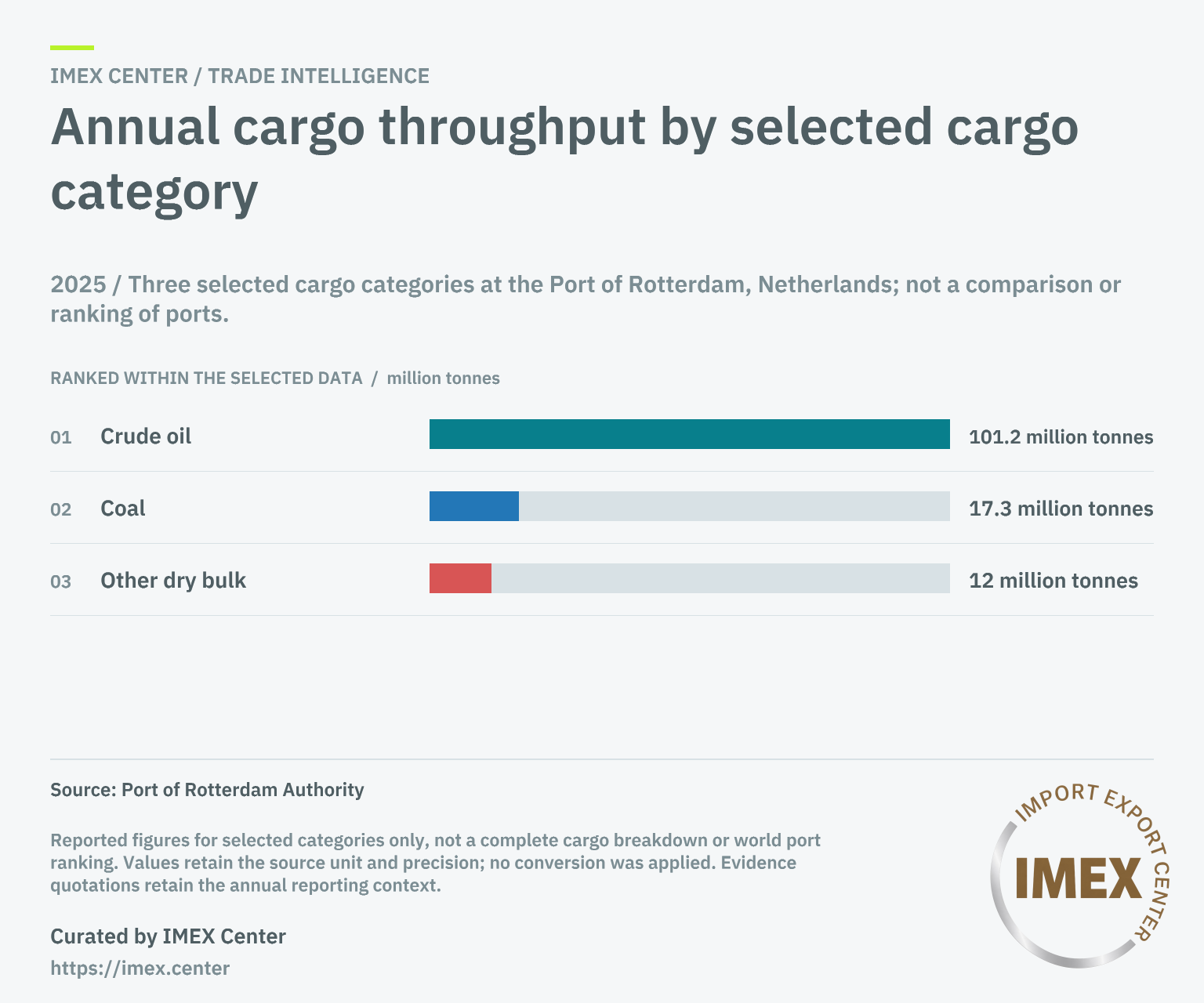
Annual cargo throughput by selected cargo category — Three selected cargo categories at the Port of Rotterdam, Netherlands; not a comparison or ranking of ports. (2025)
2025 · Three selected cargo categories at the Port of Rotterdam, Netherlands; not a comparison or ranking of ports. · Annual cargo throughput by selected cargo category: Crude oil 101.2 million tonnes; Coal 17.3 million tonnes; Other dry bulk 12 million tonnes.
| Rank | Three selected cargo categories at the Port of Rotterdam, Netherlands; not a comparison or ranking of ports. | million tonnes |
|---|---|---|
| 1 | Crude oil | 101.2 |
| 2 | Coal | 17.3 |
| 3 | Other dry bulk | 12 |
Reported figures for selected categories only, not a complete cargo breakdown or world port ranking. Values retain the source unit and precision; no conversion was applied. Evidence quotations retain the annual reporting context.
Curated by IMEX Center. Original sources:
Rotterdam port statistics help importers, exporters and sourcing managers frame better bulk-cargo enquiries—but only when used for the right purpose. Annual throughput describes cargo handled at the port. It does not establish available terminal capacity, freight pricing or demand for a particular supplier’s product.
This guide uses Port of Rotterdam Authority evidence for three selected cargo categories in calendar-year 2025: crude oil, coal and other dry bulk. It translates that historical context into practical questions for terminal operators, brokers and logistics providers, without treating port activity as a commercial guarantee.
Rotterdam port statistics: what the selected 2025 figures measure
Selected annual cargo throughput at the Port of Rotterdam, Netherlands, in 2025
The metric is annual cargo throughput, expressed in million tonnes. The figures cover selected cargo categories at Rotterdam, not a comparison or ranking of ports.
| Cargo category | Reported throughput, million tonnes |
|---|---|
| Crude oil | 101.2 |
| Coal | 17.3 |
| Other dry bulk | 12 |
These are port cargo categories, not individual supplier volumes or confirmed bookings. The selection is non-exhaustive: it is not a complete breakdown of Rotterdam’s cargo throughput, and its sum must not be presented as the port’s total.
Source and methodology
The figures come from the Port of Rotterdam Authority’s official release, “Throughput port of Rotterdam shows slight decline”. The figures above were checked against the supplied extracts from that release, rather than secondary infographic estimates.
The editorial method retains the reported category labels, annual context, units and numerical precision. No unit conversion, extrapolation or reconstruction of missing categories has been applied. No market shares or future volumes are calculated.
The supplied extracts do not establish the detailed statistical treatment of every cargo movement. These figures should therefore not be interpreted as a customs import series, domestic consumption measure or bilateral trade dataset.
Original source: Port of Rotterdam Authority. Curated by IMEX Center. Curation means editorial selection and explanation, not independent certification of the underlying statistics.
What the figures mean for a commercial enquiry
Port-level data provides context for a logistics discussion. Terminal-level evidence determines whether a particular shipment is workable.
Category throughput aggregates activity across the reporting period. It does not establish an operator’s willingness to accept your specification, available storage during your shipment window or the handling arrangements required for your parcel.
Use the statistics as background for the cargo category you are investigating. Then obtain written confirmation of cargo acceptance, operational fit and commercial terms.
Crude oil: distinguish throughput from imports
The reported crude oil throughput provides historical context for port activity. It is not automatically equivalent to Dutch crude oil imports or refinery demand. An assessment of import demand needs a separate, appropriately scoped trade dataset.
For a crude oil enquiry, identify the grade, relevant quality characteristics, parcel size and intended receiving arrangement. Ask the proposed operator to confirm tank compatibility, transfer connections, segregation requirements and any heating or sampling provisions relevant to the cargo.
The sourcing manager should establish the product requirements before the logistics team requests firm handling terms. Otherwise, an attractive initial indication may cover a service that does not fit the actual cargo.
Coal: specify the product and handling requirements
Coal throughput does not establish that every coal grade is accepted at every terminal. The enquiry should identify the intended product and use rather than rely on the broad category label.
Provide the specification, relevant safety information, particle-size characteristics and moisture requirements. Ask the operator about unloading arrangements, stockpile segregation, dust controls, weighing, sampling and onward loading.
Agree how quantity and quality will be recorded at the relevant handover points, including applicable test methods and measurement bases. Annual port statistics cannot resolve the measurement terms of an individual transaction.
Other dry bulk: do not mistake a broad label for acceptance
“Other dry bulk” is an aggregate reporting category, not a terminal acceptance list. It does not identify every included material or prove that your commodity is handled under suitable conditions.
State the exact commodity, physical form, bulk density where relevant, contamination sensitivity and any special handling requirements. Supply a safety data sheet where applicable and identify any food, feed or industrial-use requirements that affect storage and handling.
This specificity helps operators assess the actual material instead of responding to an ambiguous category description. Do not assign your commodity to this statistical category without checking the reporting definitions.
Turn port statistics into a quote-ready cargo brief
A useful enquiry allows recipients to assess operational fit and quote for the same service scope. Sending only a commodity name and a destination invites assumptions.
Before approaching providers for bulk shipping to Rotterdam, prepare a cargo brief with the following information:
- Commodity and specification: exact product, grade, intended use, origin where relevant, and applicable quality or safety documents.
- Quantity and parcel size: proposed shipment quantity, unit, tolerance and expected delivery pattern.
- Cargo presentation and handling: bulk or packaged form, packaging details where applicable, and proposed transfer or unloading arrangements, subject to operator confirmation.
- Storage requirement: expected duration, segregation, covered or open storage, and any temperature or contamination constraints.
- Route and shipment window: loading port, proposed loading and arrival windows, and scheduling flexibility.
- Vessel information: available vessel particulars, with unknowns clearly marked for confirmation.
- Inland destination: receiving site and proposed onward transport mode.
- Commercial scope: applicable Incoterms 2020 rule and named port or place for the goods transaction, requested logistics services, currency, payment terms and quotation validity.
- Inspection and documentation: proposed independent inspector where required, sampling and testing methods, acceptance criteria and applicable shipment documents.
Owner and timing: the sourcing manager should approve the commodity brief before enquiries are issued. The logistics manager should complete the transport and storage assumptions before requesting comparable quotations.
If an input remains unknown, label it as provisional. Ask each provider to explain how that uncertainty affects acceptance, scheduling or price. Do not present a requested certificate or inspection as evidence that it already exists.
Request itemised charges, not just a headline rate
A terminal handling indication and a freight quotation may cover different parts of the movement. Comparing headline prices without checking inclusions can hide material gaps.
Ask each provider to separate the services it offers and identify the charging basis. Relevant items may include unloading, transfer, storage, onward loading, weighing, sampling, inspection and documentation. Request disclosure of minimum charges, surcharges and exclusions where applicable.
Questions to settle before comparing offers
- What exactly is included in the quoted handling scope?
- When does storage charging begin, and what conditions apply?
- Who arranges inland transport and confirms receiving-site readiness?
- How are delays, cancellations and changes in parcel size treated?
- Which charges are firm, and which remain subject to vessel or cargo details?
- How long is the quotation valid?
- What written confirmation is required to secure the proposed service window?
Do not assume a named Incoterm answers every operational question. Incoterms allocate delivery obligations, risk and costs under the goods sale; they do not determine payment or ownership, or replace terminal service conditions and cargo acceptance requirements.
Owner and timing: procurement should put quotations on a consistent scope and charging basis before commercial selection. Logistics should resolve exclusions and scheduling assumptions before any binding booking.
Research omitted cargo categories separately
The selected dataset does not include LNG or other omitted cargo categories. It cannot support conclusions about their throughput or terminal availability.
Their absence here does not mean they are absent from the port; it means they are outside this article’s evidence scope. Nor should handling requirements for crude oil, coal or other dry bulk be carried over to a different cargo segment without confirmation.
For another commodity, obtain the relevant official statistics and reporting definitions. Then seek cargo-specific acceptance, handling arrangements and capacity confirmation directly from the proposed operator.
Owner and timing: the research lead should confirm the relevant category evidence before it is used in a sourcing brief. Logistics should validate operational requirements before requesting a firm quotation.
What annual throughput cannot tell a sourcing team
Historical activity is not a forward booking calendar. These selected figures cannot establish future cargo demand, available storage, vessel waiting time, a freight rate or the suitability of a particular terminal.
They also cannot identify the origin or final destination of every shipment. A port-level number is not evidence that a particular country bought that volume or that a particular supplier can deliver it.
Keep the decision process evidence-led:
- Before shortlisting: procurement should confirm the provider’s legal identity and relevant service scope, marking unresolved verification as pending.
- Before choosing an offer: logistics and procurement should obtain written cargo acceptance, itemised pricing and operational assumptions.
- Before commitment: the responsible commercial lead should confirm counterparty authority, availability, contractual responsibilities, documentation and booking conditions.
The strongest commercial use of throughput statistics is to improve the questions you ask—not to replace the answers you need.
Frequently asked questions
Do these Rotterdam port statistics show Dutch import demand?
No. They describe annual port cargo throughput for selected categories. They do not independently establish Dutch imports, domestic consumption or bilateral trade. Those questions require appropriately scoped customs or trade statistics.
Are crude oil, coal and other dry bulk the complete cargo breakdown?
No. They are a non-exhaustive selection from the official reporting evidence. They should not be presented as the full port total, a complete commodity ranking or a comparison between ports.
Can annual throughput confirm terminal capacity for my shipment?
No. Acceptance and availability require direct confirmation for your commodity, parcel size, handling requirements and shipment window. Request written operational and commercial terms before committing.
What should I send with a Rotterdam bulk-cargo enquiry?
Provide the commodity specification, quantity, parcel size, loading port, shipment window, storage requirements, handling expectations and inland destination. Ask for written acceptance, itemised charges, exclusions, quotation validity and the conditions for securing capacity.
Move from cargo context to a stronger enquiry
Combine credible port data with a precise cargo brief. Use the reported figures as historical context, then require shipment-specific evidence before selecting a provider.
For your next enquiry through IMEX Center, prepare a defined specification, logistics scope and commercial requirements. Procurement owns counterparty checks and quotation comparison; logistics owns operational confirmation. Complete both before making a binding commitment.
Source or sell globally with IMEX Center
Browse verified suppliers →