Import & Export
Export trade value — Singapore · selected commodities (2023)
03 Nov 2026 · 06:02 CET
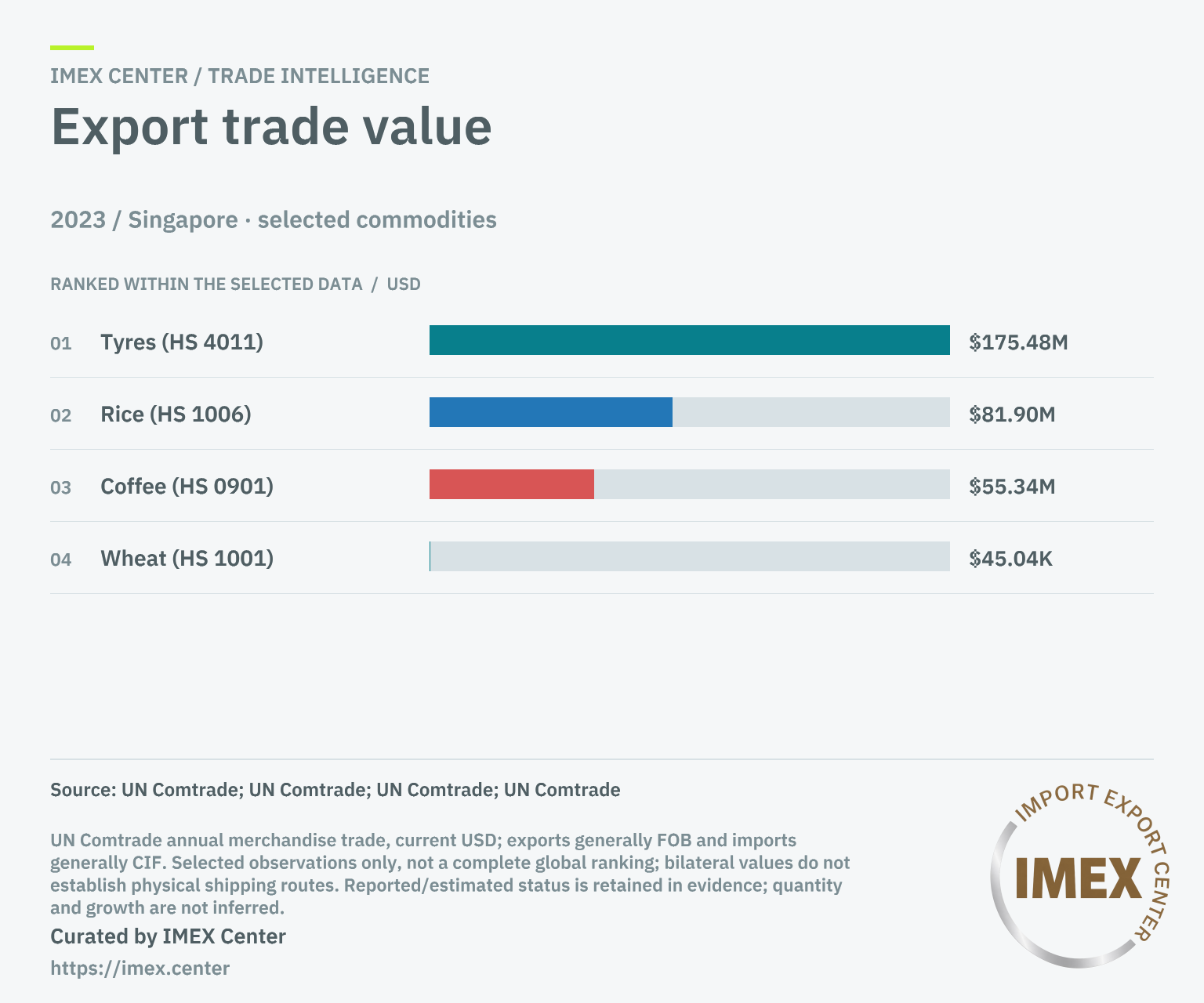
Export trade value — Singapore · selected commodities (2023)
2023 · Singapore · selected commodities · Export trade value: Tyres (HS 4011) $175.48M; Rice (HS 1006) $81.90M; Coffee (HS 0901) $55.34M.
| Rank | Singapore · selected commodities | USD |
|---|---|---|
| 1 | Tyres (HS 4011) | 175,484,440.236 |
| 2 | Rice (HS 1006) | 81,902,359.171 |
| 3 | Coffee (HS 0901) | 55,335,121.766 |
| 4 | Wheat (HS 1001) | 45,036.497 |
UN Comtrade annual merchandise trade, current USD; exports generally FOB and imports generally CIF. Selected observations only, not a complete global ranking; bilateral values do not establish physical shipping routes. Reported/estimated status is retained in evidence; quantity and growth are not inferred.
Curated by IMEX Center. Original sources:
Singapore exports can help importers identify categories worth investigating, but historical trade values are not a supplier shortlist. This guide compares selected UN Comtrade records for tyres, rice, coffee and wheat in 2023, then translates the evidence into practical questions for sourcing managers.
The central distinction is simple: export value describes trade in a defined period and scope. It does not confirm current stock, manufacturing origin, supplier capacity or a seller’s authority to supply goods. Use the figures to frame enquiries—not to replace commercial due diligence.
Export trade value — Singapore · selected commodities (2023)
Metric, period and geographic scope
The metric is export trade value, expressed in current USD. The reference period is the calendar year 2023. The geographic scope is Singapore as the exporting reporter, with the world as partner. In these records, the export values appear in both the primaryValue and fobvalue fields.
These are annual merchandise export observations, not destination-specific flows. They do not identify buyers, receiving ports, transit hubs or physical shipping routes.
Coverage is limited to four selected HS headings: tyres, rice, coffee and wheat. This is neither a complete profile of Singapore’s exports nor a ranking of its largest export industries. Tyres lead only within these selected observations.
Selected export values, in descending order
The supplied UN Comtrade records support the following comparison:
- Tyres (HS 4011): USD 175,484,440.236. The highest export value among the four selected observations.
- Rice (HS 1006): USD 81,902,359.171. Second within this limited comparison.
- Coffee (HS 0901): USD 55,335,121.766. The heading-level value does not identify the particular coffee products traded.
- Wheat (HS 1001): USD 45,036.497. The lowest value in the selected set, not evidence that no wheat trade occurred.
Values retain the precision supplied in the evidence; that precision should not be mistaken for a guarantee of statistical accuracy. These are historical trade values, not quotations, unit prices or available inventory valuations. No overall export total, market share, growth rate or quantity comparison is inferred.
How to interpret Singapore exports by HS code
HS headings provide a consistent starting point for product research. They help buyers organise enquiries, compare category-level observations and identify where more detailed product classification is needed.
However, a broad heading does not establish a specific commercial grade, brand, specification or end use. A buyer researching tyre exports still needs an exact product description; a buyer researching rice exports still needs a defined variety and processing specification.
The same boundary applies to origin. Singapore’s role as the exporting reporter does not establish where the goods were grown or manufactured. These records do not separate domestic exports from re-exports or establish their respective shares.
For every potential transaction, distinguish:
- Exporting location: where the proposed shipment will depart.
- Actual origin: where the goods were produced, supported by appropriate evidence.
- Stock location: where the offered goods are physically held now.
- Contracting seller: the legal entity responsible for performance.
- Seller authority: the evidence that the counterparty can legitimately sell the offered goods.
Keeping these questions separate prevents a country-level trade statistic from becoming an unsupported supplier claim.
Turn the selected categories into precise sourcing enquiries
Tyres: define the application before requesting a price
The supplied UN Comtrade tyre record places HS 4011 first within this selected comparison. It does not establish how many sellers operate in the category or what they can supply today.
Ask tyre sellers to specify:
- Product category and intended vehicle or equipment application.
- Sizes, load and speed specifications, and applicable technical requirements.
- Brand, manufacturer, manufacturing origin and production dates.
- Available quantities by specification, stock location and delivery lead time.
- Supporting product documents and evidence of seller authority.
Require quotations against the same specification. Otherwise, price differences may reflect different products rather than better purchasing terms. The sourcing manager should resolve specification gaps before comparing offers.
Rice: specify variety, processing and acceptance criteria
The supplied UN Comtrade rice record supports category-level research, not assumptions about a particular rice grade.
Ask sellers for variety, processing state, crop year where applicable, actual origin and packaging. Define the required quality limits, including relevant moisture and broken-grain criteria, rather than relying on descriptions such as “premium quality”. Specify units, measurement basis and test methods.
Request lot-specific analysis, an agreed sampling approach and documentary evidence appropriate to the destination. Confirm whether the quotation covers existing stock or a future procurement commitment. Those are different fulfilment propositions even when the headline price looks similar.
Coffee: identify the product form and quality basis
Singapore coffee exports under the supplied HS 0901 record should not be treated as evidence of availability for a specific origin or preparation.
For coffee beans or ground coffee, start with product form: green or roasted, caffeinated or decaffeinated, and whole bean or ground where relevant. Then request actual origin, species or blend composition, processing details, packing format and quality documentation. Confirm the detailed classification for the offered product rather than relying on the heading alone.
For sample-based purchasing, agree how the approved sample relates to the shipment lot. Ask how the seller will demonstrate consistency between the sample, commercial specification and delivered goods. Historical category value cannot answer that quality-control question.
Wheat: begin with intended use, not the heading alone
The supplied UN Comtrade wheat record does not establish milling suitability, feed suitability or compliance with a buyer’s procurement profile.
Define the intended use before approaching sellers. Where milling wheat is required, the enquiry should address protein, moisture, test weight, wet gluten, falling number, ash, foreign matter, broken grains and grain damage limits. State the buyer’s full specification rather than treating a general category description as an acceptance standard.
Agree measurement basis and test methods explicitly; do not infer moisture or dry-matter basis. Request independent lot evidence, actual origin, crop year where applicable and a clear inspection arrangement. A generic certificate or country-level observation is not a substitute for analysis of the offered lot. A request for certification is also not proof that a supplier holds it.
Build an RFQ that produces comparable offers
Once the product requirement is clear, convert the research into a structured request for quotation. The sourcing manager should complete the specification before circulation; each seller should identify compliance and deviations by the quotation deadline.
Use this checklist:
- Document control: reference, date, quotation deadline, required quote validity and authorised signatory.
- Counterparties: buyer and seller legal identities, registration and authority; mark unverified details as pending verification.
- Product: HS classification, commodity and grade, detailed description, intended use, origin, crop year where applicable, and full technical limits with units and measurement basis.
- Supply: quantity, unit, tolerance, capacity, shipment schedule and partial-shipment conditions; bulk or bagged packaging, with bag weight and markings where applicable.
- Delivery: named Incoterms 2020 rule and port or place, loading and destination ports where relevant, and shipment window.
- Price and payment: currency, unit and total price, proposed payment terms, bank acceptance where relevant and documentary conditions.
- Acceptance: a named independent inspector agreed by both parties, inspection location, sampling and test methods, and acceptance criteria.
- Evidence: certificate of analysis, certificate of origin, applicable phytosanitary documents, and relevant shipment and insurance records.
Verify both counterparties before commercial commitment. Incoterms allocate delivery responsibilities, costs and risk; they do not determine payment or ownership. FOB, CFR and CIF apply to sea and inland-waterway shipments, with risk transferring when goods are on board at loading—not on arrival at destination.
Likewise, a letter of credit at sight pays against complying documents, not automatically on vessel arrival, and does not guarantee goods quality. The commercial team should resolve documentary and bank-acceptance requirements before agreeing payment terms.
Methodology and evidence limitations
What the supplied records contain
This comparison uses the supplied UN Comtrade annual merchandise records with Singapore as reporter, exports as flow and the world as partner. The four headings share the same reference year and currency basis. Ordering is descending by the supplied export value, without filling missing categories or extending the ranking beyond the selected coverage.
All four records have isReported=false and isAggregate=true. These flags are retained; the monetary values are not relabelled as directly reported observations. The flags alone do not establish how each monetary value was compiled or estimated.
Rice additionally has isQtyEstimated=true, isNetWgtEstimated=true and legacyEstimationFlag=6. The other three records have legacyEstimationFlag=0. The rice quantity and weight flags should not be converted into an unsupported claim about the monetary value’s estimation method.
Absent or zero quantity fields are not proof of no trade. This guide therefore makes no physical-volume comparisons and derives no unit prices from those fields. A single annual observation also cannot establish growth or present-day trading capacity.
Dataset caveat
UN Comtrade annual merchandise trade, current USD; exports generally FOB and imports generally CIF. Selected observations only, not a complete global ranking; bilateral values do not establish physical shipping routes. Reported/estimated status is retained in evidence; quantity and growth are not inferred.
Original source: UN Comtrade, through the category-specific API links above. Curated by IMEX Center. Curation means editorial selection and interpretation, not independent certification of the statistics or any supplier.
How to read a selected-commodity chart
A chart of these observations should be read as a comparison of selected export values, not a map of Singapore’s export economy. Its title and labels must identify the metric, 2023 reference year, Singapore-to-world scope, USD units and all included HS headings.
Descending bars make the selected ordering easy to see, but their lengths must remain proportional to value and start from zero. Wheat’s much smaller value should have a readable label, not an artificially enlarged bar. Exact labels and clear source attribution matter more than decorative emphasis.
The same limits apply when a chart is shared separately from this article: it must retain the selected-only scope and relevant data-status caveats. Neither a branded graphic nor a large category value establishes supplier reliability, product origin or available stock. Use the comparison to decide what to investigate next, then assess each offer on its own evidence.
Frequently asked questions
Are tyres Singapore’s largest exports?
This dataset cannot establish that. Tyres have the highest export value among the four selected observations only. The comparison does not cover Singapore’s complete export portfolio.
Do these exports prove the goods were produced in Singapore?
No. Singapore is the exporting reporter, but the supplied records do not establish manufacturing or agricultural origin, or domestic-export versus re-export shares. Confirm actual origin separately for each offer.
Can the figures confirm current supplier availability?
No. They describe export value in 2023, not current inventory or seller capacity. Obtain a dated quotation, stock evidence, delivery schedule and verification of the seller’s authority.
Do zero quantity fields mean there were no exports?
No. Missing or zero quantity fields do not establish an absence of trade where the supplied records contain positive monetary values. This guide does not infer physical volumes or unit prices from those fields.
The practical next step is a purchasing brief—not a supplier assumption. Before issuing an enquiry, the sourcing manager should finalise the product specification, target delivery terms and evidence checklist. IMEX Center curates this guide to support that research-to-enquiry process.
Source or sell globally with IMEX Center
Browse verified suppliers →