
Import & Export
Sri Lanka merchandise import composition — Sri Lanka · top 30 HS chapters (2025)
11 Nov 2026 · 06:03 CET
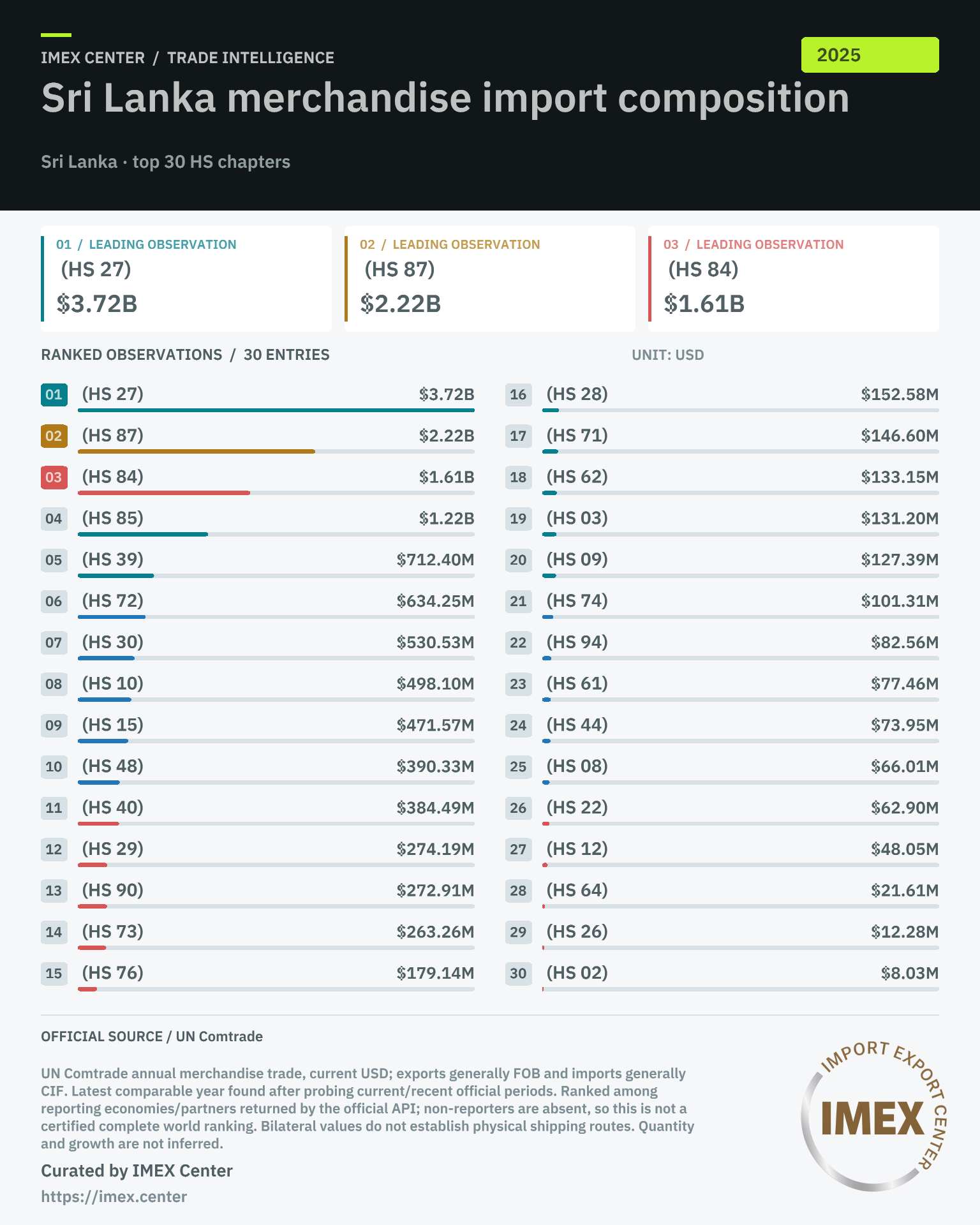
Sri Lanka merchandise import composition — Sri Lanka · top 30 HS chapters (2025)
2025 · Sri Lanka · top 30 HS chapters · Sri Lanka merchandise import composition: (HS 27) $3.72B; (HS 87) $2.22B; (HS 84) $1.61B.
| Rank | Sri Lanka · top 30 HS chapters | USD |
|---|---|---|
| 1 | (HS 27) | 3,721,238,110.996 |
| 2 | (HS 87) | 2,223,535,314.706 |
| 3 | (HS 84) | 1,614,675,676.126 |
| 4 | (HS 85) | 1,219,882,831.265 |
| 5 | (HS 39) | 712,397,325.241 |
| 6 | (HS 72) | 634,252,376.243 |
| 7 | (HS 30) | 530,531,383.758 |
| 8 | (HS 10) | 498,099,565.715 |
| 9 | (HS 15) | 471,569,514.687 |
| 10 | (HS 48) | 390,328,983.963 |
| 11 | (HS 40) | 384,487,674.572 |
| 12 | (HS 29) | 274,192,495.827 |
| 13 | (HS 90) | 272,914,451.751 |
| 14 | (HS 73) | 263,261,355.616 |
| 15 | (HS 76) | 179,140,051.755 |
| 16 | (HS 28) | 152,575,400.439 |
| 17 | (HS 71) | 146,595,897.544 |
| 18 | (HS 62) | 133,149,162.586 |
| 19 | (HS 03) | 131,201,811.531 |
| 20 | (HS 09) | 127,387,617.246 |
| 21 | (HS 74) | 101,307,721.589 |
| 22 | (HS 94) | 82,560,442.014 |
| 23 | (HS 61) | 77,464,218.123 |
| 24 | (HS 44) | 73,946,782.634 |
| 25 | (HS 08) | 66,012,942.646 |
| 26 | (HS 22) | 62,904,112.1 |
| 27 | (HS 12) | 48,052,374.16 |
| 28 | (HS 64) | 21,612,118.977 |
| 29 | (HS 26) | 12,283,763.522 |
| 30 | (HS 02) | 8,034,371.42 |
UN Comtrade annual merchandise trade, current USD; exports generally FOB and imports generally CIF. Latest comparable year found after probing current/recent official periods. Ranked among reporting economies/partners returned by the official API; non-reporters are absent, so this is not a certified complete world ranking. Bilateral values do not establish physical shipping routes. Quantity and growth are not inferred.
Curated by IMEX Center. Original sources:
A large import category is not a sales opportunity until you can connect it to a specific product, a qualified buyer and a workable transaction. For exporters researching Sri Lanka, confusing those steps can mean spending money on samples, travel and quotations before establishing whether the market fits their offer.
The supplied UN Comtrade evidence provides a starting point: annual merchandise import records for selected Harmonized System chapters in 2025. It does not establish Sri Lanka’s national top import chapters, identify purchasing companies or demonstrate growth.
This guide explains those limits and turns them into a practical research workflow. It presents no national ranking or numerical market-size table. The objective is to help exporters and sourcing managers decide what to investigate next—not to turn incomplete coverage into a confident sales forecast.
What the supplied Sri Lanka import evidence measures
The evidence package describes Sri Lanka merchandise import composition for 2025, expressed in current US dollars. Its source request selects merchandise imports, Sri Lanka as the reporting economy and an aggregate partner scope.
The supplied package contains 30 chapter records. However, the API request explicitly names those chapters in its cmdCode parameter. That makes the extract a predetermined selection, not evidence that every relevant chapter was examined before the selection was made.
The package’s description of the records as the “top 30 HS chapters” is therefore unsupported. A source label is not a substitute for checking the underlying query.
Several distinctions matter when interpreting this material:
- Trade values are not open orders. They describe merchandise trade records, not current purchasing requests.
- Chapter coverage is not product coverage. A broad chapter can contain products with different applications, buyers and compliance requirements.
- An annual period is not a trend. The supplied evidence does not contain a comparable time series.
- An aggregate partner scope is not a supplier-country breakdown. It cannot identify the origins of individual shipments.
- An official source does not eliminate methodological limits. Record construction, coverage and classification still require attention.
For a commercial team, the correct use of this extract is to frame questions for further research. It cannot answer whether a particular buyer needs your specification, accepts your price or can meet your payment conditions.
Why a selected chapter list cannot establish a national ranking
Sorting the supplied records by value would show their order within the selected group. It would not establish their positions among all Sri Lankan import chapters.
The missing comparison is straightforward: an unselected chapter could have a value above one or more selected chapters. Without comparable all-chapter evidence, that possibility remains unresolved.
This is a coverage problem rather than a sorting problem. Reordering the spreadsheet, adding attractive bars or changing the chart colors cannot fix it. Nor would deleting inconvenient rows make the remaining selection nationally representative.
A defensible national ranking would require official chapter-level observations covering the relevant comparison set, with consistent geography, period, trade flow, partner scope, valuation and classification. The review would also need to distinguish chapter records from totals and other aggregation levels, and confirm that retrieval limits had not omitted observations.
Until that work is completed, this article makes no claims about Sri Lanka’s largest import chapters. It also does not calculate a national total or national market shares from the selected records.
Read the source flags before drawing conclusions
Every supplied record contains isReported=false and isAggregate=true. Those flags should remain visible in the evidence record. The observations must not be presented as directly reported chapter records without qualification.
At the same time, these fields alone do not explain the complete construction of each value. They do not justify declaring every monetary observation either directly reported or estimated. Any fuller explanation should be grounded in official UN Comtrade documentation and the relevant record metadata.
Some records also contain estimated-weight flags. A flag attached to a weight field should not automatically be applied to the monetary value in the same record.
Why quantity fields do not support shipment estimates
The supplied records contain zero quantity entries and zero or missing weight entries. These are not a reliable basis for concluding that no goods were imported.
They also do not support calculations of tonnes, shipment counts, container requirements or average product prices. Dividing a chapter’s trade value by an unusable quantity field would create a misleading result, not a commercial benchmark.
For freight planning, obtain actual cargo information from the proposed transaction. For price comparisons, use products with comparable specifications, units, delivery terms and dates.
What the valuation and period do—and do not—tell you
The supplied records contain matching cifvalue and primaryValue fields. The accompanying source caveat describes imports as generally valued CIF and exports as generally valued FOB. This statistical valuation context does not establish the Incoterm used in any particular sales contract.
The evidence supports describing the records as being for 2025. It does not independently establish that 2025 is the latest comparable period available. Although the supplied caveat says recent periods were checked, the package does not include the underlying availability results needed to assess that claim.
The source receipt records retrieval on 11 November 2026. That is a retrieval date, not the trade period, a release date or proof that more recent comparable data were unavailable.
Move from chapter screening to product-level research
The next useful deliverable is a product research brief. Start with what your business can supply, then ask whether independent market evidence and buyer requirements support further effort.
Define the product before measuring the opportunity
Prepare a specification sheet that describes the actual item rather than a broad commercial label. Include composition, model or grade, intended use, relevant performance characteristics, packaging and available supporting documentation.
Confirm the product-level HS classification and its relationship to the classification used in the source. Where classification is uncertain, seek appropriate customs advice before relying on the code for regulatory or tariff decisions.
A practical working file should record:
- Product description and intended application.
- Proposed classification and the basis for selecting it.
- Technical specifications and acceptable tolerances.
- Available certifications, their scope and supporting evidence.
- Production capacity, minimum order and lead time.
- Packaging, handling and storage requirements.
- Warranty, installation and after-sales responsibilities where relevant.
These details turn a broad market question into something a buyer can evaluate. They also expose gaps before those gaps become quotation disputes.
Compare like with like
Product-level research should keep the period, classification and trade scope consistent. If a classification revision changes product coverage, document the mapping rather than assuming that similarly named categories are identical.
Do not combine observations from different years into a single ranking. Do not describe a change as growth unless comparable observations support the calculation. A missing value is not permission to extrapolate.
Keep the distinction between evidence and interpretation clear in the research brief. For example, a trade record may justify investigating a product category; it does not establish that your business can win customers in that category.
Treat machinery as a specification-led investigation
For a machinery exporter, application and support can be more decisive than a broad category value. A manufacturer evaluating equipment needs to know whether it fits the production process, operating environment and maintenance capability.
Ask about required output, compatibility, installation, commissioning and operator training. Establish who will supply spare parts and handle warranty claims. Confirm whether the buyer is purchasing a complete system, a replacement unit or a component.
This is an example of a qualification process, not a claim that the supplied chapter extract proves demand for any particular machine.
Qualify counterparties separately from market statistics
Import statistics cannot establish a company’s legal identity, purchasing authority or ability to perform a contract. Those questions need their own evidence.
For each prospective buyer, create a counterparty file covering legal identity, registration where applicable, business activity, authorized representatives and the proposed transaction. Record the source and date of each check. Mark unresolved information as pending verification rather than filling gaps with assumptions.
A relevant website or professional email address may support initial contact, but it is not sufficient evidence of authority to place an order or redirect payment.
Importers should apply the same discipline to sellers. Confirm the seller’s identity and authority, then assess production capacity, technical compliance and document authenticity separately. A certificate requirement in an RFQ is not proof that a supplier holds that certificate.
Where inspection is needed, agree on a named independent inspector, inspection stage, sampling method, test method and acceptance criteria. Inspection should address the transaction’s actual risks rather than serve as a generic promise of quality.
Build a quotation around the shipment, not the chart
A commercially useful offer explains exactly what is being supplied, when it can move, which documents will accompany it and which costs remain with the buyer.
Obtain shipment-specific logistics information
Request logistics quotations using actual cargo details: origin, destination, dimensions, weight, packaging, handling needs and shipment window. Aggregate trade records cannot establish the physical route, loading port or destination terminal of your proposed shipment.
Ask service providers to identify what their quotations include and exclude. Confirm handling charges, storage exposure, documentation responsibilities and conditions affecting the quoted schedule.
Before making a commercial commitment, verify applicable product-specific import requirements, duties and taxes with the buyer and a qualified customs professional. This chapter extract does not substantiate Sri Lankan regulatory requirements or landed-cost estimates for an individual product.
Separate delivery terms from payment terms
State the delivery term, named place or port, and Incoterms 2020 explicitly. Incoterms allocate delivery obligations, costs and risk; they do not determine payment or ownership.
FOB, CFR and CIF apply to sea and inland-waterway shipments. Under these terms, risk passes when goods are on board at loading. Under CFR and CIF, the seller pays freight to the named destination; CIF also requires the seller to arrange insurance as specified by the rule.
Payment needs separate agreement. An irrevocable letter of credit at sight pays against complying documents. It is not automatic payment upon vessel arrival and does not guarantee the quality of the goods.
Prepare a comparable RFQ and a controlled decision process
An RFQ should make competing quotations easier to compare, not merely invite different interpretations of a vague requirement.
Include the document reference, date, response deadline, buyer identity, authorized contact, commodity or product description, quantity, unit, tolerance, packaging and delivery schedule. Specify origin or production-year requirements where relevant.
Set out the named Incoterm and place, currency, payment proposal, inspection requirements, acceptance criteria and required documents. Ask each supplier to state unit and total prices, quotation validity, capacity, shipment timing and any technical or documentary deviations.
An LOI serves a different purpose: it expresses purchasing intent and proposed conditions. If used, it should identify which provisions, if any, are binding, together with validity, conditions precedent and authorized acceptance. It is not a concluded supply contract or proof of funds.
Assign responsibilities before outreach begins:
- Market analyst — before shortlisting: confirm classification, evidence coverage and the limits of any comparison.
- Sales or sourcing lead — before substantive negotiations: verify counterparty identity, authority and product fit.
- Logistics and customs advisers — before a firm quotation: confirm shipment assumptions, regulatory requirements and cost exclusions.
- Authorized commercial approver — before commitment: review specifications, payment conditions, inspection arrangements and unresolved risks.
This sequence keeps research connected to decisions. It also gives each unresolved issue an owner and a deadline tied to the transaction.
Source and methodological boundaries
Original source: UN Comtrade supplied API query.
This article assesses the supplied extract and source receipt; it does not claim a fresh retrieval or a completed all-chapter comparison. The evidence concerns selected annual merchandise import chapter records for Sri Lanka in 2025, in current USD, with aggregate partner coverage.
The supplied caveat’s world-ranking language does not validate a chapter ranking within Sri Lanka. No world ranking, supplier-country ranking, physical shipping route, national total, market share, growth rate or shipment quantity is inferred here. Reported, aggregate and estimated-field distinctions remain relevant to any subsequent statistical publication.
Curated by IMEX Center means editorial curation, not independent certification of the dataset, counterparties or goods.
Frequently asked questions
Does this evidence establish Sri Lanka’s national top import chapters?
No. The query requests a predetermined chapter selection. Comparable official all-chapter evidence is needed to establish national positions and identify any omitted chapters.
Can chapter import values identify Sri Lankan buyers?
No. Chapter records describe merchandise categories, not purchasing companies or open orders. Buyer discovery and counterparty qualification require separate research.
Can the supplied records establish growth or shipment volumes?
No. The supplied period does not establish a comparable trend, and the quantity and weight fields do not support physical-volume calculations.
What should an exporter investigate next?
Confirm the product specification and classification, obtain comparable product-level evidence, qualify prospective buyers and request shipment-specific logistics quotations before making a commercial commitment.
Turn research into a defined trade conversation
For exporters, the next step is to prepare a precise offer and identify businesses whose requirements match it. For importers and sourcing managers, it is to assemble a clear purchasing brief that suppliers can answer consistently. For service professionals, it is to define the logistics, inspection, engineering or other support they can legitimately provide.
Register at IMEX Center using the account type appropriate to your role. Business users should complete applicable verification before pursuing formal goods RFQs or business pre-contracts. Individual accounts are service-only and subject to the platform’s verification and eligibility requirements; they cannot list goods, bid on tenders, create formal RFQs or execute business pre-contracts.
Bring a product specification, quantity, delivery requirement and documentary checklist—not an assumption that a chapter value guarantees sales. The goal is a qualified discussion about a defined transaction, supported by evidence at every step.
Source or sell globally with IMEX Center
Browse verified suppliers →