
Import & Export
Towel Manufacturers in Turkey: Bulk Sourcing for U.S. Hotels
12 Nov 2026 · 06:03 CET
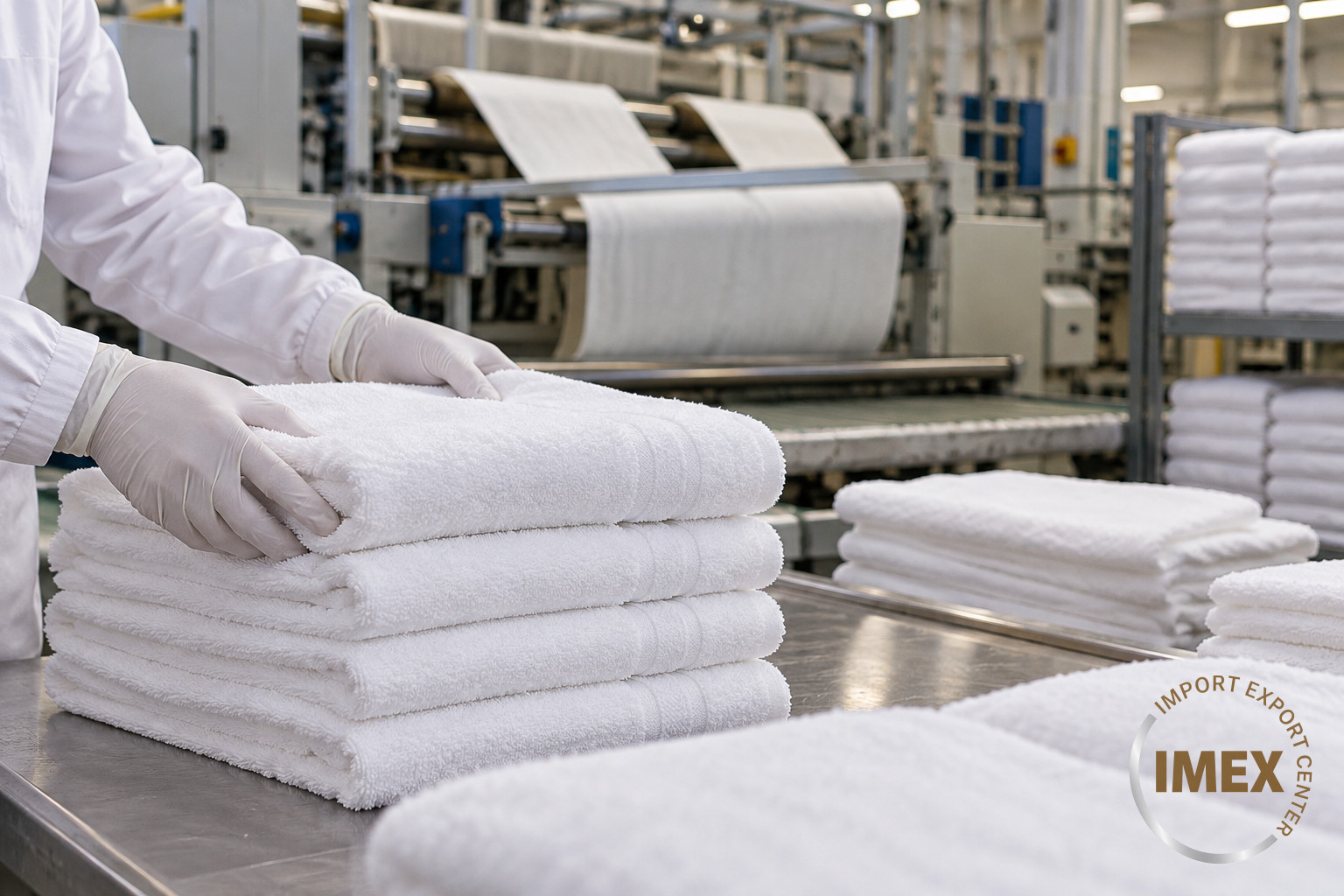
A towel order is not a bargain if the towels shrink, shed lint or fail to match the next delivery. For U.S. hotels, finding towel manufacturers in Turkey is only the first step. The real purchasing decision is whether a supplier can consistently deliver the construction your guests expect and your laundry can process successfully.
A useful comparison starts with performance after washing—not showroom softness or the lowest price per piece. Procurement, housekeeping and laundry teams need a shared specification, while the importer needs an agreed classification, labeling and delivery plan.
This guide provides a supplier-evaluation framework, not a verified manufacturer directory. Use it to define your assortment, assess production capability, document a laundry trial and prepare an RFQ that produces comparable offers.
Define the hotel towel before searching for suppliers
“Turkish towel” is a marketing description, not a complete product specification. It can describe cotton terry towels with absorbent pile loops or flat-woven hammam towels with a different construction and guest experience. The description alone does not establish manufacturing origin or cotton origin.
A flat-woven pool accessory is not automatically a substitute for a terry guestroom bath towel. Separate these products before comparing quotations.
Build an assortment sheet for bath towels, hand towels and washcloths. Treat bath sheets, pool towels and bath mats as separate items where required. Each line should identify:
- Intended location and use: guest bathroom, spa, pool or gym.
- Construction and declared fiber composition.
- Finished dimensions, measurement conditions and tolerances.
- Target mass per unit area, commonly expressed as grams per square meter, or GSM.
- Color, border design, hems and embroidery requirements.
- Opening quantities and expected replenishment pattern.
Then describe your laundry operation. An on-premise laundry and an outsourced processor may use different wash chemistry, extraction settings and drying conditions. The laundry manager should document the intended process before procurement requests samples.
Housekeeping should also review practical requirements, including towel size, storage space and presentation. A technically compliant towel can still be unsuitable if it does not fit the property's operating needs.
Shortlist towel manufacturers in Turkey by production capability
A Turkish seller address does not establish where towels were manufactured. Nor does a polished catalogue prove that the seller controls terry weaving, dyeing, finishing or packing.
Trading companies can be useful partners, but their role should be clear. Ask Turkish towel suppliers to identify the contracting entity, actual production facilities and any subcontracted stages. Establish who is responsible for quality problems and corrective action across those stages.
Request evidence that matches the order
For wholesale hotel towels, prioritize evidence relevant to recurring hospitality supply:
- Terry-weaving and finishing capability for your specified construction.
- Production-location information and available origin documentation.
- Hospitality references that the supplier is authorized to share.
- Quality-control records relevant to dimensions, weight and finishing.
- Capacity and lead-time information for initial and repeat orders.
- Controls for retaining specifications and managing material changes.
Verify both parties' legal identities and the authority of their representatives before commercial commitment. Procurement should also confirm that payment instructions belong to the agreed counterparty, using an independently confirmed contact channel for any bank-detail changes.
Treat certificates as claims to investigate: check their scope, covered facility or product, validity and issuing body rather than accepting a logo on a presentation. A management-system certificate does not establish the performance of a particular towel lot.
Test replenishment readiness
Ask whether the same construction, border, shade and dimensions will remain available for repeat orders. Establish minimum reorder quantities, production lead times and whether stock is held or manufactured only after an order.
The practical question is simple: can the next delivery join your existing linen pool without creating a visibly mismatched assortment?
Define how shade and appearance will be assessed. New towels may not look identical to extensively laundered stock, so specify the comparison conditions rather than demanding an undefined “exact match.”
Write a specification your laundry can actually test
GSM measures mass per unit area. It does not, by itself, prove absorbency, durability or guest satisfaction. A heavier towel may also affect processing costs, depending on its construction and your equipment.
Replace descriptions such as “premium quality” and “hotel grade” with measurable requirements. There is no single universal performance threshold suitable for every hotel.
Define initial and post-wash acceptance
Your specification should cover:
- Fiber composition: the declared composition and agreed verification approach.
- Dimensions and GSM: measurement conditions, tolerances and whether acceptance applies before washing, after washing or both.
- Absorbency: the agreed method, preparation procedure and acceptance limit.
- Lint release: a defined collection or assessment procedure with consistent conditions.
- Dimensional stability: separate length and width changes after agreed laundering cycles.
- Construction integrity: checks for hem opening, loose threads, pile damage and border distortion.
- Appearance: agreed assessment conditions for shade consistency and visible defects.
- Colorfastness, where relevant: agreed tests and limits appropriate to colored towels and their intended laundering conditions.
Procurement should agree the methods with the supplier and, where appropriate, an independent textile laboratory. Name any standard and edition being used; do not assume that two laboratories measure an identically named property in the same way.
Include sampling rules and the response to nonconformity. A specification is incomplete if it defines a defect but leaves acceptance, rework, replacement or rejection unresolved. Agree who pays for justified retesting and how disputes will be assessed before production begins.
Make the repeated-wash trial a joint purchasing gate
The procurement lead owns commercial approval. The hotel laundry manager owns confirmation that the trial reflects the intended laundering process. Both should approve the trial plan before samples are washed.
Ask for representative samples made to the proposed bulk construction and finish. Identify samples by supplier, product reference and batch where available. Keep an unwashed reference and record how the trial pieces were selected. Supplier-selected samples do not independently establish the consistency of future production.
Record conditions, not just opinions
The trial record should capture:
- Initial dimensions, mass, appearance and agreed absorbency results.
- Wash program, chemistry, load conditions and drying settings.
- Results at agreed wash-cycle checkpoints.
- Shrinkage, lint observations, seam failures and other defects.
- Handling feedback from laundry staff and housekeeping.
Measure under consistent conditions. Comparing an inadequately dried towel with a conditioned sample can create a misleading weight result.
If candidates are tested under different processes, do not present the results as directly comparable without explaining the limitation. Repeat the relevant comparison where necessary.
Approve the construction that passed, not merely the supplier's brand. Record the approved specification and reference samples, and require written approval before changes to yarn, construction, finishing or production arrangements.
A limited trial demonstrates performance under its recorded conditions. It does not establish an entire service life or justify an unsupported claim about how many months a towel will last.
Connect sample approval to bulk inspection
Before the first shipment, the buyer's quality lead should arrange the agreed production-lot inspection. If an independent inspector is required, name the provider and define its scope, sampling method, reporting requirements and release conditions.
Compare the bulk goods with the approved specification, not just a photograph or sales sample. Check item identity, quantities, dimensions, construction, workmanship, labels and packing within the agreed inspection scope. Any laboratory tests must be expressly included; a visual inspection does not establish fiber composition or post-wash performance.
Compare replacement economics—not weight alone
Normalize quotations before comparing them. Check dimensions, construction, packaging, quantities, delivery terms and documentary requirements. Two offers for bulk cotton terry towels from Turkey may cover materially different products or costs.
Separate the commercial assessment into three parts:
- Acquisition: product price, freight, insurance, inspection, applicable import charges and inland delivery.
- Observed processing: measured laundry inputs and buyer-provided operating costs for the trial conditions.
- Replenishment: reorder quantities, lead times, consistency commitments and remedies for nonconforming deliveries.
For the trial, calculate processing cost per towel-cycle only when recorded costs and the actual number of towel-cycles processed are available. State what is included and excluded. For mixed laundry loads, disclose how shared costs were allocated rather than attributing the entire load's cost to the trial towels. Do not turn a limited observation into a lifetime cost claim.
For received shipments, track landed acquisition cost against units accepted under the agreed inspection criteria. Keep later laundry performance separate so an initial acceptance rate is not confused with durability.
Replacement economics also includes availability. A low unit price offers limited protection if repeat orders require a new construction or an impractical minimum quantity. After delivery, procurement and laundry should record replacement reasons so later purchasing decisions distinguish product failures from loss, staining and processing damage.
Check U.S. classification, entry and labeling before commitment
If you plan to import towels from Turkey to the USA, involve your U.S. customs broker while the product specification is being finalized—not after packing. Identify the importer of record and confirm its responsibilities; using a broker does not transfer all compliance obligations away from the importer.
Confirm the tariff line and current measures
HS 6302.60 covers toilet and kitchen linen of terry towelling or similar terry fabrics, of cotton. It is a classification starting point to investigate for cotton terry towels, not a final U.S. entry determination for every product sold as a Turkish towel. Flat-woven products, different fibers and other construction details may require different analysis.
Use the official U.S. International Trade Commission Harmonized Tariff Schedule to investigate the applicable U.S. tariff line. Ask the broker to review classification, origin treatment, current duties and any additional measures relevant to the planned entry. Where material uncertainty remains, consider obtaining a CBP ruling before commitment.
No current duty rate is quoted here. The final calculation requires the actual goods and applicable entry-date rules. Consult CBP's basic importing and exporting guidance when planning importer responsibilities and entry documentation.
A shipment dispatched from Turkey is not necessarily of Turkish origin. Ask the supplier for production and material traceability appropriate to the transaction, and have the importer assess applicable admissibility requirements, including forced-labor restrictions.
Approve labels and documents together
Use the FTC's textile and wool labeling guidance to check fiber-content, country-of-origin and responsible-business identification requirements for the intended transaction.
Confirm any relevant exemptions, including their conditions, rather than assuming that institutional hotel purchasing is automatically exempt. Check CBP origin-marking obligations separately. Agree label wording, placement and artwork before production.
Request laundering instructions for operational use, but do not assume that apparel care-label rules automatically apply to towels.
The importer and broker should agree the required entry documents; procurement should ensure the supplier can provide them. Distinguish legally required records from additional documents requested under the purchase agreement or payment instrument. Resolve discrepancies between labels, invoices and origin information before shipment.
Send a purchase-ready RFQ
A structured RFQ helps hotel towel manufacturers in Turkey quote the same requirement and disclose deviations early. It requests an offer; it is not a concluded supply contract or evidence of buyer funds.
Include:
- Document reference, issue date, quotation deadline and authorized buyer contact.
- Buyer legal identity and verification status; requested seller identity, registration and authority evidence.
- Intended use, origin requirements and itemized technical specifications.
- Quantities, units, quantity tolerances, unit prices and total prices by item.
- Bulk or individually packed presentation, carton details and markings.
- Named Incoterms 2020 delivery place or port, loading and destination points, shipment windows and partial-shipment conditions.
- Currency, payment proposal, bank acceptability and documentary conditions.
- Trial approval, sampling, testing, inspection and acceptance requirements.
- Required shipping, origin, testing and applicable insurance documents.
- Repeat-order quantities, lead times and change-control commitments.
- Quote validity, capacity confirmation, supporting evidence and a clear list of deviations.
Mark an unverified counterparty as pending verification. Do not populate a template with assumed registration details, certifications or authority.
Ask the supplier to identify excluded charges. FOB, CFR and CIF are sea and inland-waterway terms; select the term that fits the actual shipment and handover. For containerized shipments handed to a carrier before vessel loading, discuss whether FCA or another suitable term better reflects the arrangement.
Under FOB, CFR and CIF, risk passes when goods are on board at the loading port. Under CFR and CIF, the seller pays freight to the named destination port; CIF also requires seller-arranged insurance. Incoterms allocate delivery obligations, costs and risk—not payment or ownership. Specify any insurance coverage needed beyond the selected term's requirements.
If proposing an irrevocable letter of credit at sight, align its documents with the transaction. It pays against complying documents, not automatically upon vessel arrival, and does not guarantee towel quality.
Assign approval owners before placing the order
Use clear decision gates rather than an open-ended sample discussion:
- Before requesting quotations: procurement finalizes the assortment; laundry confirms the proposed processing conditions.
- Before bulk-order approval: laundry and quality approve the trial results; procurement closes technical and commercial deviations.
- Before production: the importer and broker complete the import review; the supplier receives approved specifications and label artwork.
- Before shipment: the quality lead resolves inspection findings, and the importer or broker checks the agreed shipment documents.
- Before commercial commitment: the authorized buyer confirms counterparty verification, payment arrangements and the final agreement.
Insert actual deadlines and named contacts into the purchasing plan. Do not leave responsibility with an undefined “team.”
Use IMEX Center as a starting point for business sourcing
A towel purchase connects supplier discovery, technical approval, logistics and payment. Keep the same approved specification and evidence requirements across those conversations so a low quotation does not obscure an unresolved operating or import risk.
For hotel procurement teams: register a business account with IMEX Center and prepare the assortment sheet and laundry-trial requirements before approaching suppliers. Confirm account eligibility and available sourcing features before planning a formal RFQ workflow.
For hospitality importers: register with your business role and prepare a shipment brief covering the importer of record, destination, delivery term and required services. Obtain written provider terms for logistics, inspection and insurance rather than assuming a quoted service covers every risk.
For Turkish manufacturers: register your business and prepare a clear capability statement identifying your production role, facility information, technical compliance, deviations and replenishment offer. Support certification and origin claims with evidence that the buyer can check.
Any platform verification status should be assessed for its actual scope and recency. It does not replace product testing, factory due diligence or lot acceptance. Formal RFQs and business pre-contracts require an eligible business account; Individual accounts are not eligible for these activities or for listing goods.
Any draft commercial document also needs authorized review. A generated document alone is not proof of funds or evidence that a supply contract has been concluded.
Frequently asked questions
Are Turkish towels always suitable for hotel bathrooms?
No. The term can describe terry towels or flat-woven hammam products. Specify construction, intended use and laundry-performance requirements before comparing offers.
What GSM should a hotel choose?
There is no universal best GSM. Compare candidates against your guest experience, handling needs and measured laundry performance. Weight alone does not establish absorbency or durability.
Does a Turkish supplier address prove Turkish origin?
No. Verify the manufacturing location and supporting origin information. A seller may distribute goods produced elsewhere, so seller identity and product origin require separate checks.
Can a sample trial predict towel service life?
Only within its demonstrated scope. A repeated-wash trial supports acceptance under recorded conditions; it does not establish lifetime performance. Track bulk deliveries and actual replacement reasons over time.
The best sourcing decision is the one your evidence supports: an approved construction, a workable import plan and a supplier able to replenish consistently. Hotel buyers, hospitality importers and Turkish manufacturers can register their business with IMEX Center to begin with a clearly defined sourcing or supply brief.
Source or sell globally with IMEX Center
Browse verified suppliers →